
[Paper Review] An extremely compact, low-mass post-starburst galaxy at $z=5.2$
This study presents the discovery of MACS0417-z5PSB, a highly compact, low-mass post-starburst galaxy at z=5.2, using JWST/NIRSpec and NIRCam data. With a stellar mass of 4.3×10⁷ M☉ and a rest-UV half-light radius of 30±7 pc, it exhibits a recent burst of star formation followed by a steep decline, suggesting it is in the process of quenching, likely via internal feedback rather than environmental processes or AGN activity.
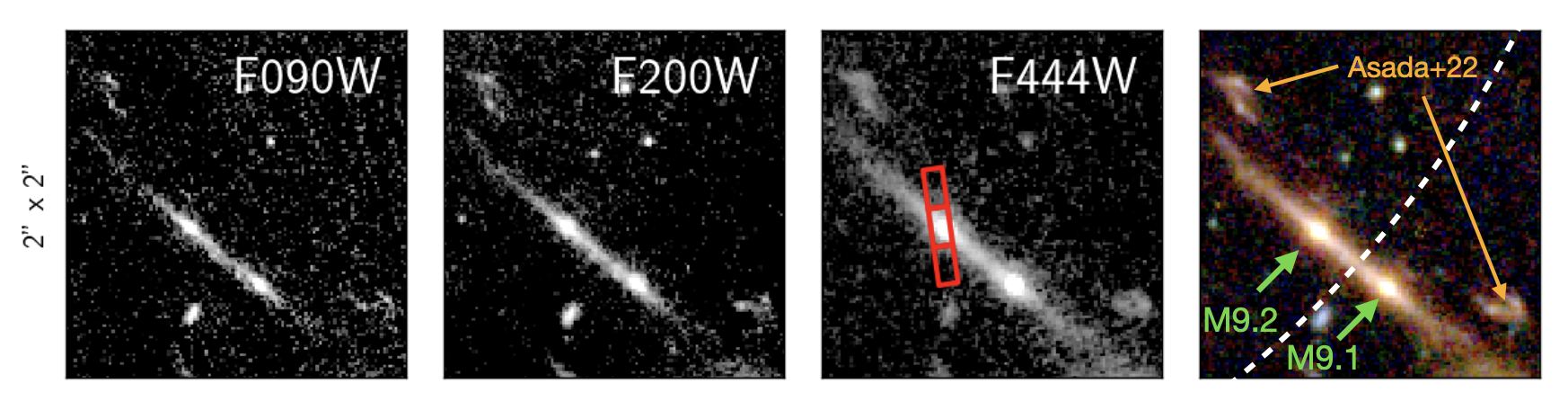
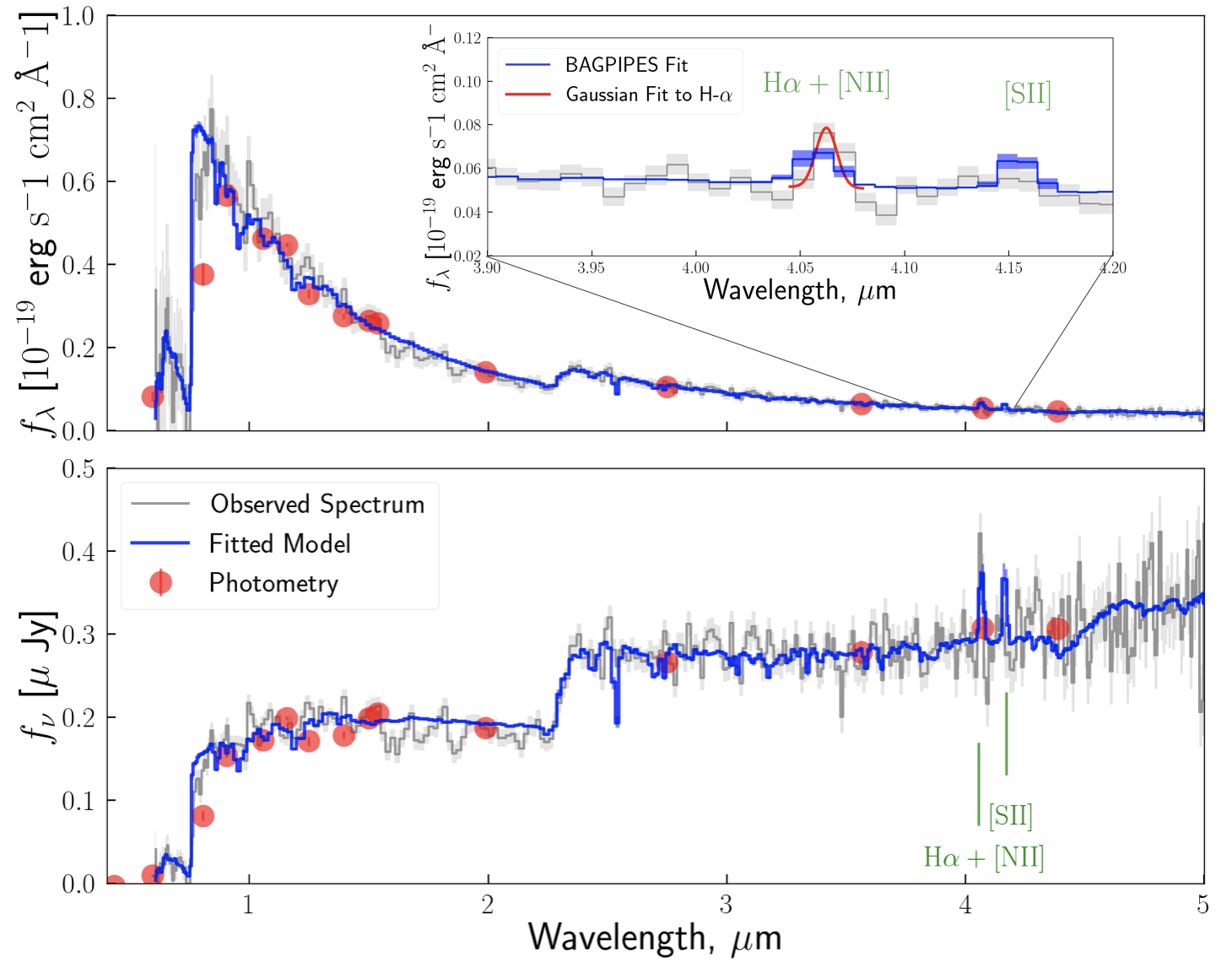
We report the discovery of a low-mass $z=5.200\pm 0.002$ galaxy that is in the process of ceasing its star formation. The galaxy, MACS0417-z5PSB, is multiply imaged with magnification factors $\sim40$ by the galaxy cluster MACS J0417.5-1154, observed as part of the CAnadian NIRISS Unbiased Cluster Survey (CANUCS). Using observations of MACS0417-z5PSB with a JWST/NIRSpec Prism spectrum and NIRCam imaging, we investigate the mechanism responsible for the cessation of star formation of the galaxy, and speculate about possibilities for its future. Using spectrophotometric fitting, we find a remarkably low stellar mass of $ m{M_*}=4.3\pm^{0.9}_{0.8} imes 10^{7} m{M_{\odot}}$, less than 1% of the characteristic stellar mass at $z\sim5$. We measure a de-lensed rest-UV half-light radius in the source plane of $30\pm^{7}_{5}$ pc, and measure a star formation rate from H$α$ of $0.14\pm^{0.17}_{0.12}$ $ m{M_{\odot}/yr}$. We find that under the assumption of a double power law star formation history, MACS0417-z5PSB has seen a recent rise in star formation, peaking $\sim10-30$ Myr ago and declining precipitously since then. Together, these measurements reveal a low-mass, extremely compact galaxy which is in the process of ceasing star formation. We investigate the possibilities of mechanisms that have led to the cessation of star formation in MACS0417-z5PSB, considering stellar and AGN feedback, and environmental processes. We can likely rule out an AGN and most environmental processes, but leave open the possibility that MACS0417-z5PSB could be a star forming galaxy in the lull of a bursty star formation history.
Motivation & Objective
- To identify and characterize a rare, low-mass, compact post-starburst galaxy at high redshift (z≈5.2) to understand early quenching mechanisms.
- To determine the star formation history and physical properties of MACS0417-z5PSB using high-resolution JWST spectroscopy and imaging.
- To investigate the quenching mechanism—whether internal feedback, environmental processes, or stochastic star formation—responsible for its transition to quiescence.
- To assess the implications for galaxy evolution models, particularly regarding the formation of compact quiescent galaxies and the role of stellar feedback in early massive systems.
Proposed method
- Utilized JWST/NIRSpec prism spectroscopy to measure Hα emission and Balmer absorption lines for star formation rate and stellar population age estimation.
- Applied spectrophotometric fitting with a double power law star formation history to model the galaxy's formation and quenching timeline.
- Used strong gravitational lensing by MACS J0417.5-1154 to magnify the galaxy, enabling high-resolution observations of its compact structure.
- Performed de-lensing to recover intrinsic physical properties, including rest-UV size and stellar mass, from multiply imaged components.
- Compared observed properties with simulations and theoretical models to rule out AGN feedback and environmental quenching mechanisms.
- Evaluated the potential for future rejuvenation via gas content and merger history using ALMA [CII] and population statistics.
Experimental results
Research questions
- RQ1What is the star formation history of MACS0417-z5PSB, and when did its recent burst and subsequent decline occur?
- RQ2What physical mechanism is responsible for the quenching of star formation in this low-mass, compact galaxy at z=5.2?
- RQ3How does the extreme compactness and low stellar mass of MACS0417-z5PSB challenge existing models of quiescent galaxy formation?
- RQ4Could this galaxy be in a temporary lull of a bursty star formation history rather than permanently quenched?
- RQ5What role do stellar feedback or dark matter halo potential wells play in sustaining quiescence in such low-mass systems?
Key findings
- The galaxy has a stellar mass of 4.3±0.9/0.8×10⁷ M☉, less than 1% of the characteristic mass at z≈5, making it one of the lowest-mass quiescent galaxies observed at this redshift.
- The rest-UV half-light radius is 30±7/5 pc in the source plane, indicating extreme compactness and high stellar surface density.
- The Hα-derived star formation rate is 0.14±0.17/0.12 M☉/yr, consistent with a recent, short-lived burst followed by a sharp decline.
- Spectroscopic modeling indicates a recent star formation peak 10–30 Myr ago, followed by a rapid quenching, suggesting a post-starburst phase.
- AGN feedback and environmental quenching (e.g., ram pressure, harassment) are unlikely due to lack of broad emission and absence of nearby massive structures.
- The galaxy may represent a progenitor of compact quiescent galaxies, with potential for future rejuvenation via gas infall or mergers if residual gas remains.
Read this paper
Open the full text in the Nubint reader and ask about any passage as you read.
Read this paper on NubintThis review was generated by AI from the original paper. Please check the paper before citing it.