
[Paper Review] An Overview of Diffusion Models: Applications, Guided Generation, Statistical Rates and Optimization
A comprehensive survey of diffusion models covering their applications, conditional guidance mechanisms, theoretical properties, and optimization frameworks, with emphasis on unconditional and conditional diffusion models and their sample complexity and guidance design.
Diffusion models, a powerful and universal generative AI technology, have achieved tremendous success in computer vision, audio, reinforcement learning, and computational biology. In these applications, diffusion models provide flexible high-dimensional data modeling, and act as a sampler for generating new samples under active guidance towards task-desired properties. Despite the significant empirical success, theory of diffusion models is very limited, potentially slowing down principled methodological innovations for further harnessing and improving diffusion models. In this paper, we review emerging applications of diffusion models, understanding their sample generation under various controls. Next, we overview the existing theories of diffusion models, covering their statistical properties and sampling capabilities. We adopt a progressive routine, beginning with unconditional diffusion models and connecting to conditional counterparts. Further, we review a new avenue in high-dimensional structured optimization through conditional diffusion models, where searching for solutions is reformulated as a conditional sampling problem and solved by diffusion models. Lastly, we discuss future directions about diffusion models. The purpose of this paper is to provide a well-rounded theoretical exposure for stimulating forward-looking theories and methods of diffusion models.
Motivation & Objective
- Survey emerging applications of diffusion models across vision, audio, life sciences, RL, and optimization.
- Summarize theoretical progress on unconditional diffusion models, including score learning, estimation, and sampling.
- Present theoretical developments for conditional diffusion models and the role of guidance in shaping distributions.
- Bridge diffusion models with black-box optimization and high-dimensional structured optimization.
- Discuss future directions connecting diffusion models to stochastic control and robustness.
Proposed method
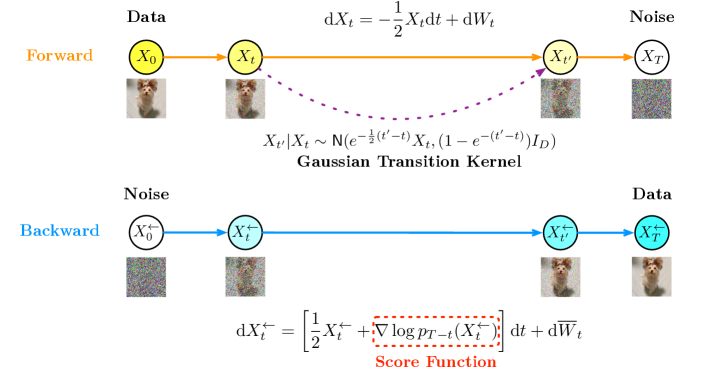
- Describe continuous-time diffusion model formalism via forward and backward SDEs and their discretization.
- Explain how conditional diffusion models incorporate guidance through conditional scores and practical learning methods.
- Review score matching and denoising score matching as core learning objectives for the score function.
- Summarize theoretical results on score approximation, estimation, and distribution learning for high-dimensional data.
- Discuss the role of guidance (classifier/ classifier-free) in enabling task-specific conditional generation.
- Outline how diffusion models are used for black-box optimization and structured solution search.
Experimental results
Research questions
- RQ1Can diffusion models learn data distributions accurately and efficiently, and what is the sample complexity in high-dimensional or structured settings?
- RQ2How can conditional diffusion models generate distributions aligned with guidance, and how should guidance be designed and evaluated?
- RQ3What are the theoretical guarantees for learning the score function and for sampling/distribution estimation with diffusion models?
- RQ4How can diffusion models be leveraged for high-dimensional optimization and black-box reward-guided tasks?
- RQ5What are the connections between diffusion models and broader areas such as stochastic control and robust optimization?
Key findings
- The paper surveys both unconditional and conditional diffusion models, outlining forward and backward process formulations and practical score estimation.
- It highlights score matching and denoising score matching as central training objectives, including challenges like score blowup and early stopping.
- It discusses various network architectures (U-Net, transformers) and their roles in score approximation and data efficiency.
- It covers sampling acceleration techniques and latent diffusion approaches used in practical systems.
- It connects diffusion-guided generation to black-box optimization, showing how conditional diffusion models can generate high-quality solutions conditioned on target rewards.
- It identifies future directions linking diffusion models to stochastic control, robustness, and discrete diffusion variants.

Read this paper
Open the full text in the Nubint reader and ask about any passage as you read.
Read this paper on NubintThis review was generated by AI from the original paper. Please check the paper before citing it.