
[Paper Review] Analysing quantum systems with randomised measurements
This paper presents a systematic framework for analyzing quantum systems using randomised measurements—where measurement settings are chosen randomly without requiring a shared reference frame or calibrated devices. It demonstrates how statistical moments of correlation functions over random measurements enable reference-frame-independent detection and characterization of quantum entanglement, Bell nonlocality, and invariant state properties, with experimental validation and applications to shadow tomography and non-linear function estimation.
Measurements with randomly chosen settings determine many important properties of quantum states without the need for a shared reference frame or calibration. They naturally emerge in the context of quantum communication and quantum computing when dealing with noisy environments, and allow the estimation of properties of complex quantum systems in an easy and efficient manner. In this review, we present the advancements made in utilising randomised measurements in various scenarios of quantum information science. We describe how to detect and characterise different forms of entanglement, including genuine multipartite entanglement and bound entanglement. Bell inequalities are discussed to be typically violated even with randomised measurements, especially for a growing number of particles and settings. Furthermore, we also present an overview on the estimation of non-linear functions of quantum states and shadow tomography from randomised measurements. Throughout the review, we complement the description of theoretical ideas by explaining key experiments.
Motivation & Objective
- To develop a reference-frame-independent method for detecting and characterizing quantum entanglement using statistical moments of randomised measurement outcomes.
- To extend the applicability of randomised measurements to higher-dimensional and multipartite systems, including genuine multipartite entanglement and bound entanglement.
- To establish connections between randomised measurements and non-linear functions of density matrices, such as purity, fidelity, and local unitary invariants.
- To investigate the role of randomised measurements in certifying non-local correlations and violating Bell inequalities, especially in multipartite scenarios.
- To bridge theoretical frameworks with experimental implementations, accounting for finite statistics and practical constraints in real-world quantum systems.
Proposed method
- Utilizes randomised measurements drawn from t-designs, particularly Haar-random unitaries, to average over measurement settings without requiring knowledge of individual settings.
- Employs statistical moments of correlation functions (e.g., first and second moments) to extract information about quantum state properties invariant under local unitary transformations.
- Applies the Bloch decomposition of multipartite states to express correlation functions and derive criteria for entanglement based on sector lengths and PT moments.
- Leverages quantum t-designs to simplify the implementation of averaging over random measurements, reducing experimental complexity.
- Introduces a framework for shadow tomography using randomised measurements to estimate non-linear functions of density matrices, such as Makhlin invariants and topological invariants.
- Derives and analyzes Bell-type inequalities and their violation probabilities under random measurement settings, showing typicality of nonlocality even with partial randomness.
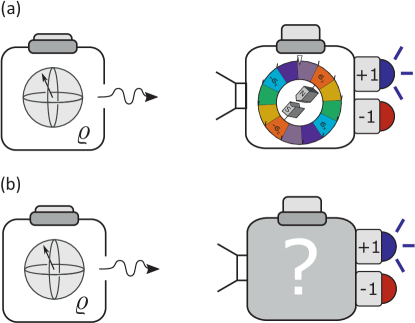
Experimental results
Research questions
- RQ1Can entanglement in mixed quantum states be detected and characterized without prior knowledge of measurement settings or reference frames?
- RQ2To what extent can statistical moments of randomised measurement outcomes reveal non-local correlations and certify Bell nonlocality?
- RQ3How can randomised measurements be used to estimate non-linear functions of quantum states, such as purity, fidelity, and local unitary invariants?
- RQ4What is the probability and strength of Bell inequality violation when measurement settings are chosen randomly, especially in multipartite systems?
- RQ5Can randomised measurements fully reconstruct the complete set of local unitary invariants for higher-dimensional or multipartite quantum states?
Key findings
- Randomised measurements enable reference-frame-independent detection of various forms of entanglement, including genuine multipartite entanglement and bound entanglement, through statistical analysis of correlation moments.
- Theoretical criteria for n-qubit and two-qubit entanglement are derived and validated experimentally, showing robustness even under finite statistics and partial randomness.
- Higher-order moments of correlation distributions allow for the estimation of non-linear state properties such as purity, fidelity, and Makhlin invariants, with applications in shadow tomography.
- Bell inequalities are typically violated under randomised measurements, with the probability of violation increasing with the number of particles and measurement settings.
- Genuine multipartite nonlocality can be guaranteed even under restricted randomness, and the average correlation strength under random settings reveals intrinsic non-classical features.
- Experimental demonstrations confirm the feasibility of the approach in real-world scenarios, including implementations using trapped ions and photonic systems, with quantitative agreement between theory and data.
Better researchstarts right now
From reading papers to final review, dramatically reduce your research time.
No credit card · Free plan available
This review was created by AI and reviewed by human editors.