
[Paper Review] Anatomy of Thermally Interplayed Spin-Orbit Torque Driven Antiferromagnetic Switching
This study establishes a thermally interplayed spin-orbit torque (SOT)-driven antiferromagnetic (AFM) switching model by integrating Langevin random fields into the Landau-Lifshitz-Gilbert equation, experimentally validating that both Joule heating and SOT jointly govern AFM switching. The key finding is a quantified threshold SOT current density of 338 MA cm⁻² for AFM switching in Pt/IrMn-MTJs, with thermal effects dominating in Cu-based devices due to weak spin-orbit coupling.
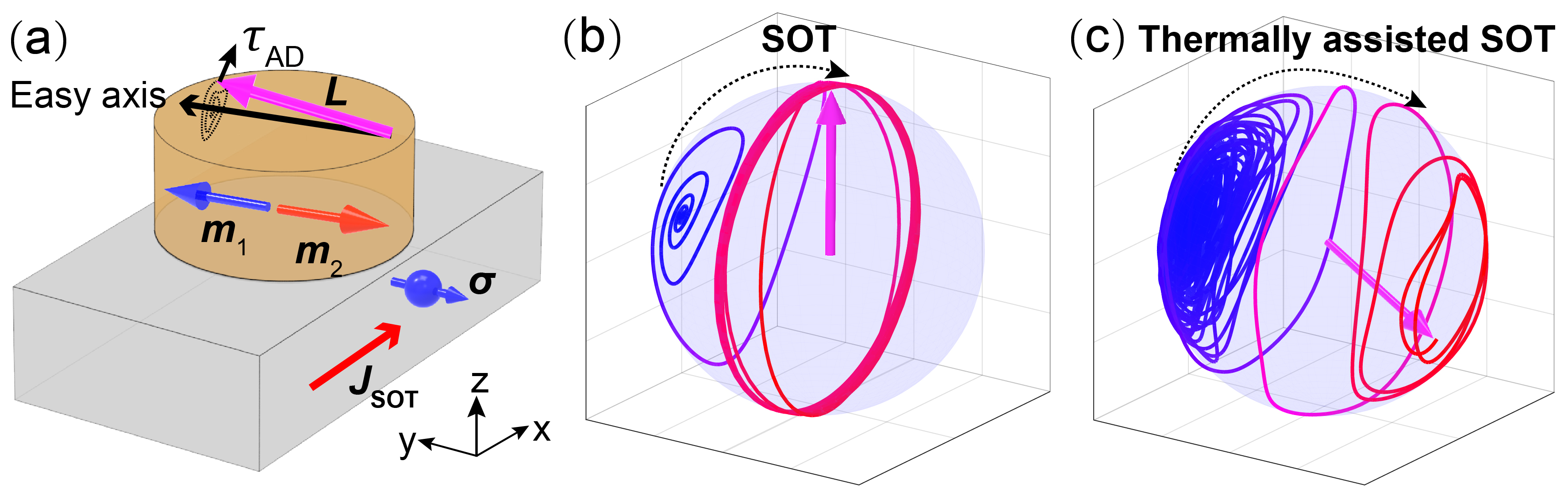
Current-induced antiferromagnetic (AFM) switching remains critical in spintronics, yet the interplay between thermal effects and spin torques still lacks clear clarification. Here we experimentally investigate the thermally interplayed spin-orbit torque induced AFM switching in magnetic tunnel junctions via pulse-width dependent reversal and time-resolved measurements. By introducing the Langevin random field into the AFM precession equation, we establish a novel AFM switching model that anatomically explains the experimental observations. Our findings elucidate the currentinduced AFM switching mechanism and offer significant promise for advancements in spintronics.
Motivation & Objective
- To clarify the interplay between thermal effects and spin-orbit torque (SOT) in current-induced antiferromagnetic (AFM) switching, a mechanism not clearly understood in prior studies.
- To experimentally isolate and quantify the contributions of Joule heating and SOT to AFM switching in magnetic tunnel junctions (MTJs) with varying pulse widths.
- To develop and validate a macroscopic physical model that incorporates both SOT and thermal fluctuations for AFM switching dynamics.
- To determine the intrinsic SOT threshold current density for AFM switching by decoupling thermal and spin torque effects using temperature-resolved measurements.
- To demonstrate asynchronous switching between FM and AFM layers in exchange-biased MTJs (EB-MTJs) for accurate AFM state readout and characterization.
Proposed method
- Incorporated a Langevin random field into the Landau-Lifshitz-Gilbert (LLG) equation to model thermal fluctuations at finite temperatures, enabling a macroscopic description of AFM dynamics.
- Used time-resolved voltage measurements via an oscilloscope to track real-time resistance changes in EB-MTJs, allowing direct estimation of device temperature rise during current pulses.
- Employed harmonic measurements to calibrate the spin Hall angle (ξ_DL = 0.15(1)) in Pt, enabling accurate SOT strength estimation.
- Fabricated Pt/IrMn-MTJ and Cu/IrMn-MTJ devices with 700 nm nanopillars and 100% TMR ratio to enable high-fidelity readout of AFM states.
- Applied pulse-width-dependent current sweeps to extract switching probabilities and estimate effective switching temperatures (T_switching) across different time scales.
- Fitted experimental data to a thermal activation model to determine blocking temperature (T_b) and compare it with T_switching to distinguish between thermal and SOT-driven switching mechanisms.
Experimental results
Research questions
- RQ1How do thermal fluctuations and spin-orbit torque (SOT) co-determine the switching dynamics of antiferromagnetic (AFM) order in magnetic tunnel junctions?
- RQ2What is the relative contribution of Joule heating versus SOT to AFM switching in Pt- and Cu-based MTJs with identical IrMn/CoFeB structures?
- RQ3Can the threshold SOT current density for AFM switching be quantified independently of thermal effects, and what is its intrinsic value?
- RQ4How does the pulse width affect the effective temperature during AFM switching, and what does this reveal about the thermal-SOT interplay?
- RQ5To what extent does the observed switching behavior in EB-MTJs align with a macroscopic model that includes Langevin noise and SOT in the LLG framework?
Key findings
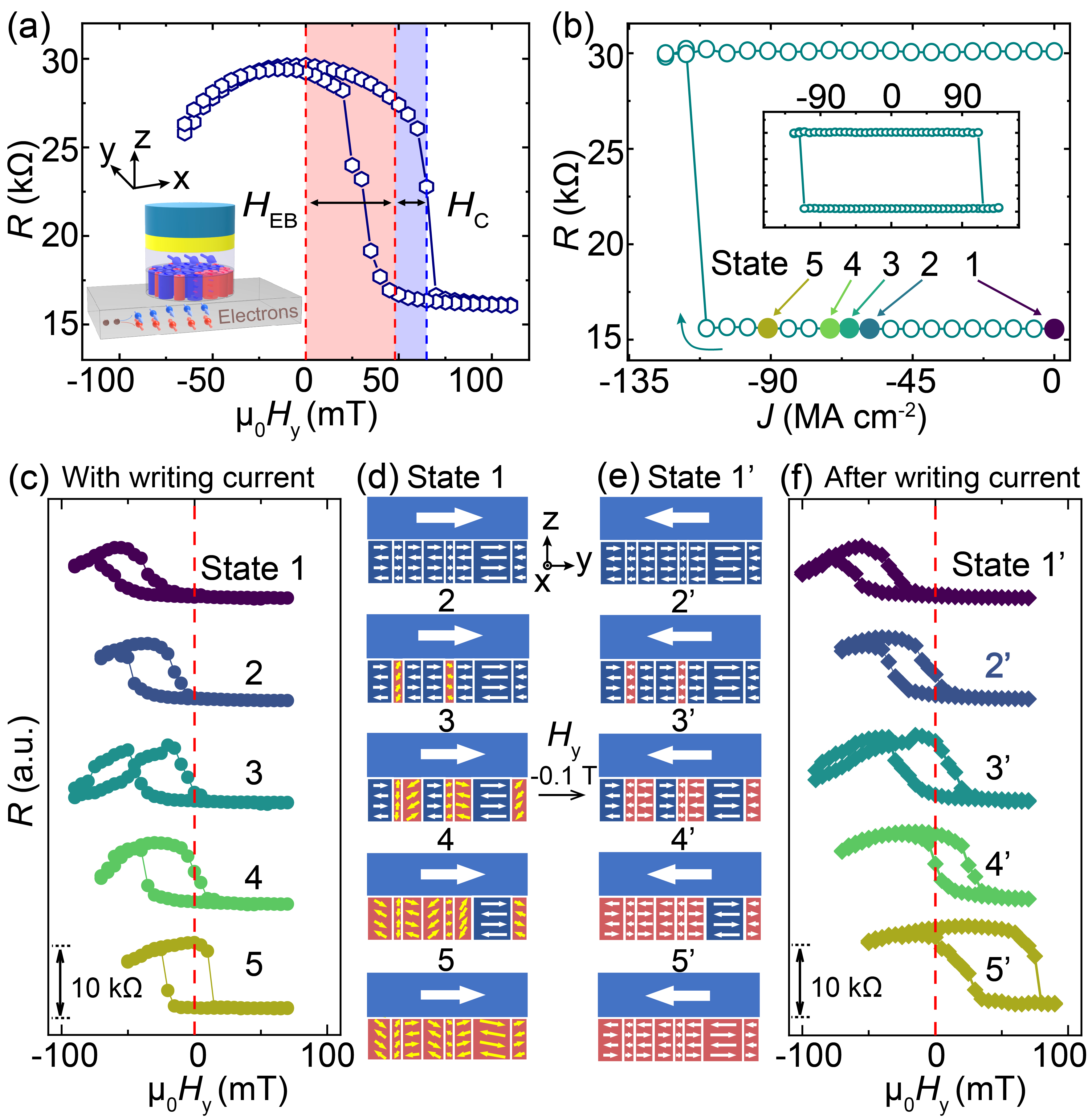
- In Cu/IrMn-MTJs, the estimated switching temperature (T_switching) closely matches the blocking temperature (T_b), indicating that AFM switching is primarily driven by Joule heating due to the weak spin-orbit coupling in Cu.
- In Pt/IrMn-MTJs, T_switching is significantly lower than T_b, demonstrating that SOT plays a dominant role in switching, especially at short pulse widths.
- The threshold SOT current density for AFM switching in Pt/IrMn-MTJs is quantified as 338 MA cm⁻², approximately an order of magnitude higher than that for FM switching.
- A linear dependence is observed between the normalized threshold SOT current density and the inverse of the temperature-corrected pulse width, validating the thermally interplayed SOT switching model.
- Time-resolved measurements show that for pulse widths below 1 µs, the device temperature does not reach saturation, confirming the need for real-time temperature estimation in ultrafast switching studies.
- Asynchronous switching between the FM and AFM layers in EB-MTJs enables accurate detection of AFM state transitions, facilitating precise characterization of the switching mechanism.
Read this paper
Open the full text in the Nubint reader and ask about any passage as you read.
Read this paper on NubintThis review was generated by AI from the original paper. Please check the paper before citing it.