
[Paper Review] Angle Basis: a Generative Model and Decomposition for Functional Connectivity
This paper introduces Angle Basis, a novel generative model and decomposition method for functional connectivity (FC) in fMRI that represents FC as a combination of sine-wave basis states and a jitter component. It achieves comparable predictive performance to FC using only 5–10 bases, with both the reconstruction and residual contributing equally to prediction—when ensembled, they exceed FC’s AUC by up to 5%, and the residual enables near-perfect subject fingerprinting (97.3% accuracy).
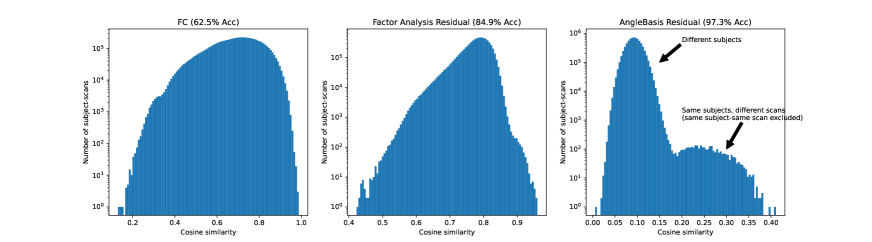
Functional connectivity (FC) is one of the most common inputs to fMRI-based predictive models, due to a combination of its simplicity and robustness. However, there may be a lack of theoretical models for the generation of FC. In this work, we present a straightforward decomposition of FC into a set of basis states of sine waves with an additional jitter component. We show that the decomposition matches the predictive ability of FC after including 5-10 bases. We also find that both the decomposition and its residual have approximately equal predictive value, and when combined into an ensemble, exceed the AUC of FC-based prediction by up to 5%. Additionally, we find the residual can be used for subject fingerprinting, with 97.3% same-subject, different-scan identifiability, compared to 62.5% for FC. Unlike PCA or Factor Analysis methods, our method does not require knowledge of a population to perform its decomposition; a single subject is enough. Our decomposition of FC into two equally-predictive components may lead to a novel appreciation of group differences in patient populations. Additionally, we generate synthetic patient FC based on user-specified characteristics such as age, sex, and disease diagnosis. By creating synthetic datasets or augmentations we may reduce the high financial burden associated with fMRI data acquisition.
Motivation & Objective
- To develop a theoretically grounded, single-subject-compatible decomposition of functional connectivity (FC) without requiring population-level statistics.
- To investigate whether FC can be decomposed into interpretable, generative components that retain predictive power.
- To evaluate the predictive utility of both the reconstruction and residual components of the decomposition.
- To enable synthetic FC generation based on phenotypic attributes (e.g., age, sex, diagnosis) to reduce fMRI data acquisition costs.
- To explore the potential of the residual component for high-accuracy subject identification (fingerprinting).
Proposed method
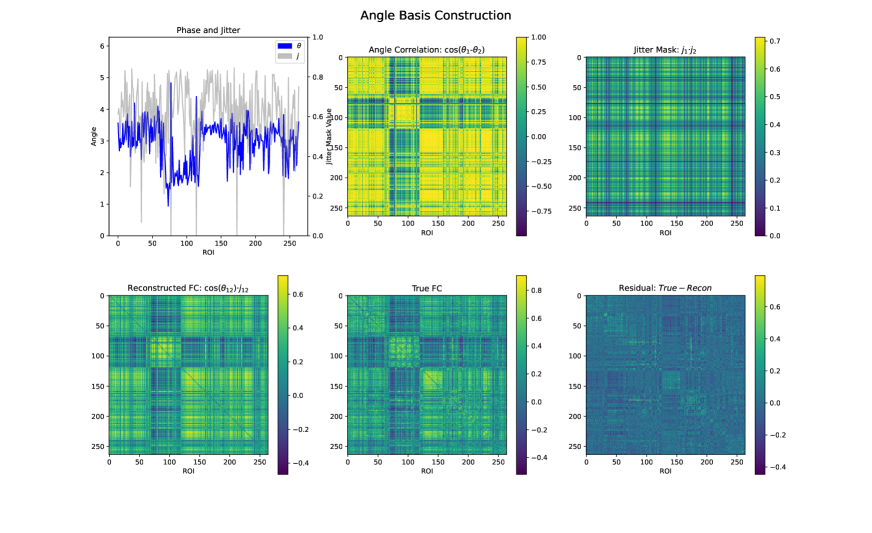
- The method models the BOLD signal as a sum of sine waves with varying phases and amplitudes, representing functional connectivity as a Fourier-like decomposition.
- Each region of interest (ROI) is assigned a phase and amplitude, forming a set of basis states that reconstruct the original FC matrix.
- A jitter term is added at each ROI to account for phase variability, improving reconstruction accuracy.
- The decomposition is optimized via least-squares fitting to minimize reconstruction error.
- The residual (difference between original FC and reconstruction) is preserved and used as a complementary predictive feature.
- Synthetic FC is generated by specifying phenotypic parameters (e.g., age, sex, diagnosis), using trained models to predict basis parameters and reconstruct FC.
Experimental results
Research questions
- RQ1Can functional connectivity be effectively decomposed into a set of interpretable, generative basis states using only a single subject’s data?
- RQ2Do the reconstructed FC and its residual component each retain significant predictive power for phenotypic traits such as age, sex, race, and diagnosis?
- RQ3Can an ensemble of the reconstruction and residual outperform standard FC-based prediction models?
- RQ4Is the residual component highly discriminative for subject fingerprinting across different scans of the same individual?
- RQ5Can phenotypically informed synthetic FC be reliably generated to reduce reliance on real fMRI data acquisition?
Key findings
- Using only 5–10 angle basis components, the reconstruction achieves predictive performance comparable to original FC in age, sex, race, and schizophrenia diagnosis prediction.
- The residual component alone achieves predictive accuracy comparable to the reconstruction, with AUC values of 0.744 ± 0.065 (sex) and 0.812 ± 0.040 (race) in the PNC dataset.
- An ensemble of the reconstruction and residual components exceeds the AUC of FC alone by up to 5% in several prediction tasks.
- The residual enables highly accurate subject fingerprinting, achieving 97.3% same-subject, different-scan identification, compared to 62.5% for FC.
- The model enables generation of synthetic FC that reflects phenotypic characteristics, such as strong intra-DMN connectivity in synthetic females and flatter profiles in synthetic males.
- The method is computationally efficient, requiring only seconds per subject on a mid-tier GPU, and does not require population-level data for decomposition.
Read this paper
Open the full text in the Nubint reader and ask about any passage as you read.
Read this paper on NubintThis review was generated by AI from the original paper. Please check the paper before citing it.