
[Paper Review] Atomique: A Quantum Compiler for Reconfigurable Neutral Atom Arrays
This paper introduces FPQA-C, a scalable quantum compilation framework for Field-Programmable Qubit Arrays (FPQA), a novel neutral atom quantum architecture enabling dynamic atom movement to reduce long-range gate overhead. By combining a hierarchical qubit-array and qubit-atom mapper with a high-parallelism router, FPQA-C reduces 2Q gate count by up to 5.3× and circuit depth by up to 3.6× compared to leading alternatives, including superconducting and fixed-atom arrays.
The neutral atom array has gained prominence in quantum computing for its scalability and operation fidelity. Previous works focus on fixed atom arrays (FAAs) that require extensive SWAP operations for long-range interactions. This work explores a novel architecture reconfigurable atom arrays (RAAs), also known as field programmable qubit arrays (FPQAs), which allows for coherent atom movements during circuit execution under some constraints. Such atom movements, which are unique to this architecture, could reduce the cost of long-range interactions significantly if the atom movements could be scheduled strategically. In this work, we introduce Atomique, a compilation framework designed for qubit mapping, atom movement, and gate scheduling for RAA. Atomique contains a qubit-array mapper to decide the coarse-grained mapping of the qubits to arrays, leveraging MAX k-Cut on a constructed gate frequency graph to minimize SWAP overhead. Subsequently, a qubit-atom mapper determines the fine-grained mapping of qubits to specific atoms in the array and considers load balance to prevent hardware constraint violations. We further propose a router that identifies parallel gates, schedules them simultaneously, and reduces depth. We evaluate Atomique across 20+ diverse benchmarks, including generic circuits (arbitrary, QASMBench, SupermarQ), quantum simulation, and QAOA circuits. Atomique consistently outperforms IBM Superconducting, FAA with long-range gates, and FAA with rectangular and triangular topologies, achieving significant reductions in depth and the number of two-qubit gates.
Motivation & Objective
- Address the challenge of high SWAP overhead in fixed atom arrays (FAA) by enabling dynamic atom reconfiguration in FPQA.
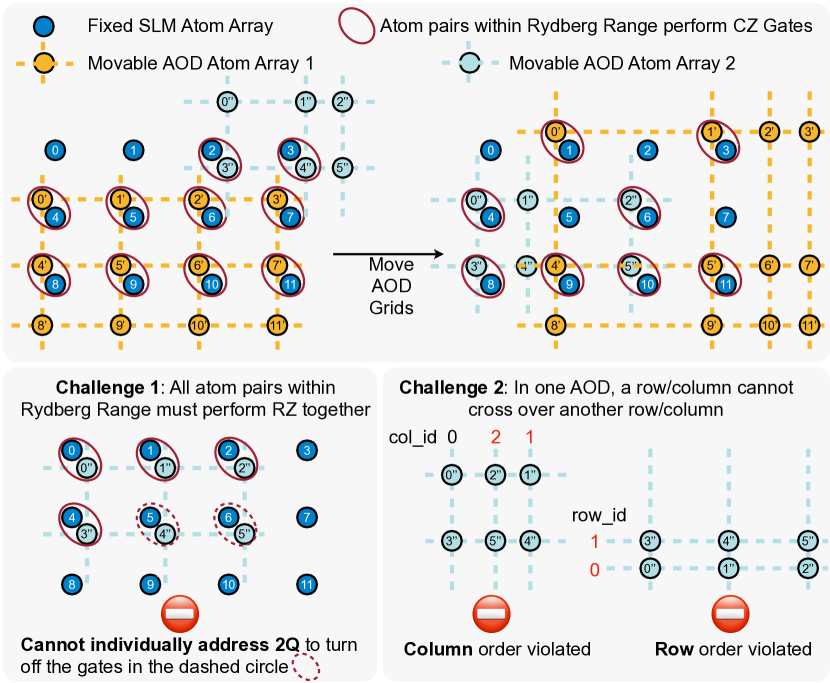
- Overcome hardware constraints in FPQA—such as non-overlapping atom movements and non-parallelizable edge sets—through a novel compilation framework.
- Minimize circuit depth and 2Q gate count in FPQA while ensuring fault-tolerance via error budget and code distance analysis.
- Develop a scalable, heuristic-based compilation stack that supports both NISQ and fault-tolerant quantum computing workloads on FPQA.
- Enable high parallelism in 2Q gate execution by co-scheduling atom movements and gate operations under strict hardware constraints.
Proposed method
- Formulate qubit-array mapping as a MAX k-Cut problem on a gate frequency graph to maximize inter-array 2Q gates and minimize SWAP operations.
- Design a qubit-atom mapper that assigns qubits to specific atoms while balancing load and avoiding hardware constraint violations.
- Implement a high-parallelism router that iteratively identifies and schedules parallelizable 2Q gates alongside coordinated atom movements.
- Model the FPQA hardware as a dynamic multipartite coupling graph with conditional edge sets to capture all possible qubit interactions based on atom positions.
- Integrate error models for atom transfer and movement into circuit simulation, estimating logical error rates and resource requirements under surface code error correction.
- Use empirical fitting to derive logical error rate scaling: $ p_l = \alpha \cdot (p^*)^d $, with $ \alpha_{FPQA} = 0.0265 $, $ p^*_{FPQA} = 0.0112 $, showing improved error threshold over FAA with qubit shelving.
Experimental results
Research questions
- RQ1Can dynamic atom reconfiguration in FPQA significantly reduce 2Q gate overhead compared to fixed atom arrays?
- RQ2How can a compilation framework efficiently schedule atom movements and 2Q gate executions under strict hardware constraints like non-overlapping movements and non-parallelizable edge sets?
- RQ3To what extent does FPQA-C improve circuit depth and 2Q gate count across diverse quantum workloads including QAOA, quantum simulation, and QASMBench?
- RQ4How does the logical error rate of FPQA scale with code distance, and how does it compare to FAA with qubit shelving under the same error budget?
- RQ5What is the impact of atom transfer between SLM and AOD on circuit reliability, and how can this be mitigated in the compilation stack?
Key findings
- FPQA-C reduces 2Q gate count by up to 5.3× compared to IBM superconducting processors across 20+ benchmarks.
- Circuit depth is reduced by up to 3.6× compared to IBM superconducting processors, with improvements of 3.2×, 3.1×, and 2.2× over FAA with rectangular, triangular, and long-range gate topologies.
- The logical error rate of FPQA scales as $ p_l = 0.0265 \cdot (0.0112)^d $, showing a higher error threshold and lower error pre-factor than FAA with qubit shelving ($ \alpha_{FAA} = 0.0299 $, $ p^*_{FAA} = 0.0101 $).
- FPQA-C achieves high parallelism in 2Q gate execution by co-scheduling atom movements and gate operations, avoiding unwanted Rydberg interactions through careful routing.
- The framework reduces reliance on SWAP gates by maximizing inter-array 2Q gates via MAX k-Cut-based qubit-array mapping, significantly lowering overhead.
- Resource estimation shows that FPQA requires fewer physical qubits and lower code distances than FAA to achieve the same error budget, due to reduced error propagation from movement and transfer.
Better researchstarts right now
From reading papers to final review, dramatically reduce your research time.
No credit card · Free plan available
This review was created by AI and reviewed by human editors.