
[Paper Review] Autoencoder-based Joint Communication and Sensing of Multiple Targets
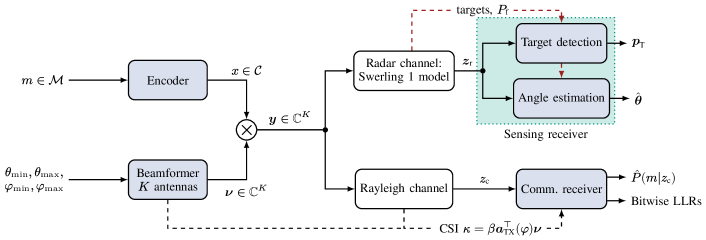
This paper proposes an autoencoder-based joint communication and sensing (JCAS) system that enables simultaneous multi-target detection and angle estimation in a single-carrier wireless system. By introducing a novel counting encoding scheme and set-based training methods (permutation, sorting), the approach achieves superior angle estimation performance—outperforming ESPRIT for small sample sizes—while enabling precise control of the false alarm rate, crucial for real-time radar applications with limited snapshots.
We investigate the potential of autoencoders (AEs) for building a joint communication and sensing (JCAS) system that enables communication with one user while detecting multiple radar targets and estimating their positions. Foremost, we develop a suitable encoding scheme for the training of the AE and for targeting a fixed false alarm rate of the target detection during training. We compare this encoding with the classification approach using one-hot encoding for radar target detection. Furthermore, we propose a new training method that complies with possible ambiguities in the target locations. We consider different options for training the detection of multiple targets. We can show that our proposed approach based on permuting and sorting can enhance the angle estimation performance so that single snapshot estimations with a low standard deviation become possible. We outperform an ESPRIT benchmark for small numbers of measurement samples.
Motivation & Objective
- To develop a joint communication and sensing (JCAS) system that supports multi-target detection and localization using a single waveform.
- To address the challenge of training neural networks for multiple target detection with limited snapshots, a common constraint in real-world radar systems.
- To design an encoding scheme that enables precise control over the false alarm rate, critical for reliable radar detection.
- To improve angle estimation accuracy in single-snapshot scenarios, where conventional methods like ESPRIT suffer from high variance.
- To evaluate and compare different set-based training methods (permutation, sorting) for handling multiple target outputs in neural networks.
Proposed method
- Introduces a novel counting encoding scheme that treats target detection as a regression-like task rather than classification, enabling direct control over the false alarm rate.
- Applies permutation and sorting techniques to handle the ambiguity in target order during training, ensuring consistent loss calculation across different permutations of detected targets.
- Uses a two-stage training strategy: first train the target detection and angle estimation networks separately, then jointly fine-tune them to improve performance.
- Employs a mean squared error (MSE) loss for angle estimation and binary cross-entropy for detection, with weighted false alarm rate as a key training constraint.
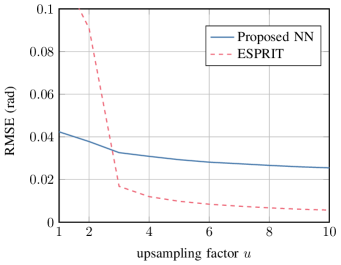
- Implements upsampling of the radar signal to increase effective sample size and improve estimation stability, especially for low-signal scenarios.
- Compares the proposed counting encoding with traditional one-hot encoding, showing improved stability and lower false alarm rate control.
Experimental results
Research questions
- RQ1Can an autoencoder-based JCAS system effectively detect and localize multiple radar targets using a single-carrier waveform?
- RQ2How does the proposed counting encoding scheme compare to one-hot encoding in terms of false alarm rate control and detection performance?
- RQ3What set-based training methods (permutation, sorting) are most effective for multi-target angle estimation in neural networks with limited snapshots?
- RQ4Can the proposed system outperform classical signal processing methods like ESPRIT in single-snapshot scenarios?
- RQ5How does the upsampling factor influence the accuracy and stability of angle estimation in low-sample regimes?
Key findings
- The proposed counting encoding maintains the weighted false alarm rate within 10% of the target value, while one-hot encoding oscillates around a higher, less controllable rate of approximately 3×10⁻².
- For multiple targets (T_max=3), the counting encoding achieves a detection rate of 0.83 at high SNR, significantly outperforming one-hot encoding, which reaches only 0.5 due to unstable false alarm control.
- The permutation-based set method achieves the lowest root mean squared error (RMSE) in angle estimation, reducing RMSE from 0.1 to 0.04 after joint training.
- The system outperforms the ESPRIT benchmark for upsampling factors u ≤ 3, particularly in single-snapshot scenarios where ESPRIT fails due to high variance.
- The detection rate saturates at 0.83 as the upsampling factor u increases, indicating that further improvements require adaptive threshold tuning.
- The counting encoding enables direct element-wise multiplication of angle estimates with detection outputs, offering computational advantages over one-hot encoding.
Read this paper
Open the full text in the Nubint reader and ask about any passage as you read.
Read this paper on NubintThis review was generated by AI from the original paper. Please check the paper before citing it.