
[Paper Review] Background-induced complex mass states of graviton: quantization and tensor power spectrum
This paper proposes that graviton two-point functions on de-Sitter space can develop an infinite number of background-induced complex mass poles, which are not necessarily pathological if stability conditions are met. Using a consistent Bunch-Davies vacuum quantization, it shows these states can enhance the tensor power spectrum at high frequencies, leading to potentially observable stochastic gravitational wave signals.
We start from the assumption that the theory of gravity can be formulated in terms of 4-dimensional action, and there are only 2 graviton polarization states, as in general relativity. It can be a non-perturbative effective action discussed in the asymptotic safety program or the result of some other UV modification of the general relativity making it a complete theory. From these general grounds, we study the properties of the graviton two-point function on top of cosmological de-Sitter space. We find that the no-ghost requirement formulated for the flat background does not necessarily hold for the de-Sitter space where the graviton two-point function can have an infinite number of complex-conjugate poles. We show that under certain stability conditions, their appearance doesn't contradict any fundamental principle. We discuss their observational consequences for the tensor power spectrum from inflation and for the stochastic gravitational wave background.
Motivation & Objective
- To investigate whether complex mass poles in the graviton two-point function on de-Sitter space violate fundamental principles of quantum field theory.
- To establish conditions under which these complex poles do not lead to classical or quantum instabilities.
- To develop a consistent quantization scheme for these background-induced complex mass states in de-Sitter spacetime.
- To explore the observational consequences of these states on the tensor power spectrum during inflation.
- To assess the potential for detecting these effects via future stochastic gravitational wave background experiments.
Proposed method
- Derives the effective action for gravity on de-Sitter space, showing that form-factors depend on background curvature, leading to modified graviton propagators.
- Analyzes the graviton two-point function in momentum space, identifying an infinite number of complex-conjugate poles arising from non-local infinite derivative gravity.
- Applies a Bunch-Davies vacuum definition at future null infinity (η → ∞), ensuring well-defined quantization for complex mass states.
- Derives classical stability conditions that prevent exponential growth of modes, particularly near the de-Sitter boundary.
- Computes the tensor power spectrum using asymptotic expansions of Hankel functions with complex order, capturing behavior near the stability parabola.
- Estimates the stochastic gravitational wave energy density using the power spectrum, incorporating redshift and relativistic degrees of freedom.
Experimental results
Research questions
- RQ1Can the graviton two-point function on de-Sitter space develop an infinite number of complex-conjugate poles without violating causality or unitarity?
- RQ2What classical stability conditions must complex mass states satisfy to avoid exponential growth and background destabilization?
- RQ3Is a consistent Bunch-Davies vacuum quantization possible for background-induced complex mass graviton states in de-Sitter space?
- RQ4How do complex mass poles affect the tensor power spectrum at high conformal momenta during inflation?
- RQ5Can these effects lead to observable signatures in the stochastic gravitational wave background detectable by future experiments?
Key findings
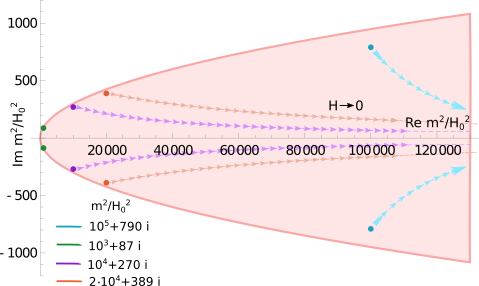
- The presence of complex-conjugate poles in the graviton two-point function on de-Sitter space does not violate fundamental principles if the imaginary part of the mass is sufficiently small compared to the real part.
- Classical stability is ensured when the complex mass lies within a specific region bounded by a parabolic curve in the complex mass plane, preventing runaway growth.
- The Bunch-Davies vacuum is well-defined at future infinity for complex mass states, enabling consistent quantization with creation and annihilation operators for each conjugate pair.
- Near the stability parabola, the tensor power spectrum scales as $ rac{16b^2}{/pi} (-q au)^{-2a} $ with $ a o 3/2 $, $ b = ext{Im} _{+} $, leading to enhancement proportional to $ b^2 o m_1/H_0 $.
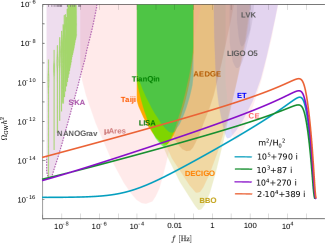
- Numerical results confirm the asymptotic scaling, showing significant power enhancement at high frequencies when the real part of the mass is $ ext{Re}(m) o 10^2 - 10^3 H_0^2 $.
- The stochastic gravitational wave energy density $ ilde{ ho}_{GW} $ can be enhanced at high frequencies, with detectable signals possible in future GW detectors if the mass is close to the stability boundary.
Read this paper
Open the full text in the Nubint reader and ask about any passage as you read.
Read this paper on NubintThis review was generated by AI from the original paper. Please check the paper before citing it.