
[Paper Review] Binary black hole spins: model selection with GWTC-3
This study uses hierarchical Bayesian inference on 59 confident binary black hole events from GWTC-3 to test spin models based on angular momentum transport in massive stars. It finds that models predicting only vanishingly small black hole spins are inconsistent with data, while models including a sub-population of tidally spun-up black holes provide a good fit, highlighting the critical role of the precessing spin parameter in constraining formation scenarios.
The origin of the spins of stellar-mass black holes is still controversial, and angular momentum transport inside massive stars is one of the main sources of uncertainty. Here, we apply hierarchical Bayesian inference to derive constraints on spin models from the 59 most confident binary black hole merger events in the third gravitational-wave transient catalogue (GWTC-3). We consider up to five parameters: chirp mass, mass ratio, redshift, effective spin, and precessing spin. For model selection, we use a set of binary population synthesis simulations spanning drastically different assumptions for black hole spins and natal kicks. In particular, our spin models range from maximal to minimal efficiency of angular momentum transport in stars. We find that, if we include the precessing spin parameter into our analysis, models predicting only vanishingly small spins are in tension with GWTC-3 data. On the other hand, models in which most spins are vanishingly small, but that also include a sub-population of tidally spun-up black holes are a good match to the data. Our results show that the precessing spin parameter has a crucial impact on model selection.
Motivation & Objective
- To constrain black hole spin models using gravitational wave data from the third catalog (GWTC-3).
- To test the impact of angular momentum transport efficiency in massive stars on black hole spin distributions.
- To evaluate whether models with vanishingly small spins are consistent with observed binary black hole mergers.
- To assess the role of natal kicks and precessing spin in model selection.
Proposed method
- Hierarchical Bayesian inference is applied to 59 confident binary black hole merger events from GWTC-3.
- Five parameters are modeled: chirp mass, mass ratio, redshift, effective spin, and precessing spin.
- A suite of binary population synthesis simulations is used, spanning different assumptions for angular momentum transport (inefficient to very efficient) and natal kick models.
- Models range from minimal spin (F) to efficient transport (M, Max), with inclusion of tidally spun-up black holes (B21) in select cases.
- Model selection is performed using log-likelihood comparisons across spin and kick assumptions.
- The precessing spin parameter χp is explicitly included to assess its influence on model discrimination.
Experimental results
Research questions
- RQ1Which black hole spin models are most consistent with the observed spin distribution in GWTC-3?
- RQ2Does the inclusion of the precessing spin parameter χp significantly alter model selection outcomes?
- RQ3Are models predicting uniformly vanishingly small black hole spins compatible with GWTC-3 data?
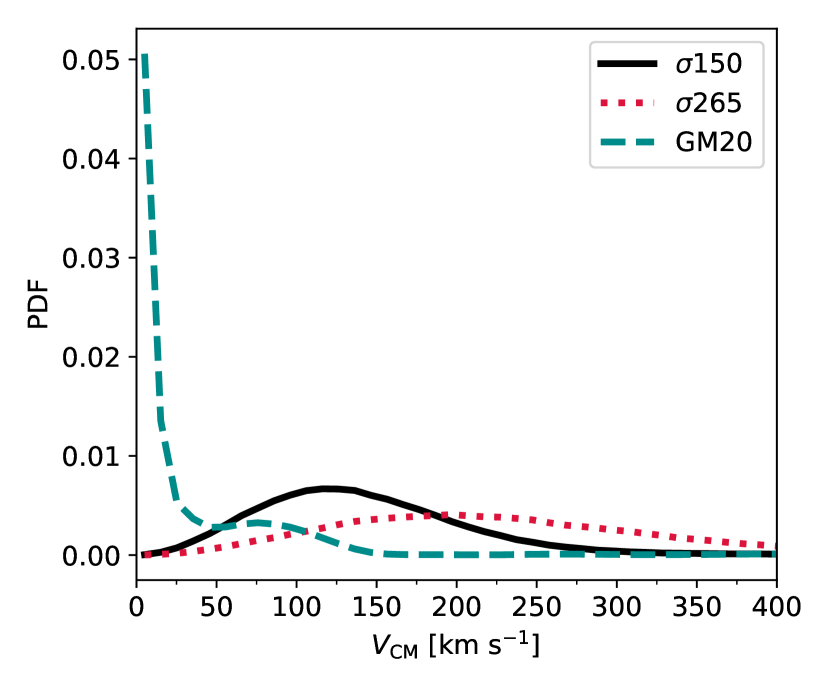
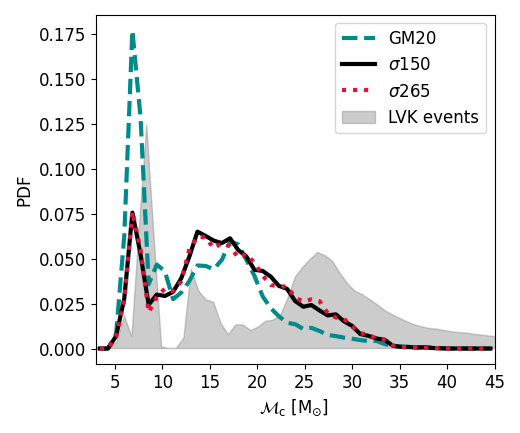
- RQ4How do different natal kick models (σ=150, 265 km/s, and G20) affect the fit to observed data?
- RQ5What is the role of tidally spun-up black holes in explaining the observed spin distribution?
Key findings
- Models predicting only vanishingly small black hole spins (model F) are in tension with GWTC-3 data and are rejected.
- Models with mostly low spins but a sub-population of tidally spun-up black holes (F_B21) provide a good fit to the data.
- Models with inefficient angular momentum transport (G and G_21) yield significantly lower log-likelihood values than those with efficient transport (M, M_B21, Max, Max_B21).
- Models with large natal kicks (σ=265 and σ=150 km/s) are favored over the low-kick G20 model.
- The precessing spin parameter χp plays a crucial role in distinguishing between spin models, improving model selection sensitivity.
- The data show mild evidence for spin-orbit misalignment, supporting the inclusion of precessing spin in the analysis.
Read this paper
Open the full text in the Nubint reader and ask about any passage as you read.
Read this paper on NubintThis review was generated by AI from the original paper. Please check the paper before citing it.