
[Paper Review] Binary vision: The merging black hole binary mass distribution via iterative density estimation
This paper introduces an iterative density estimation method using adaptive-width kernel density estimation (awKDE) to reconstruct the full two-dimensional mass distribution of merging binary black holes from gravitational wave data without assuming parametric forms like power laws. The method reduces bias from measurement uncertainties and reveals a secondary mass distribution with distinct spectral-like features and an anti-correlation with primary mass near 10 M⊙, challenging prior assumptions of universal mass ratio distributions.
Binary black hole (BBH) systems detected via gravitational-wave (GW) emission are a recently opened astrophysical frontier with many unknowns and uncertainties. Accurate reconstruction of the binary distribution with as few assumptions as possible is desirable for inference on formation channels and environments. Most population analyses have, though, assumed a power law in binary mass ratio $q$, and/or assumed a universal $q$ distribution regardless of primary mass. Kernel density estimation (KDE)-based methods allow us to dispense with such assumptions and directly estimate the joint binary mass distribution. We deploy a self-consistent iterative method to estimate this full BBH mass distribution, finding local maxima in primary mass consistent with previous investigations and a secondary mass distribution with a partly independent structure, inconsistent with both power laws and with a constant function of $q$. We find a weaker preference for near-equal mass binaries than in most previous investigations; instead, the secondary mass has its own "spectral lines" at slightly lower values than the primary, and we observe an anti-correlation between primary and secondary masses around the ~$10M_\odot$ peak.
Motivation & Objective
- To reconstruct the full two-dimensional mass distribution of merging binary black holes without assuming parametric forms such as power laws in mass ratio q.
- To reduce bias from measurement uncertainties in individual event parameters by employing an iterative re-weighting scheme based on awKDE density estimates.
- To investigate whether the secondary mass distribution is independent of the primary mass or exhibits structure inconsistent with constant or power-law q distributions.
- To test the validity of common assumptions in population inference, such as a universal q distribution or q ∝ m₁^β, using data-driven methods.
- To provide a non-parametric, self-consistent framework for population inference in gravitational wave astronomy that minimizes model dependence.
Proposed method
- The method employs adaptive-width kernel density estimation (awKDE) to non-parametrically estimate the joint probability density of primary and secondary black hole masses from gravitational wave detections.
- An iterative re-weighting scheme is applied, inspired by the expectation-maximization algorithm, to refine the density estimate by reweighting posterior samples using the current density estimate as a proposal distribution.
- The algorithm alternates between estimating the density from current samples and updating the sample weights to better reflect the true underlying distribution, reducing bias from noisy individual event measurements.
- Gaussian kernels are used for density estimation, with bandwidths adapted to local data density to improve accuracy in sparse regions.
- The method is applied to GWTC-1 to GWTC-3 gravitational wave event catalogs, focusing on binary black hole mergers.
- The approach avoids assumptions about functional forms for the mass ratio distribution, allowing for the detection of complex, non-uniform structures such as local maxima and anti-correlations.
Experimental results
Research questions
- RQ1Does the secondary black hole mass distribution exhibit structure independent of the primary mass, inconsistent with a constant or power-law mass ratio distribution?
- RQ2Is there evidence for an anti-correlation between primary and secondary masses in the 10 M⊙ peak region, as suggested by the data?
- RQ3How does the iterative re-weighting scheme improve the accuracy of population-level mass distribution reconstruction compared to standard KDE?
- RQ4To what extent do current assumptions about q (e.g., power law or constant) bias population inference in binary black hole studies?
- RQ5Can a non-parametric, data-driven method reveal features in the mass distribution that are missed by parametric models?
Key findings
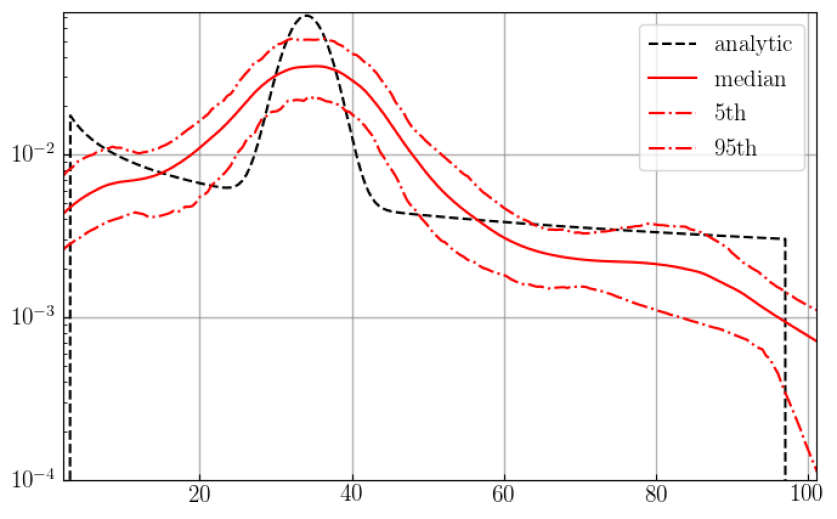
- The method reveals a secondary mass distribution with distinct local maxima at slightly lower masses than the primary, indicating a non-uniform, structured distribution inconsistent with a constant or power-law q function.
- An anti-correlation is observed between primary and secondary masses around the ∼10 M⊙ peak, suggesting a physical correlation in formation or evolution processes.
- The preference for near-equal mass binaries is weaker than in most previous studies, challenging the common assumption of a strong q ≈ 1 preference.
- The iterative re-weighting scheme effectively reduces bias from measurement uncertainties in individual event parameters, improving the fidelity of the reconstructed population distribution.
- The joint mass distribution shows clear deviations from both power-law and constant q models, indicating that universal q assumptions are not supported by the data.
- The method successfully identifies 'spectral-like' features in the secondary mass distribution, suggesting complex underlying astrophysical processes in binary black hole formation.
Read this paper
Open the full text in the Nubint reader and ask about any passage as you read.
Read this paper on NubintThis review was generated by AI from the original paper. Please check the paper before citing it.