
[Paper Review] BIRB: A Generalization Benchmark for Information Retrieval in Bioacoustics
BIRB introduces a realistic, complex benchmark for evaluating machine learning models in bioacoustic information retrieval, focusing on generalization across distribution shifts between citizen science (focal) recordings and real-world passive soundscapes. It uses representation learning and nearest-centroid search to retrieve bird vocalizations, revealing significant performance drops under covariate shift and label noise, especially in rare species and held-out regions.
The ability for a machine learning model to cope with differences in training and deployment conditions--e.g. in the presence of distribution shift or the generalization to new classes altogether--is crucial for real-world use cases. However, most empirical work in this area has focused on the image domain with artificial benchmarks constructed to measure individual aspects of generalization. We present BIRB, a complex benchmark centered on the retrieval of bird vocalizations from passively-recorded datasets given focal recordings from a large citizen science corpus available for training. We propose a baseline system for this collection of tasks using representation learning and a nearest-centroid search. Our thorough empirical evaluation and analysis surfaces open research directions, suggesting that BIRB fills the need for a more realistic and complex benchmark to drive progress on robustness to distribution shifts and generalization of ML models.
Motivation & Objective
- To address the lack of realistic benchmarks for evaluating model generalization in bioacoustics, particularly under distribution shifts between training and deployment data.
- To create a holistic benchmark that captures multiple facets of generalization—such as covariate shift, label noise, and class imbalance—within a single, complex evaluation framework.
- To support both ML and conservation research communities by enabling evaluation of models on real-world, large-scale, unlabeled audio field data with diverse acoustic conditions.
- To identify and quantify the relative impact of different generalization challenges, such as differences in recording modalities (focal vs. passive), label quality, and geographic specificity.
- To drive progress toward robust, deployable models for conservation applications by providing a standardized, open benchmark with diverse regional soundscapes and curated training data.
Proposed method
- Constructs a benchmark using three data types: XC Focal (citizen science, high-quality labels), XC Background (crowdsourced, noisier labels), and regional soundscapes (expert-annotated, low SNR, passive recordings).
- Applies representation learning via AudioMAE and S EfficientNet models to embed audio clips into a shared embedding space for retrieval.
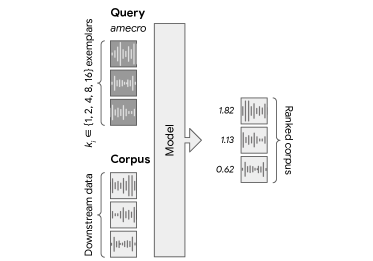
- Employs a nearest-centroid search strategy to retrieve target vocalizations based on a small number of exemplar clips provided per class.
- Evaluates model performance across multiple evaluation regions (e.g., New York State, Hawaii, Colombia/Costa Rica, Peru, Sierra Nevada) with varying data availability and label fidelity.
- Introduces three evaluation settings: Artificially Rare (rare species not in training), Heldout (entire region not in upstream data), and species availability breakdowns to assess generalization under data scarcity.
- Uses cROC-AUC as the primary metric to compare model performance across different data splits, model architectures, and data sources.
Experimental results
Research questions
- RQ1How do models trained on citizen science focal recordings generalize to real-world passive soundscapes with different recording conditions and lower signal-to-noise ratios?
- RQ2What is the relative impact of label noise, covariate shift, and data scarcity on model performance in bioacoustic retrieval tasks?
- RQ3How does performance vary when models are evaluated on geographically distinct regions not seen during training, especially for species not present in the upstream training data?
- RQ4To what extent does pre-training on large-scale, diverse citizen science data (XC) improve generalization to rare or unseen species in passive soundscapes?
- RQ5How do different model architectures (e.g., AudioMAE, S EfficientNet) and fine-tuning strategies perform under varying data availability and label quality conditions?
Key findings
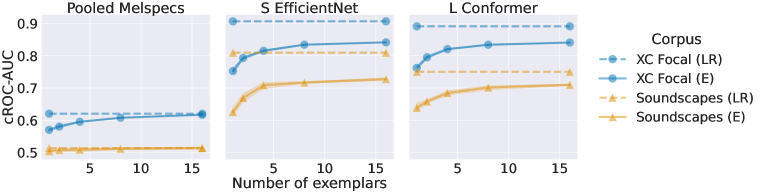
- Models trained on XC Focal data show significant performance degradation when deployed on passive soundscapes, particularly in regions with no overlap in species or recording conditions.
- The XC Background corpus presents the highest generalization challenge due to label noise and lower annotation quality, though performance differences from XC Focal are not always statistically significant.
- Performance on Heldout regions (e.g., Island of Hawai’i, Colombia & Costa Rica) is substantially lower than on seen regions, indicating strong covariate shift effects.
- Despite differences in data quality and source, AudioMAE (fine-tuned) and S EfficientNet models show nearly indistinguishable performance on the Artificially Rare species in New York State, suggesting robustness to data source under certain conditions.
- Heldout species in Sierra Nevada, USA and Peru show high variability in cROC-AUC, with no consistent trend between available and unavailable species, indicating complex interplay between vocalization characteristics and model generalization.
- The benchmark reveals that current models struggle most with rare species and unseen geographies, highlighting the need for improved data augmentation, self-supervised pretraining, and domain adaptation techniques in bioacoustic ML.
Read this paper
Open the full text in the Nubint reader and ask about any passage as you read.
Read this paper on NubintThis review was generated by AI from the original paper. Please check the paper before citing it.