
[Paper Review] Boosting galactic outflows with enhanced resolution
The paper shows that increasing resolution to resolve the local gas cooling length in galactic outflows enhances their multiphase structure and energetics, boosting mass, metal, and energy loading factors away from the galaxy.
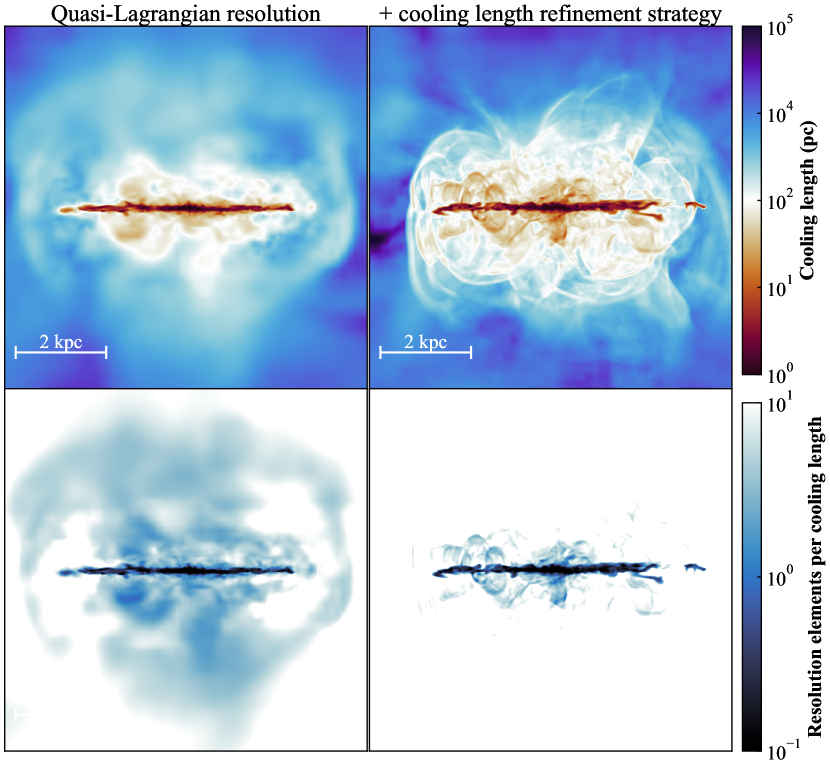
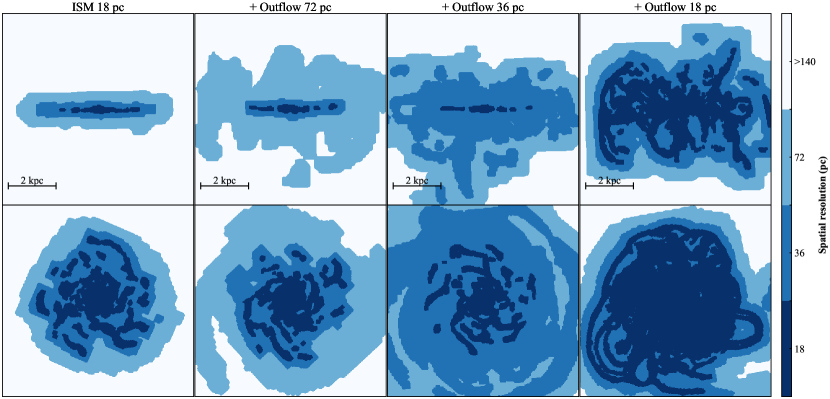
We study how better resolving the cooling length of galactic outflows affect their energetics. We perform radiative-hydrodynamical galaxy formation simulations of an isolated dwarf galaxy ($M_{\star}=10^{8}\, \mathrm{M}_\odot$) with the Ramses-RTZ code, accounting for non-equilibrium cooling and chemistry coupled to radiative transfer. Our simulations reach a spatial resolution of $18 \, \mathrm{pc}$ in the interstellar medium (ISM) using a traditional quasi-Lagrangian scheme. We further implement a new adaptive mesh refinement (AMR) strategy to resolve the local gas cooling length, allowing us to gradually increase the resolution in the stellar-feedback-powered outflows, from $\geq 200 \, \mathrm{pc}$ to $18 \, \mathrm{pc}$. The propagation of outflows into the inner circumgalactic medium (CGM) is significantly modified by this additional resolution, but the ISM, star formation and feedback remain by and large the same. With increasing resolution in the diffuse gas, the hot outflowing phase ($T > 8 imes 10^{4} \, \mathrm{K}$) systematically reaches overall higher temperatures and stays hotter for longer as it propagates outwards. This leads to two-fold increases in the time-averaged mass and metal outflow loading factors away from the galaxy ($r=5\, \mathrm{kpc}$), a five-fold increase in the average energy loading factor, and a $\approx$50 per cent increase in the number of sightlines with $N_{ ext{OVI}} \geq 10^{13}\, \mathrm{cm}^{-2}$. Such a significant boost to the energetics of outflows without new feedback mechanisms or channels strongly motivates future studies quantifying the efficiency with which better-resolved multiphase outflows regulate galactic star formation in a cosmological context.
Motivation & Objective
- Understand how resolving the local gas cooling length affects galactic outflow energetics.
- Quantify changes in outflow phase structure (cold, warm, hot) with increasing resolution.
- Determine how resolution impacts mass, metal, and energy loading factors at kiloparsec scales.
- Assess observational implications via ionization tracers like O VI in better-resolved winds.
Proposed method
- Perform radiative-hydrodynamical simulations of an isolated dwarf galaxy with ramses-rtz.
- Solve non-equilibrium cooling and chemistry coupled to on-the-fly radiative transfer for 60+ ionic species.
- Implement a new AMR refinement targeting the local gas cooling length to refine outflows from >200 pc down to 18 pc.
- Maintain consistent star formation and feedback budgets across resolution runs to isolate resolution effects.
- Compare outflow properties at multiple heights (e.g., r=5 kpc) and analyze phase distributions via PDFs.
- Use time-averaged diagnostics over ~500 Myr after an initial relaxation period.
Experimental results
Research questions
- RQ1How does resolving the local cooling length of diffuse outflowing gas affect outflow energetics and phase structure?
- RQ2What are the quantitative changes in mass, metal, and energy loading factors as resolution improves?
- RQ3Does better cooling-length resolution change observable ionic tracers such as O VI in the inner CGM?
- RQ4Can improved resolution be achieved without altering the star formation and feedback histories in dwarf galaxies?
Key findings
- Improved cooling-length resolution yields a more multiphase outflow with colder dense and hotter diffuse components.
- Time-averaged mass loading factors at 5 kpc nearly double with higher resolution in the diffuse gas.
- Time-averaged metal loading factors at 5 kpc increase by a comparable amount to mass loading factors.
- Average energy loading factor increases by about a factor of five with better-resolved outflows.
- The fraction of sightlines with N(O VI) >= 1e13 cm^-2 increases by ~50%.
- The ISM properties and global star formation rates remain largely unchanged across resolutions, isolating the impact to outflow energetics.
Read this paper
Open the full text in the Nubint reader and ask about any passage as you read.
Read this paper on NubintThis review was generated by AI from the original paper. Please check the paper before citing it.