
[Paper Review] Broadband Visible Wavelength Microcomb Generation In Silicon Nitride Microrings Through Air-Clad Dispersion Engineering
This paper demonstrates broadband visible microcomb generation in silicon nitride microring resonators by replacing silica cladding with air cladding to engineer anomalous dispersion, enabling soliton formation down to 461 nm. The approach achieves 125 THz comb bandwidth with only 150 mW on-chip power, overcoming material dispersion limitations in the visible spectrum.
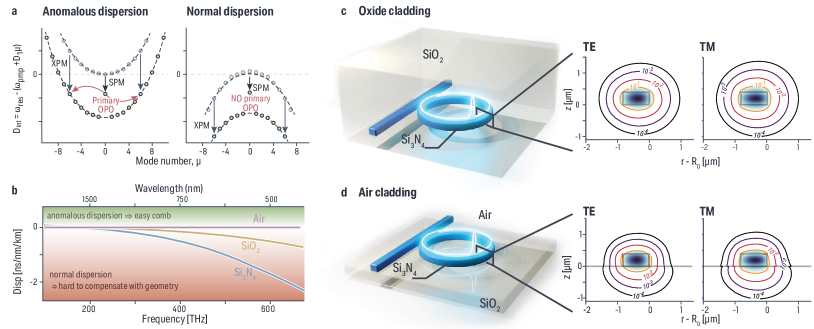
The development of broadband microresonator frequency combs at visible wavelengths is pivotal for the advancement of compact and fieldable optical atomic clocks and spectroscopy systems. Yet, their realization necessitates resonators with anomalous dispersion, an arduous task due to the prevailing normal dispersion regime of materials within the visible spectrum. In this work, we evince that silicon nitride microring resonators with air cladding on top and sides -- a deviation from the frequently employed silica-embedded resonators -- allows for the direct generation of broadband microcombs in the visible range. We experimentally demonstrate combs pumped at 1060~nm (283~THz) that reach wavelengths as short as 680~nm (440 THz), and combs pumped at 780~nm (384 THz) that reach wavelengths as short as 630 nm (475 THz). We further show through simulations that microcombs extending to wavelengths as low as 461 nm (650 THz) should be accessible in this platform.
Motivation & Objective
- Overcome the challenge of normal dispersion in silicon nitride and silica at visible wavelengths to enable microcomb generation.
- Address the lack of anomalous dispersion in conventional SiO2-embedded Si3N4 microrings below 900 nm.
- Demonstrate experimentally and theoretically that air-clad microring resonators support broadband microcomb generation in the visible spectrum.
- Achieve high nonlinearity and low threshold for comb excitation despite moderate Q-factors by enhancing mode confinement.
- Enable practical, scalable photonic integrated circuits for visible-frequency applications such as optical atomic clocks and on-chip spectroscopy.
Proposed method
- Engineer dispersion in Si3N4 microring resonators by replacing silica cladding with air cladding to induce anomalous group velocity dispersion in the visible range.
- Use finite-difference eigenmode simulations to map the integrated dispersion $ D_{\text{int}}(\mu) $ and identify pump frequencies where anomalous dispersion occurs.
- Fabricate microring resonators with air cladding on top and sides, using a SiO2-embedded Si3N4 platform with a low-loss oxide facet for efficient coupling.
- Pump the resonators at 1060 nm (283 THz) and 780 nm (384 THz) to generate broadband microcombs via modulation instability and dissipative Kerr soliton formation.
- Leverage high refractive index contrast in air-clad structures to increase the effective nonlinear coefficient $ \gamma $, compensating for moderate Q-factors (~100×10³).
- Simulate DKS comb spectra across a range of pump frequencies (up to 517 THz) to predict accessible bandwidths extending to 650 THz (461 nm).
Experimental results
Research questions
- RQ1Can air-clad silicon nitride microring resonators achieve anomalous dispersion in the visible spectrum where conventional SiO2-embedded structures fail?
- RQ2To what extent does air cladding enhance the effective nonlinear coefficient $ \gamma $, enabling microcomb generation at low on-chip pump power despite moderate Q-factors?
- RQ3What is the maximum achievable comb bandwidth and shortest wavelength in air-clad Si3N4 microrings when pumped at different visible frequencies?
- RQ4Can the dispersion of air-clad microrings be tuned post-fabrication to optimize comb generation for specific applications?
- RQ5Is it feasible to generate octave-spanning or near-octave-spanning combs in the visible using air-clad Si3N4 platforms without requiring ultra-high Q-factors?
Key findings
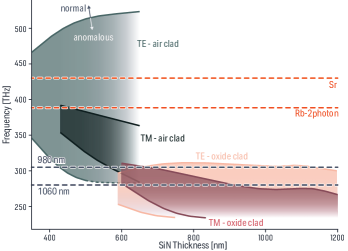
- Air-clad Si3N4 microrings exhibit anomalous dispersion down to 515 THz (583 nm), extending the accessible visible range beyond the 310 THz limit of SiO2-embedded counterparts.
- Experimentally, microcombs were generated at 1060 nm pump (283 THz) with spectral coverage extending to 680 nm (440 THz), and at 780 nm pump (384 THz) reaching 630 nm (475 THz).
- The effective nonlinear coefficient $ \gamma $ increased significantly due to higher refractive index contrast, enabling comb generation with only ~150 mW on-chip pump power.
- Simulations predict that microcombs can extend down to 461 nm (650 THz) when pumped at 517 THz (580 nm), demonstrating access to the blue region of the visible spectrum.
- Despite moderate Q-factors (~100×10³), the enhanced mode confinement enables broadband comb generation over a 125 THz bandwidth, comparable to octave-spanning combs at longer wavelengths.
- The platform supports post-processing and microheater tuning for dynamic dispersion control, enabling practical, field-deployable visible microcombs.
Read this paper
Open the full text in the Nubint reader and ask about any passage as you read.
Read this paper on NubintThis review was generated by AI from the original paper. Please check the paper before citing it.