
[Paper Review] Building and Using Personal Knowledge Graph to Improve Suicidal Ideation Detection on Social Media
This paper proposes a knowledge graph-enhanced deep learning framework that integrates personal factors—such as posts, personality traits, and life experiences—into a suicide-oriented knowledge graph to improve suicidal ideation detection on social media. By leveraging a two-layered attention mechanism on multimodal data (text, images, social graphs, and knowledge), the method achieves over 93% accuracy on microblog and Reddit datasets, with post content, stress level, and ruminant thinking emerging as top predictors.
A large number of individuals are suffering from suicidal ideation in the world. There are a number of causes behind why an individual might suffer from suicidal ideation. As the most popular platform for self-expression, emotion release, and personal interaction, individuals may exhibit a number of symptoms of suicidal ideation on social media. Nevertheless, challenges from both data and knowledge aspects remain as obstacles, constraining the social media-based detection performance. Data implicitness and sparsity make it difficult to discover the inner true intentions of individuals based on their posts. Inspired by psychological studies, we build and unify a high-level suicide-oriented knowledge graph with deep neural networks for suicidal ideation detection on social media. We further design a two-layered attention mechanism to explicitly reason and establish key risk factors to individual's suicidal ideation. The performance study on microblog and Reddit shows that: 1) with the constructed personal knowledge graph, the social media-based suicidal ideation detection can achieve over 93% accuracy; and 2) among the six categories of personal factors, post, personality, and experience are the top-3 key indicators. Under these categories, posted text, stress level, stress duration, posted image, and ruminant thinking contribute to one's suicidal ideation detection.
Motivation & Objective
- To address the challenge of detecting suicidal ideation in social media, where user expressions are often implicit and data are sparse.
- To improve detection performance by integrating psychological knowledge into a personalized, suicide-oriented knowledge graph.
- To identify the most influential personal factors—such as personality, experience, and post content—that contribute to suicidal ideation.
- To develop a multimodal, attention-based deep learning model that reasons explicitly over personal knowledge for improved interpretability and accuracy.
Proposed method
- Constructed a high-level, suicide-oriented personal knowledge graph integrating six categories of personal factors: post, personality, experience, social interaction, demographic, and mental health.
- Employed deep neural networks to extract and unify features from text, images, and social network structures into the knowledge graph.
- Designed a two-layered attention mechanism: the first layer attends to key information in user posts, and the second layer reasons over knowledge graph entities to highlight critical risk factors.
- Integrated multimodal inputs—text, images, social graph, and knowledge graph—into an end-to-end deep learning framework for joint representation learning.
- Trained the model on two real-world datasets: Sina Weibo (Chinese microblog) and Reddit, using a combination of supervised and self-supervised learning.
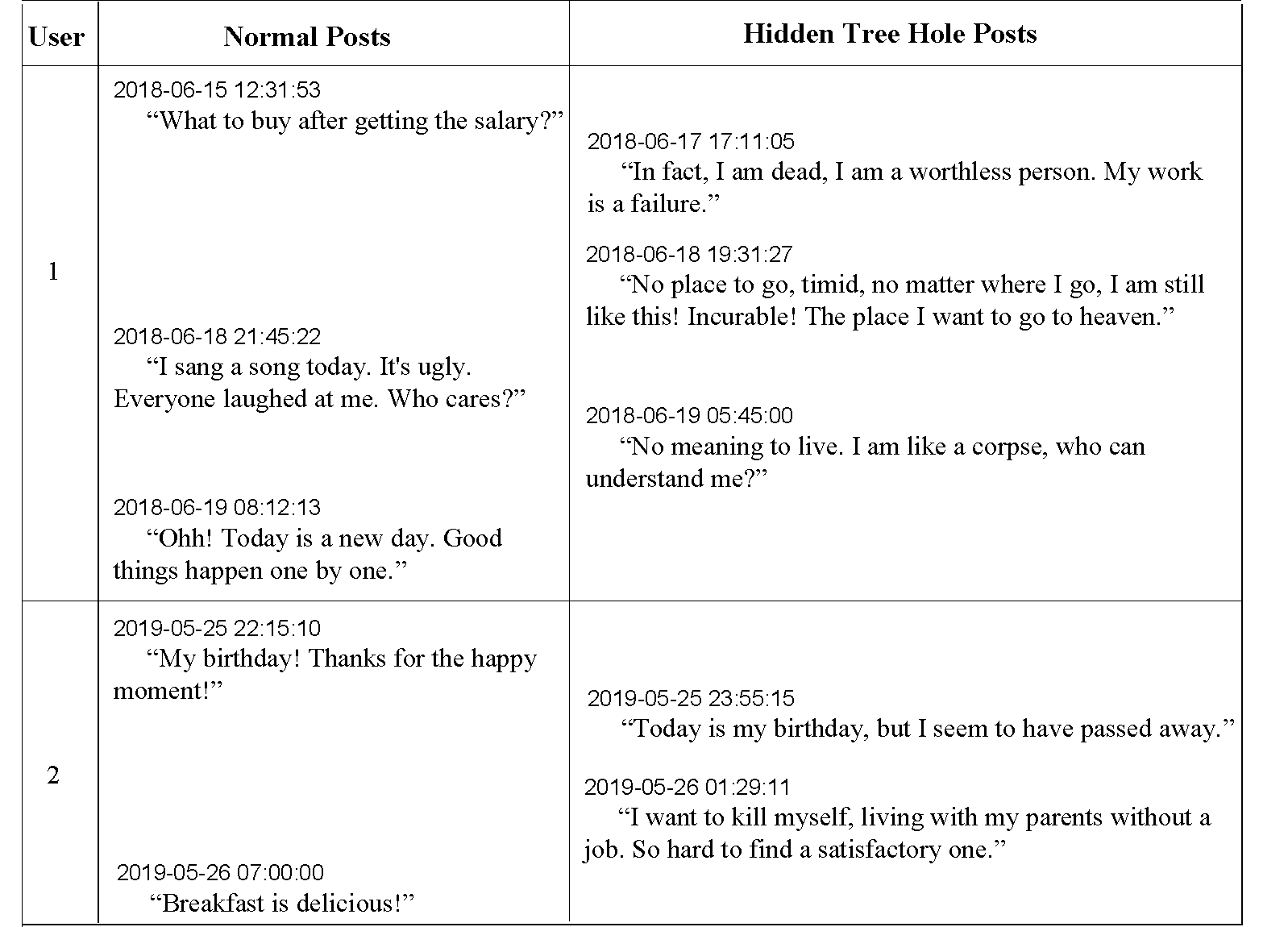
Experimental results
Research questions
- RQ1How can personal knowledge graphs be effectively constructed to represent individual-level risk factors for suicidal ideation?
- RQ2What role do different personal factors—such as post content, personality traits, and life experiences—play in predicting suicidal ideation?
- RQ3Can a two-layered attention mechanism improve the interpretability and accuracy of suicidal ideation detection by explicitly reasoning over knowledge graph entities?
- RQ4How does the integration of multimodal data (text, image, social graph, knowledge graph) affect detection performance compared to unimodal or limited multimodal baselines?
Key findings
- The proposed knowledge graph-based method achieved over 93% accuracy on both the Sina Weibo and Reddit datasets, significantly outperforming state-of-the-art approaches.
- Among the six personal factor categories, post content, personality traits, and life experiences were identified as the top three key indicators for suicidal ideation detection.
- Within the post category, the actual text of the post was the most influential factor, followed by stress level and stress duration.
- Ruminant thinking and posted images were also found to be significant contributors to detection performance.
- The model's inference time was comparable to other deep learning methods, with the knowledge graph-enhanced model requiring slightly more training time due to multimodal integration.
- Data quality significantly impacted performance: lower noise (e.g., real user identities, sufficient posting history) led to higher detection accuracy, suggesting data reliability is crucial.
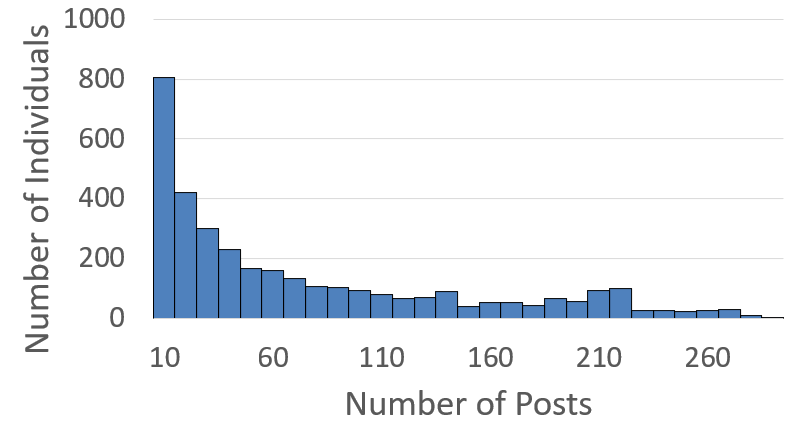
Read this paper
Open the full text in the Nubint reader and ask about any passage as you read.
Read this paper on NubintThis review was generated by AI from the original paper. Please check the paper before citing it.