
[Paper Review] Bulk-boundary and RPS Thermodynamics from Topology perspective
This paper investigates the topological thermodynamics of Reissner-Nordström AdS and charged Gauss-Bonnet AdS black holes in bulk-boundary and restricted phase space (RPS) formalisms. It demonstrates that while bulk-boundary and extended thermodynamics yield identical topological charges (Qt = -1), RPS thermodynamics exhibits a distinct topological class with a single critical point of Qt = +1, independent of higher-derivative curvature terms.
In this article, we investigate the bulk-boundary and restricted phase space (RPS) thermodynamics of Rissner-Nordström (R-N) AdS and 6-dimensional charged Gauss-Bonnet AdS black holes. Also, we examine the topological characteristics of the considered black holes and compare them with the extended thermodynamics results. In fact, we have found that the topological behavior of the bulk-boundary thermodynamics is the same as that of the extended thermodynamics, whereas the RPS thermodynamics exhibits a distinct behavior. We also demonstrate that within the RPS formalism, there is only one critical point with a topological charge of +1 $(Q_t=+1)$. Additionally, for RPS formalism, the inclusion of higher derivative curvature terms in the form of Gauss-Bonnet gravity does not alter the topological classification of critical points in charged AdS black holes.
Motivation & Objective
- To compare the topological classification of critical points in Reissner-Nordström AdS and charged Gauss-Bonnet AdS black holes across bulk-boundary, extended, and restricted phase space (RPS) thermodynamics.
- To investigate how the fixed cosmological constant in RPS formalism alters the topological structure of critical points compared to variable cosmological constant in bulk-boundary and extended thermodynamics.
- To determine whether higher-derivative curvature terms (via Gauss-Bonnet gravity) affect the topological charge classification in RPS thermodynamics.
- To validate the consistency of topological charge assignment using the residue method in vector field analysis of thermodynamic phase diagrams.
- To clarify the physical interpretation of critical points in RPS formalism, particularly regarding non-equilibrium transitions and phase behavior analogous to van der Waals systems.
Proposed method
- Employing Duan’s topological current-mapping theory to assign topological charges (Qt) to critical points in thermodynamic phase diagrams via the residue method.
- Constructing vector fields (nμ) on the r_h–θ or T–S planes to visualize critical point behavior and compute topological charges from singularities.
- Applying the restricted phase space (RPS) formalism, which fixes the cosmological constant and excludes pressure–volume conjugate pairs, retaining only central charge C and chemical potential μ.
- Comparing results from bulk-boundary thermodynamics (where bulk and boundary CFT thermodynamics are topologically equivalent) with extended phase space thermodynamics (EPS) and RPS formalism.
- Using analytical expressions for temperature T(r_h) and entropy S(r_h) in both R-N AdS and Gauss-Bonnet AdS black holes to derive spinodal curves and locate critical points.
- Evaluating the total topological charge as the sum of individual charges at critical points, with Qt = +1 for RPS and Qt = -1 for bulk-boundary/extended formalisms.
Experimental results
Research questions
- RQ1How do the topological charges of critical points in Reissner-Nordström AdS black holes compare between bulk-boundary, extended, and restricted phase space thermodynamics?
- RQ2Does the inclusion of Gauss-Bonnet curvature terms alter the topological classification of critical points in the restricted phase space formalism?
- RQ3Why does the RPS formalism yield a single critical point with Qt = +1, while bulk-boundary and extended thermodynamics yield Qt = -1?
- RQ4What is the role of the cosmological constant’s dynamical vs. fixed nature in determining the topological charge of critical points?
- RQ5How does the behavior of the T–S diagram in RPS formalism, particularly the minimum at the critical point, relate to non-equilibrium phase transitions?
Key findings
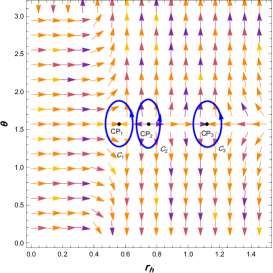
- In bulk-boundary and extended thermodynamics, the total topological charge for both Reissner-Nordström AdS and charged Gauss-Bonnet AdS black holes is Qt = -1, consistent with prior literature.
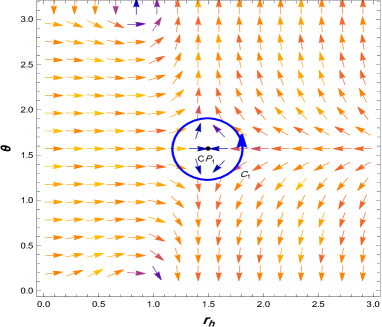
- In the restricted phase space (RPS) formalism, only one critical point exists for both black hole types, with a topological charge of Qt = +1.
- The topological classification in RPS thermodynamics is independent of higher-derivative Gauss-Bonnet terms, as the topological charge remains Qt = +1 regardless of the coupling parameter α.
- The cosmological constant’s fixed nature in RPS formalism leads to a fundamentally different topological structure compared to bulk-boundary and extended thermodynamics, where it is dynamical.
- The critical point in RPS formalism appears as a minimum in the T–S diagram, indicating a non-equilibrium phase transition, analogous to van der Waals behavior.
- The vector field analysis confirms a single isolated critical point with Qt = +1 in RPS, while bulk-boundary thermodynamics shows a maximum point with Qt = -1, indicating a first-order phase transition.
Read this paper
Open the full text in the Nubint reader and ask about any passage as you read.
Read this paper on NubintThis review was generated by AI from the original paper. Please check the paper before citing it.