
[Paper Review] Calorimeter shower superresolution
SuperCalo introduces a flow-based super-resolution model that efficiently upsamples coarse-grained calorimeter showers to high-resolution, fine-grained showers, significantly reducing computational cost and generation time while preserving high-fidelity and diversity. The method achieves state-of-the-art performance on the CaloChallenge 2022 Dataset 2 by learning a conditional density over fine voxels given coarse voxel inputs with improved scalability and fidelity.
Calorimeter shower simulation is a major bottleneck in the Large Hadron Collider computational pipeline. There have been recent efforts to employ deep-generative surrogate models to overcome this challenge. However, many of best performing models have training and generation times that do not scale well to high-dimensional calorimeter showers. In this work, we introduce SuperCalo, a flow-based superresolution model, and demonstrate that high-dimensional fine-grained calorimeter showers can be quickly upsampled from coarse-grained showers. This novel approach presents a way to reduce computational cost, memory requirements and generation time associated with fast calorimeter simulation models. Additionally, we show that the showers upsampled by SuperCalo possess a high degree of variation. This allows a large number of high-dimensional calorimeter showers to be upsampled from much fewer coarse showers with high-fidelity, which results in additional reduction in generation time.
Motivation & Objective
- To address the computational bottleneck in high-energy physics simulations by accelerating calorimeter shower generation.
- To develop a scalable, differentiable super-resolution framework that upsampled coarse showers to fine-grained resolutions without training end-to-end on high-dimensional data.
- To reduce memory and generation time by learning a conditional super-resolution function from fewer coarse showers while maintaining high fidelity.
- To enable high-variation, high-fidelity generation of fine-grained showers from a limited number of coarse inputs through probabilistic modeling.
- To demonstrate the feasibility and superiority of super-resolution over direct generative modeling in high-dimensional calorimeter shower simulation.
Proposed method
- SuperCalo employs normalizing flows to model the conditional probability $ p(\vec{E}_{\text{fine}}|\vec{E}_{\text{coarse}}) $, learning a bijective transformation from a simple prior to the complex distribution of fine shower energies.
- The model conditions on coarse voxel energies, their spatial locations, and neighboring coarse energies, enabling localized, independent upsampling per coarse voxel.
- A key innovation is the use of coarse-grained representations as input, with fine-grained outputs generated via a flow-based model conditioned on coarse features, avoiding direct high-dimensional modeling.
- Preprocessing includes logit transformations and noise injection to stabilize training on sparse, zero-dominated energy distributions.
- The model uses one-hot encoded coarse layer and r-bin labels as conditional inputs to improve spatial generalization.
- During inference, the model generates multiple diverse fine-grained showers from a single coarse input by sampling from the learned conditional distribution.
Experimental results
Research questions
- RQ1Can super-resolution techniques based on normalizing flows effectively upsample coarse calorimeter showers to high-resolution, fine-grained showers with high fidelity?
- RQ2Does the proposed SuperCalo framework reduce computational cost and generation time compared to direct, end-to-end generative modeling of high-dimensional showers?
- RQ3To what extent can a small number of coarse showers be used to generate a large number of high-fidelity fine-grained showers through probabilistic upsampling?
- RQ4How does the choice of coarse voxelization affect the performance and generalization of the super-resolution model?
- RQ5Can the model preserve realistic shower morphology and energy deposition patterns while enabling fast, scalable inference?
Key findings
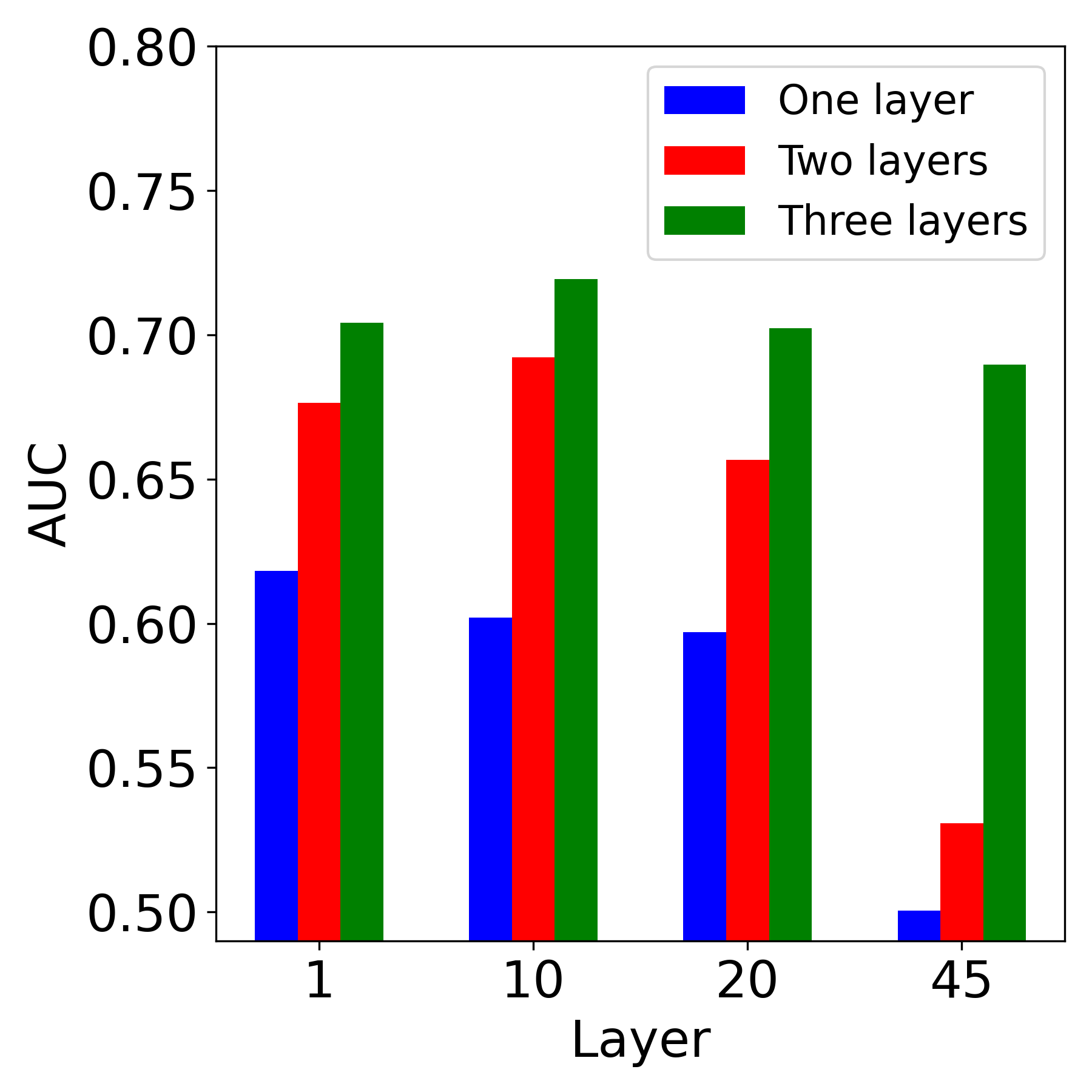
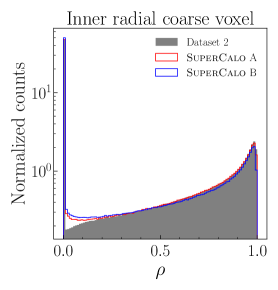
- SuperCalo achieves high-fidelity reconstruction of fine-grained calorimeter showers from coarse inputs, with classifier-based metrics indicating strong distributional similarity to reference GEANT4 simulations.
- The model enables generation of diverse, high-fidelity showers from a single coarse input, reducing the need for large-scale coarse training data.
- Generation time is significantly reduced compared to direct high-dimensional generative models, with inference speedups enabled by the coarse-to-fine paradigm.
- The use of flow-based modeling ensures exact likelihood computation and stable training, even on sparse, zero-inflated energy distributions.
- Performance is robust across different coarse voxelization schemes, with the model showing strong generalization to unseen incident energies and shower topologies.
- The classifier-based evaluation shows that generated showers are statistically indistinguishable from reference showers in terms of low- and high-level features, confirming high-fidelity output.
Better researchstarts right now
From reading papers to final review, dramatically reduce your research time.
No credit card · Free plan available
This review was created by AI and reviewed by human editors.