
[Paper Review] Ultra-High-Resolution Detector Simulation with Intra-Event Aware GAN and Self-Supervised Relational Reasoning
The paper introduces IEA-GAN, a GAN with intra-event relational reasoning and self-supervised losses to generate ultra-high-resolution detector responses, achieving state-of-the-art fidelity (FID = 1.50) on Belle II PXD data and enabling storage reductions.
Simulating high-resolution detector responses is a computationally intensive process that has long been challenging in Particle Physics. Despite the ability of generative models to streamline it, full ultra-high-granularity detector simulation still proves to be difficult as it contains correlated and fine-grained information. To overcome these limitations, we propose Intra-Event Aware Generative Adversarial Network (IEA-GAN). IEA-GAN presents a Relational Reasoning Module that approximates an event in detector simulation, generating contextualized high-resolution full detector responses with a proper relational inductive bias. IEA-GAN also introduces a Self-Supervised intra-event aware loss and Uniformity loss, significantly enhancing sample fidelity and diversity. We demonstrate IEA-GAN's application in generating sensor-dependent images for the ultra-high-granularity Pixel Vertex Detector (PXD), with more than 7.5 M information channels at the Belle II Experiment. Applications of this work span from Foundation Models for high-granularity detector simulation, such as at the HL-LHC (High Luminosity LHC), to simulation-based inference and fine-grained density estimation. To our knowledge, IEA-GAN is the first algorithm for faithful ultra-high-granularity full detector simulation with event-based reasoning.
Motivation & Objective
- Motivate fast, storage-efficient simulation of ultra-high-resolution detector responses in particle physics.
- Address challenges of fine-grained, correlated within-event detector images with high spatial resolution.
- Develop a GAN architecture that captures intra-event correlations and class-to-class relations.
- Propose new loss terms and a relational reasoning module to improve fidelity and diversity.
Proposed method
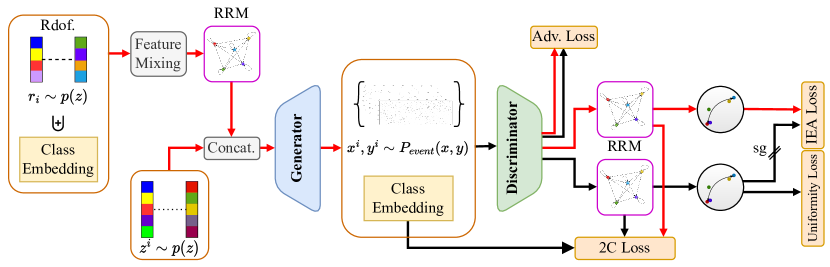
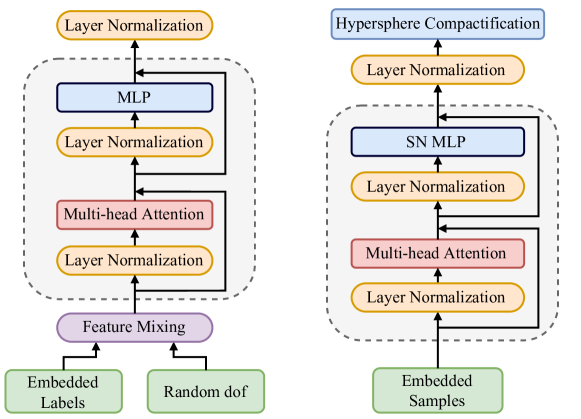
- Introduce Intra-Event Aware GAN (IEA-GAN) with a Relational Reasoning Module (RRM) that forms a context-aware event graph.
- Use a self-supervised 2C loss to model dyadic class-to-class relations and a Uniformity loss to prevent mode collapse.
- Decorate generator embeddings with random degrees of freedom (Rdof) representing event-level variability.
- Project embeddings to a unit hypersphere to stabilize training and enable relational reasoning.
- Train with a combination of adversarial, 2C, IEA, and Uniformity losses to capture intra-event correlations and context.
- Evaluate using image-level metrics (FID) and physics-level metrics (occupancy, helix parameter resolution).
Experimental results
Research questions
- RQ1How can we faithfully generate ultra-high-resolution, detector-like images that preserve intra-event correlations?
- RQ2Can relational reasoning and self-supervised losses improve fidelity and diversity beyond state-of-the-art GANs for high-dimensional detector data?
- RQ3Do the generated samples reproduce realistic occupancy, energy distributions, and track parameter resolutions comparable to Geant4?
- RQ4Is it possible to achieve substantial storage reduction by on-the-fly generation versus offline background overlays?
Key findings
- IEA-GAN achieves the lowest FID among evaluated models, with 1.50±0.16, outperforming WGAN-gp, BigGAN-deep, ContraGAN, and PE-GAN.
- IEA-GAN captures intra-event correlations and layer-dependent contextual information, improving sample diversity and realism.
- The model yields strong agreement with Geant4 in pixel-level distributions and maintains physical behavior in helix parameter resolutions.
- Uniformity loss and the Relational Reasoning Module help mitigate mode collapse and better represent bi-modal occupancy distributions.
- Application to Belle II PXD (7.5M channels) demonstrates substantial storage savings by enabling on-the-fly generation instead of storing background overlays.
- The approach offers potential applicability to HL-LHC-scale detector simulations and other fine-grained density estimation tasks.
Read this paper
Open the full text in the Nubint reader and ask about any passage as you read.
Read this paper on NubintThis review was generated by AI from the original paper. Please check the paper before citing it.