
[Paper Review] Capse.jl: efficient and auto-differentiable CMB power spectra emulation
Capse.jl is a neural network-based emulator that predicts CMB temperature, polarization, and lensing power spectra in microseconds with sub-0.1σ error across scales relevant to CMB-S4. It enables Bayesian inference up to 6 orders of magnitude faster than traditional methods by combining differentiable architecture with gradient-based samplers like NUTS and Pathfinder, achieving Planck-like cosmological constraints in under a second.
We present Capse.jl, a novel neural network-based emulator designed for rapid and accurate prediction of Cosmic Microwave Background (CMB) temperature, polarization, and lensing angular power spectra. The emulator computes predictions in just a few microseconds with emulation errors below $0.1σ$ for all the scales relevant for the upcoming CMB-S4 survey. Capse.jl can also be trained in an hour's time on a 8-cores CPU. We test Capse.jl on Planck 2018, ACT DR4, and 2018 SPT-3G data and demonstrate its capability to derive cosmological constraints comparable to those obtained by traditional methods, but with a computational efficiency that is three to six orders of magnitude higher. We take advantage of the differentiability of our emulators to use gradient-based methods, such as Pathfinder and Hamiltonian Monte Carlo (HMC), which speed up the convergence and increase sampling efficiency. Together, these features make Capse.jl a powerful tool for studying the CMB and its implications for cosmology. When using the fastest combination of our likelihoods, emulators, and analysis algorithm, we are able to perform a Plancky TT + TE + EE analysis in less than a second. To ensure full reproducibility, we provide open access to the codes and data required to reproduce all the results of this work.
Motivation & Objective
- Address the high computational cost of CMB likelihood evaluations in Bayesian cosmological inference using traditional Boltzmann solvers like CAMB.
- Develop a highly efficient, accurate, and differentiable emulator for CMB angular power spectra across temperature, polarization, and lensing.
- Enable rapid sampling and optimization using gradient-based inference methods such as Hamiltonian Monte Carlo and Pathfinder.
- Achieve computational speedups of 3–6 orders of magnitude compared to standard MCMC pipelines using CAMB and Cobaya.
- Ensure full reproducibility and open access to code and training data for community adoption and validation.
Proposed method
- Train a deep neural network to emulate CMB angular power spectra (TT, TE, EE, BB, and lensing) across a broad cosmological parameter space.
- Leverage automatic differentiation in Julia to make the emulator fully differentiable, enabling gradient-based inference algorithms.
- Apply Chebyshev polynomial decomposition to reduce output dimensionality and accelerate likelihood evaluation, improving computational efficiency.
- Use a multi-scale training strategy with synthetic parameter combinations to ensure accuracy across the full range of multipoles relevant to CMB-S4.
- Integrate the emulator into a full Bayesian inference pipeline using the Cobaya framework, replacing CAMB in likelihood evaluations.
- Benchmark performance using gradient-based samplers: NUTS, MicroCanonical HMC, and Pathfinder, comparing convergence and sampling efficiency.
Experimental results
Research questions
- RQ1Can a differentiable neural network emulator achieve sub-0.1σ accuracy in predicting CMB power spectra across all relevant scales for upcoming surveys?
- RQ2To what extent can gradient-based samplers like NUTS and Pathfinder accelerate cosmological inference when used with a differentiable emulator?
- RQ3How does the computational performance of Capse.jl compare to traditional CAMB-based pipelines in terms of wall-clock time for Planck, ACT DR4, and SPT-3G datasets?
- RQ4Can Chebyshev polynomial decomposition significantly enhance the efficiency of likelihood evaluation without sacrificing accuracy?
- RQ5Is the emulator robust and accurate enough to reproduce cosmological constraints comparable to those from CAMB and Cobaya on real data?
Key findings
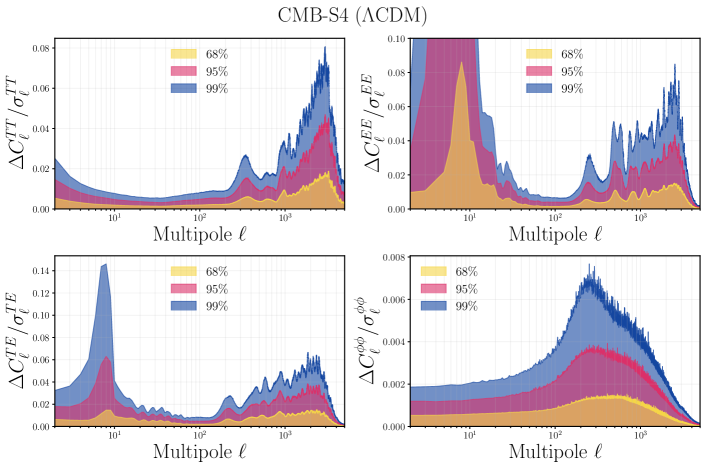
- Capse.jl computes CMB power spectra in under 10 microseconds per call, with emulation errors below 0.1σ across all scales relevant to CMB-S4.
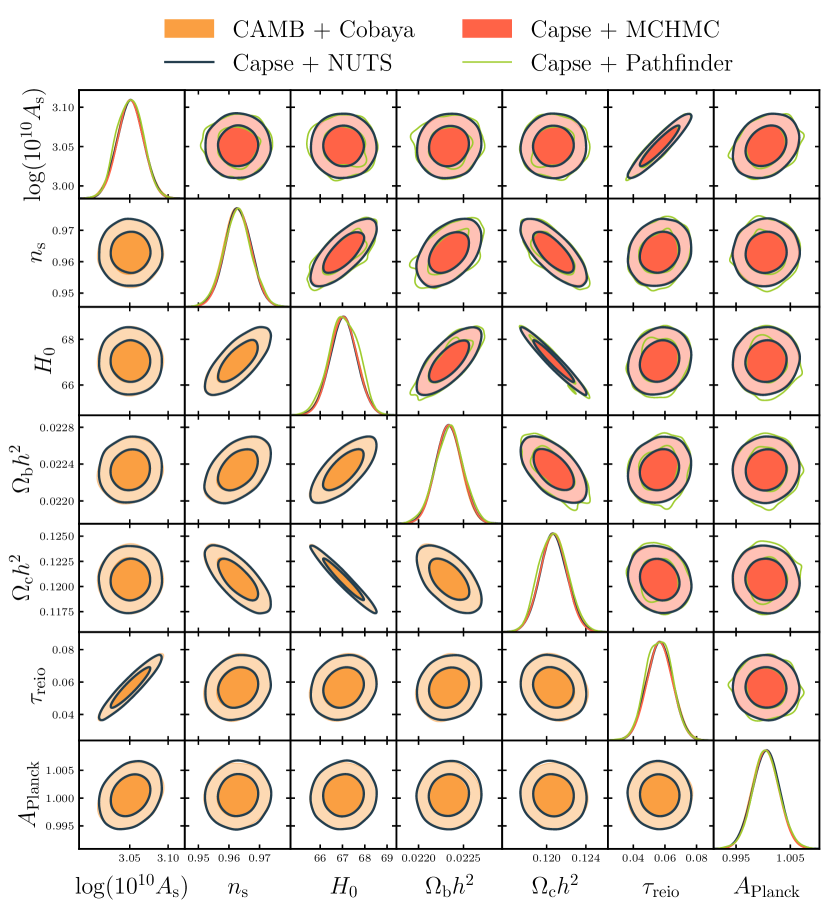
- The emulator achieves full cosmological constraints comparable to CAMB-based pipelines on Planck 2018, ACT DR4, and SPT-3G 2018 data, with posteriors differing by less than 0.1σ.
- A Planck TT+TE+EE analysis using Capse.jl, the fastest likelihood combination, and NUTS sampling completes in less than one second, compared to ~100 CPU hours with CAMB and Cobaya.
- The use of gradient-based samplers like NUTS and Pathfinder reduces analysis time by 2–6 orders of magnitude: 0.5 CPU hours for Planck, 1 hour for ACT, and 14 hours for SPT-3G.
- MicroCanonical HMC outperforms standard NUTS by a factor of 2–3 in efficiency while producing nearly identical posteriors.
- Chebyshev polynomial decomposition improves Planck analysis efficiency by nearly an order of magnitude and enables scalable, high-precision emulation with potential extension to galaxy clustering analyses.
Better researchstarts right now
From reading papers to final review, dramatically reduce your research time.
No credit card · Free plan available
This review was created by AI and reviewed by human editors.