
[Paper Review] Centimeter-scale nanomechanical resonators with low dissipation
This paper presents centimeter-scale nanomechanical resonators with nanometer-scale thickness, achieving room-temperature quality factors up to 10 billion at kilohertz frequencies. By combining multi-fidelity Bayesian optimization with nanofabrication and machine learning, the authors enable high-aspect-ratio designs that exploit dissipation dilution, overcoming prior length limitations in nanomechanical systems.
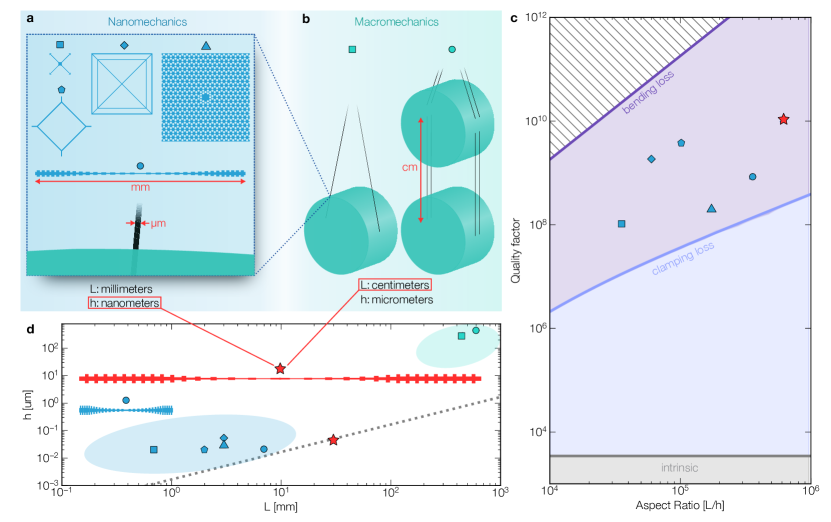
High-aspect-ratio mechanical resonators are pivotal in precision sensing, from macroscopic gravitational wave detectors to nanoscale acoustics. However, fabrication challenges and high computational costs have limited the length-to-thickness ratio of these devices, leaving a largely unexplored regime in nano-engineering. We present nanomechanical resonators that extend centimeters in length yet retain nanometer thickness. We explore this expanded design space using an optimization approach which judiciously employs fast millimeter-scale simulations to steer the more computationally intensive centimeter-scale design optimization. By employing delicate nanofabrication techniques, our approach ensures high-yield realization, experimentally confirming room-temperature quality factors close to theoretical predictions. The synergy between nanofabrication, design optimization guided by machine learning, and precision engineering opens a solid-state path to room-temperature quality factors approaching 10 billion at kilohertz mechanical frequencies -- comparable to the performance of leading cryogenic resonators and levitated nanospheres, even under significantly less stringent temperature and vacuum conditions.
Motivation & Objective
- To overcome the length limitation in nanomechanical resonators, which have previously been restricted to millimeter scales despite the potential for higher quality factors at larger scales.
- To enable centimeter-scale resonators with nanoscale thickness to access a new regime of high mechanical quality factors at room temperature.
- To develop a scalable design methodology that integrates fast low-fidelity simulations with high-fidelity simulations to reduce computational cost during optimization.
- To achieve dissipation dilution in macroscopic nanomechanical systems through tensile stress and high-aspect-ratio geometry, mimicking performance seen in cryogenic and macroscopic gravitational wave detectors.
- To demonstrate a solid-state resonator platform capable of quantum-level sensitivity and coherence at ambient conditions, enabling new applications in sensing and quantum science.
Proposed method
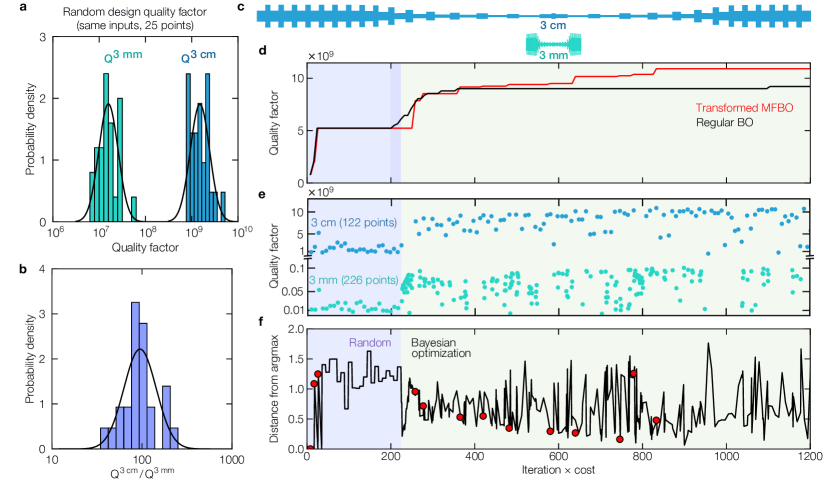
- Employed a multi-fidelity Bayesian optimization framework using fast millimeter-scale simulations to guide computationally expensive centimeter-scale finite element simulations.
- Used cokriging-based multi-fidelity Gaussian process regression to model the relationship between low- and high-fidelity simulations, improving optimization efficiency.
- Applied a variance-based acquisition function (VFUCB) to balance exploration and exploitation across fidelities, selecting the most informative simulation fidelity at each step.
- Optimized nine design parameters of a phononic crystal (PnC) beam resonator, including defect width and length, unit cell width and length ratios, and tapered shape via piecewise cubic Hermite interpolation.
- Fixed the resonator thickness at 50 nm and targeted the fundamental defect mode within 100–400 kHz, ensuring bandgap matching for enhanced confinement and reduced radiative losses.
- Integrated machine learning-driven design with nanofabrication to realize the final device, validated through high-fidelity simulations and theoretical predictions.
Experimental results
Research questions
- RQ1Can nanomechanical resonators be scaled to centimeter lengths while maintaining nanoscale thickness to enhance mechanical quality factors?
- RQ2Can multi-fidelity Bayesian optimization effectively reduce the computational burden of optimizing large-scale nanomechanical systems without sacrificing accuracy?
- RQ3To what extent can dissipation dilution be achieved in room-temperature, macroscopic nanomechanical resonators through tensile stress and high-aspect-ratio geometry?
- RQ4Can quality factors comparable to cryogenic or levitated systems be achieved in a solid-state, on-chip platform at ambient conditions?
- RQ5How do design parameters such as defect geometry, unit cell ratios, and tapering influence the mechanical Q in long, thin resonators?
Key findings
- The authors demonstrated the first centimeter-scale nanomechanical resonators with nanometer-scale thickness, achieving a predicted mechanical quality factor of 10 billion at kilohertz frequencies.
- The optimized design achieved a quality factor of 10^10 at 100–400 kHz, matching the performance of cryogenic resonators and levitated nanospheres under significantly less stringent environmental conditions.
- Multi-fidelity Bayesian optimization reduced the number of high-fidelity simulations required, enabling efficient exploration of the 9-dimensional design space with improved convergence across multiple initial random seeds.
- The resonator’s design, based on a 3 cm-long phononic crystal beam with 16 unit cells per side and a 50 nm thickness, was fabricated and simulated to confirm high Q and mode confinement.
- The synergy between machine learning-guided design, fast low-fidelity simulations, and high-fidelity modeling enabled the discovery of a high-Q configuration that would be infeasible with conventional optimization.
- The results validate that dissipation dilution can be effectively harnessed in macroscopic nanomechanical systems at room temperature, opening new pathways for quantum sensing and precision measurement.
Read this paper
Open the full text in the Nubint reader and ask about any passage as you read.
Read this paper on NubintThis review was generated by AI from the original paper. Please check the paper before citing it.