
[Paper Review] ChatAgri: Exploring Potentials of ChatGPT on Cross-linguistic Agricultural Text Classification
ChatAgri demonstrates that ChatGPT can perform agricultural text classification with competitive accuracy to PLM fine-tuning, offering strong cross-linguistic transfer and zero-shot capability without domain-specific fine-tuning.
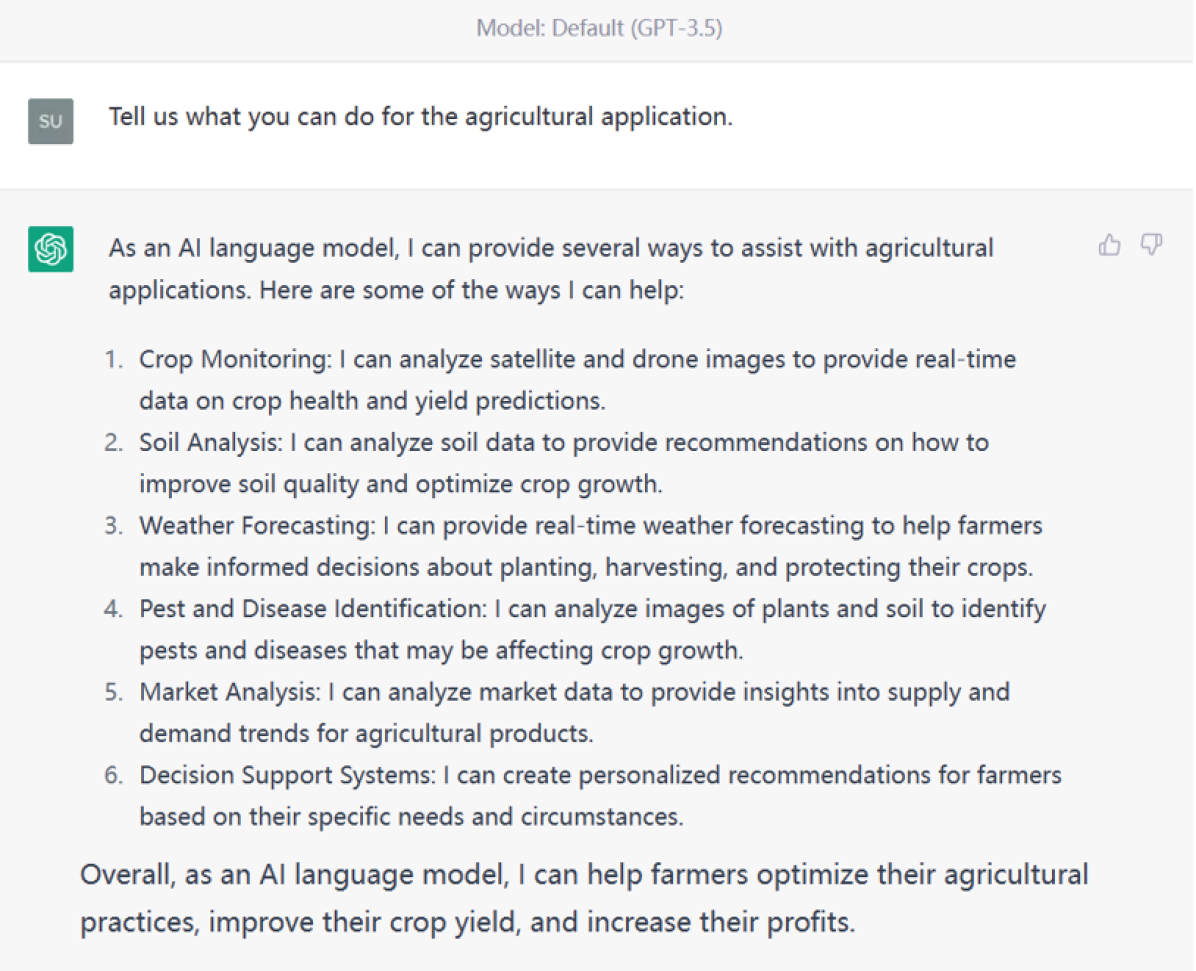
In the era of sustainable smart agriculture, a massive amount of agricultural news text is being posted on the Internet, in which massive agricultural knowledge has been accumulated. In this context, it is urgent to explore effective text classification techniques for users to access the required agricultural knowledge with high efficiency. Mainstream deep learning approaches employing fine-tuning strategies on pre-trained language models (PLMs), have demonstrated remarkable performance gains over the past few years. Nonetheless, these methods still face many drawbacks that are complex to solve, including: 1. Limited agricultural training data due to the expensive-cost and labour-intensive annotation; 2. Poor domain transferability, especially of cross-linguistic ability; 3. Complex and expensive large models deployment.Inspired by the extraordinary success brought by the recent ChatGPT (e.g. GPT-3.5, GPT-4), in this work, we systematically investigate and explore the capability and utilization of ChatGPT applying to the agricultural informatization field. ....(shown in article).... Code has been released on Github https://github.com/albert-jin/agricultural_textual_classification_ChatGPT.
Motivation & Objective
- Motivate the use of large language models for agricultural text classification amid data and annotation bottlenecks.
- Evaluate ChatGPT (GPT-3.5) and GPT-4 against PLM-based fine-tuning and prompt-tuning baselines.
- Investigate prompt construction, answer alignment, and ChatGPT variants to maximize classification performance.
- Assess cross-linguistic transferability across multilingual agricultural datasets.
- Promote accessible, low-resource deployment of AI for agricultural information processing.
Proposed method
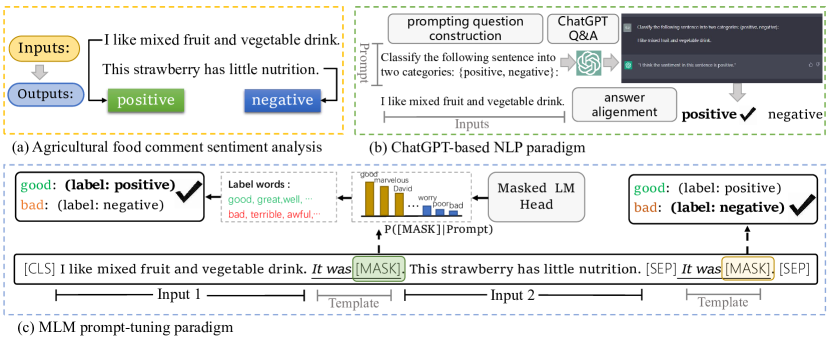
- Design and test multiple task-specific prompting strategies (manual prompts, ChatGPT-triggered prompts, zero-shot similarity prompts, and Chain-of-Thought prompts).
- Define answer alignment strategies to map ChatGPT outputs to predefined categories.
- Compare ChatGPT-based classification with PLM-based fine-tuning and prompt-tuning baselines through systematic experiments.
- Conduct zero-shot and multilingual experiments to assess transferability without domain-specific fine-tuning.
- Release ChatAgri code to enable reproducibility and further research.
Experimental results
Research questions
- RQ1Can ChatGPT achieve competitive agricultural text classification performance without fine-tuning on agricultural data?
- RQ2How do prompt construction and answer alignment impact ChatGPT-based classification accuracy?
- RQ3Does ChatAgri exhibit cross-linguistic transferability across multilingual agricultural corpora?
- RQ4What are the hardware and interface requirements for deploying ChatAgri in practical settings?
Key findings
- ChatGPT-based ChatAgri achieves competitive performance compared with PLM-based fine-tuning methods.
- Zero-shot learning experiments demonstrate ChatAgri’s potential without annotated agricultural data.
- Multi-linguistic experiments show excellent cross-linguistic transferability across agricultural topics.
- ChatAgri relies on network interface with minimal hardware, avoiding large-scale model deployment.
- The authors released ChatAgri code on GitHub to support reproducibility and further research.
Read this paper
Open the full text in the Nubint reader and ask about any passage as you read.
Read this paper on NubintThis review was generated by AI from the original paper. Please check the paper before citing it.