
[Paper Review] ChatGPT Asks, BLIP-2 Answers: Automatic Questioning Towards Enriched Visual Descriptions
The paper presents ChatCaptioner, an automatic questioning system where ChatGPT asks BLIP-2 questions to enrich image captions, yielding more informative descriptions and more objects detected than BLIP-2 alone, validated by human evaluations.
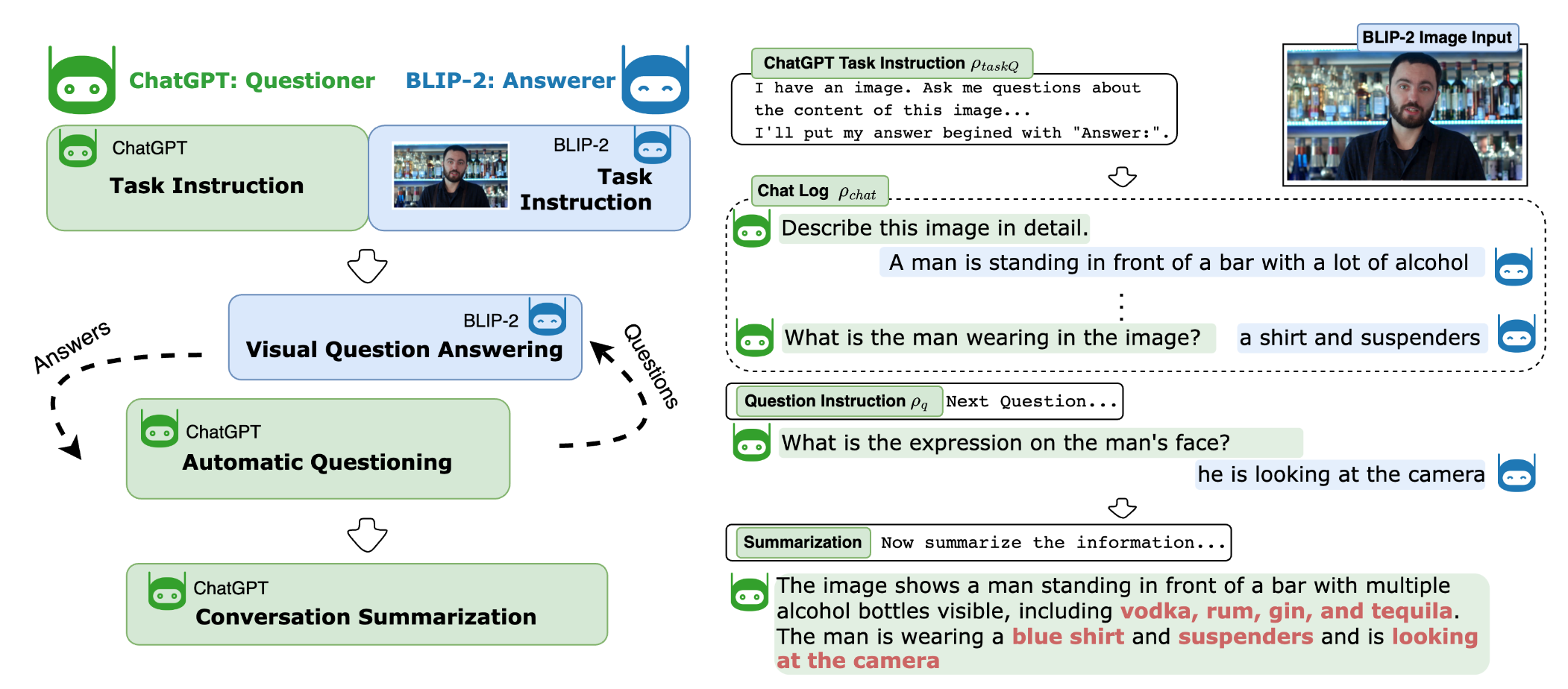
Asking insightful questions is crucial for acquiring knowledge and expanding our understanding of the world. However, the importance of questioning has been largely overlooked in AI research, where models have been primarily developed to answer questions. With the recent advancements of large language models (LLMs) like ChatGPT, we discover their capability to ask high-quality questions when provided with a suitable prompt. This discovery presents a new opportunity to develop an automatic questioning system. In this paper, we introduce ChatCaptioner, a novel automatic-questioning method deployed in image captioning. Here, ChatGPT is prompted to ask a series of informative questions about images to BLIP-2, a strong vision question-answering model. By keeping acquiring new visual information from BLIP-2's answers, ChatCaptioner is able to generate more enriched image descriptions. We conduct human-subject evaluations on common image caption datasets such as COCO, Conceptual Caption, and WikiArt, and compare ChatCaptioner with BLIP-2 as well as ground truth. Our results demonstrate that ChatCaptioner's captions are significantly more informative, receiving three times as many votes from human evaluators for providing the most image information. Besides, ChatCaptioner identifies 53% more objects within the image than BLIP-2 alone measured by WordNet synset matching. Code is available at https://github.com/Vision-CAIR/ChatCaptioner
Motivation & Objective
- Demonstrate that automatic, instruction-following LLMs can generate informative questions to improve image captions.
- Integrate an automatic questioning loop between ChatGPT and BLIP-2 to extract more image details.
- Assess whether the enriched captions are more informative and cover more objects than baseline captioning models.
- Evaluate the quality of questions and the correctness of captions via human studies across multiple datasets.
Proposed method
- Prompt ChatGPT to generate one informative question at a time about the image, building on prior Q&A (three-part prompt: task instruction, chat log, and per-question instruction).
- Use BLIP-2 as the visual question-answering respondent, with an uncertainty prompt to avoid fabricating answers.
- Discard any fabricated answers that follow an answering pattern to keep the dialogue consistent.
- Summarize the conversation with ChatGPT to produce the final enriched image caption.
- Compare captions via human evaluation against BLIP-2 and ground-truth captions, and analyze object coverage using WordNet synset matching.

Experimental results
Research questions
- RQ1Can ChatGPT generate diverse, informative questions that extract more visual information from BLIP-2 than static captioning?
- RQ2Do ChatCaptioner captions provide richer image descriptions and identify more objects than BLIP-2 alone?
- RQ3What is the impact of an uncertainty prompt on BLIP-2’s answer quality and overall caption accuracy?
- RQ4How diverse are the questions produced by the automatic questioning mechanism across images and datasets?
- RQ5How do human evaluators rate the informativeness and correctness of ChatCaptioner captions compared to baselines?
Key findings
- ChatCaptioner’s captions are significantly more informative, receiving three times as many human votes for providing the most image information.
- ChatCaptioner identifies 53% more objects within images than BLIP-2 alone as measured by WordNet synset matching.
- Uncertainty prompts reduce BLIP-2’s incorrect answers by addressing uncertainty in unanswerable or vague questions.
- The automatic questions are diverse, covering high-level, object-level, numerical, and contextual aspects of images.
- ChatGPT and InstructGPT demonstrate strong, non-repeating question generation, while smaller models show repetition or poor questioning ability.
Read this paper
Open the full text in the Nubint reader and ask about any passage as you read.
Read this paper on NubintThis review was generated by AI from the original paper. Please check the paper before citing it.