
[Paper Review] Chebyshev Polynomial-Based Kolmogorov-Arnold Networks: An Efficient Architecture for Nonlinear Function Approximation
The paper introduces Chebyshev KAN, a network layer that uses Chebyshev polynomials to approximate multivariate functions guided by the Kolmogorov-Arnold representation theorem, and demonstrates its effectiveness on MNIST-like tasks and a fractal-like 2D function.
Accurate approximation of complex nonlinear functions is a fundamental challenge across many scientific and engineering domains. Traditional neural network architectures, such as Multi-Layer Perceptrons (MLPs), often struggle to efficiently capture intricate patterns and irregularities present in high-dimensional functions. This paper presents the Chebyshev Kolmogorov-Arnold Network (Chebyshev KAN), a new neural network architecture inspired by the Kolmogorov-Arnold representation theorem, incorporating the powerful approximation capabilities of Chebyshev polynomials. By utilizing learnable functions parametrized by Chebyshev polynomials on the network's edges, Chebyshev KANs enhance flexibility, efficiency, and interpretability in function approximation tasks. We demonstrate the efficacy of Chebyshev KANs through experiments on digit classification, synthetic function approximation, and fractal function generation, highlighting their superiority over traditional MLPs in terms of parameter efficiency and interpretability. Our comprehensive evaluation, including ablation studies, confirms the potential of Chebyshev KANs to address longstanding challenges in nonlinear function approximation, paving the way for further advancements in various scientific and engineering applications.
Motivation & Objective
- Motivate the need for improved nonlinear function approximation in high-dimensional settings.
- Propose a Chebyshev KAN layer that implements a Chebyshev-based Kolmogorov-Arnold representation.
- Demonstrate the method on image-like data (MNIST) and a fractal-like 2D function to assess approximation capability.
- Explore ablation studies on polynomial degree and input normalization to understand their impact on performance.
- Outline future directions and potential integrations with broader neural network architectures.
Proposed method
- Represent multivariate functions as a superposition of univariate Chebyshev interpolants per the Kolmogorov-Arnold framework.
- Normalize inputs to the [-1,1] interval using tanh activation before Chebyshev evaluation.
- Compute Chebyshev polynomials up to degree n via the recurrence T_n(x)=2xT_{n-1}(x)-T_{n-2}(x) and assemble outputs through a learnable coefficient tensor Θ.
- Form the output Y as a weighted sum of Chebyshev polynomials across input dimensions and polynomial orders: Y= sum_{k=0}^{n} sum_{j=1}^{d_in} T_{j,k} ⊙ Θ_{j,:,k}.
- Train Θ by backpropagation to minimize a chosen loss function (e.g., MSE for regression, cross-entropy for classification).
- Optionally integrate the Chebyshev KAN layer into larger architectures (CNNs, RNNs) to enhance function approximation.
Experimental results
Research questions
- RQ1Can Chebyshev-based KAN layers approximate high-dimensional continuous functions effectively compared to traditional MLPs?
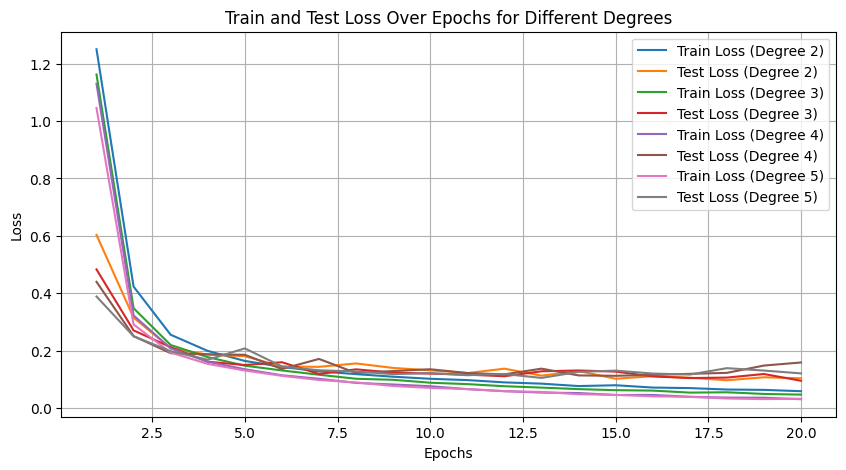
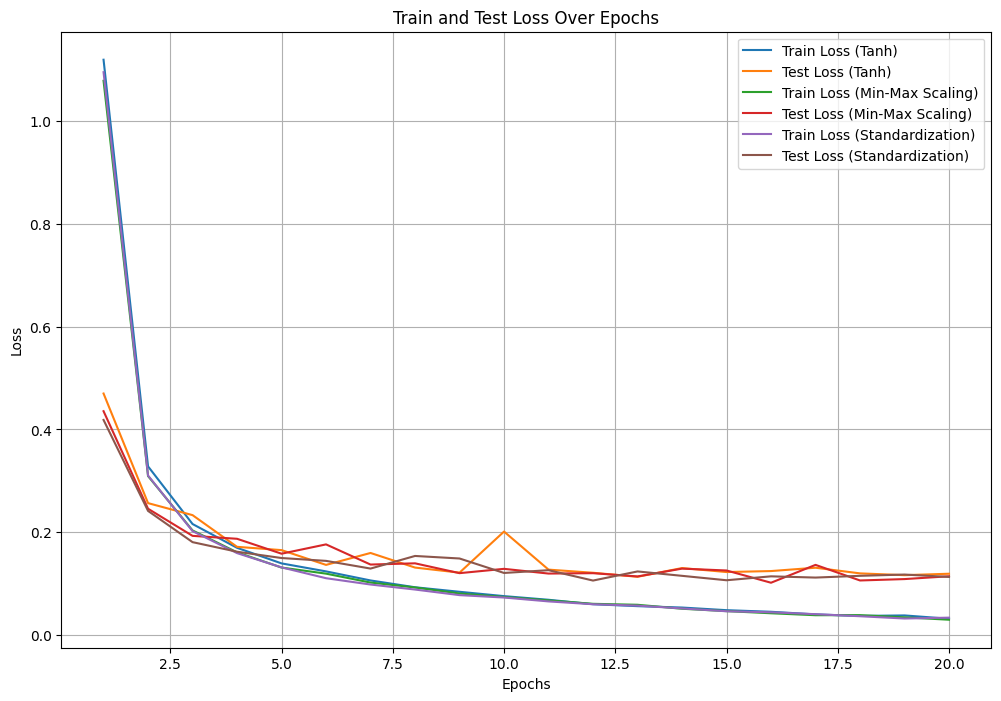
- RQ2What is the impact of polynomial degree and input normalization on approximation accuracy and model complexity?
- RQ3How does Chebyshev KAN perform on image-like data (e.g., MNIST) and on complex nonlinear 2D/fractal-like functions?
Key findings
- On MNIST-like classification, degree-3 Chebyshev polynomials yielded the best accuracy among tested degrees (0.9718) with a moderate parameter count (103,136).
- Degree 4 led to a notable drop in accuracy (0.9553) despite higher parameter count (128,896).
- Degree 5 achieved 0.9646 accuracy, indicating diminishing returns beyond degree 3 for MNIST.
- Standardization as input normalization slightly outperformed tanh and min-max in MNIST experiments (0.9692 vs 0.9680–0.9683).
- The fractal-like 2D function experiment shows the Chebyshev KAN can capture intricate patterns with a 3-layer setup mapping 2D inputs to 8 features, then 16 features, then 1 output, across degrees 8 and 4 in respective layers.
Read this paper
Open the full text in the Nubint reader and ask about any passage as you read.
Read this paper on NubintThis review was generated by AI from the original paper. Please check the paper before citing it.