
[Paper Review] ChipNeMo: Domain-Adapted LLMs for Chip Design
ChipNeMo demonstrates domain-adapted LLMs for chip design by combining domain-adaptive pretraining, custom tokenizers, domain-specific supervised fine-tuning, and retrieval-augmented generation to outperform vanilla LLMs on engineering chatbot, EDA script generation, and bug summarization tasks, enabling up to 5x parameter reductions for similar performance.
ChipNeMo aims to explore the applications of large language models (LLMs) for industrial chip design. Instead of directly deploying off-the-shelf commercial or open-source LLMs, we instead adopt the following domain adaptation techniques: domain-adaptive tokenization, domain-adaptive continued pretraining, model alignment with domain-specific instructions, and domain-adapted retrieval models. We evaluate these methods on three selected LLM applications for chip design: an engineering assistant chatbot, EDA script generation, and bug summarization and analysis. Our evaluations demonstrate that domain-adaptive pretraining of language models, can lead to superior performance in domain related downstream tasks compared to their base LLaMA2 counterparts, without degradations in generic capabilities. In particular, our largest model, ChipNeMo-70B, outperforms the highly capable GPT-4 on two of our use cases, namely engineering assistant chatbot and EDA scripts generation, while exhibiting competitive performance on bug summarization and analysis. These results underscore the potential of domain-specific customization for enhancing the effectiveness of large language models in specialized applications.
Motivation & Objective
- Demonstrate the effectiveness of domain-adapted LLMs for industrial chip design tasks.
- Showcase techniques: domain-adaptive pretraining, domain-specific tokenizers, supervised fine-tuning, and retrieval-augmented generation.
- Evaluate on three use-cases: engineering assistant chatbot, EDA script generation, and bug summarization/analysis.
- Assess how domain adaptation affects model size, cost, and performance relative to base LLaMA2 models.
Proposed method
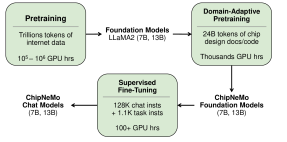
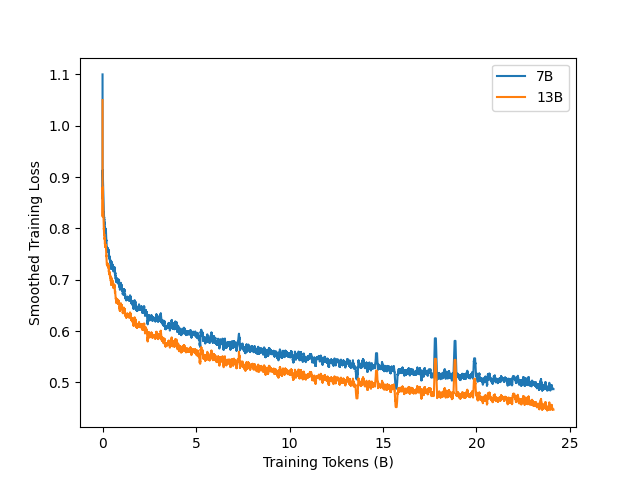
- Construct a ChipNeMo foundation model by applying domain-adaptive pretraining (DAPT) to LLaMA2 7B/13B using domain-specific data (internal chip design texts and public sources).
- Adapt the tokenizer with domain-specific tokens to improve tokenization efficiency (approx. 9K new tokens added).
- Apply supervised fine-tuning (SFT) with a combination of general chat data (128k samples) and domain-specific instruction data (≈1.1k samples).
- Retrain a domain-adapted retrieval model and integrate retrieval-augmented generation (RAG) to ground responses in in-domain passages.
- Evaluate using AutoEval-style domain benchmarks, human ratings, and code-generation metrics across three applications.
- Compare ChipNeMo against vanilla LLMs (e.g., LLaMA2-13B-Chat*, LLaMA2-70B-Chat) and analyze scaling, tokenization, and retrieval effects.
Experimental results
Research questions
- RQ1How do domain-adapted LLMs perform on chip-design tasks compared with general-purpose LLMs?
- RQ2What is the impact of domain-adaptive pretraining, domain-specific tokenizers, and domain-aligned SFT on task performance?
- RQ3Can retrieval-augmented generation improve the accuracy and grounding of domain-specific responses in chip design scenarios?
- RQ4What are the trade-offs in model size, training cost, and inference efficiency when applying ChipNeMo techniques?
- RQ5How do the three evaluated applications (engineering assistant chatbot, EDA script generation, bug summarization/analysis) fare under domain adaptation?
Key findings
- Domain-adapted ChipNeMo models outperform vanilla LLMs on multiple domain benchmarks and human evaluations across all three tasks.
- Engineering assistant chatbot scores 7.4/10 on expert evaluation; EDA script generation exceeds 50% correctness; bug summarization/assignment tasks rated 4–5/7 by experts.
- Domain adaptation closes the gap between a state-of-the-art 70B model and a 13B model, enabling up to 5x parameter reduction with similar or better performance for context-heavy tasks.
- Customized domain tokenizers reduce DAPT token count by up to 3.3% without harming effectiveness on applications.
- Domain-adapted retrieval models improve retriever hit rate by 30% over a pre-trained retriever, boosting RAG performance.
- Retrieval augmentation with domain data significantly boosts human-evaluated scores for RAG-enabled models.
Read this paper
Open the full text in the Nubint reader and ask about any passage as you read.
Read this paper on NubintThis review was generated by AI from the original paper. Please check the paper before citing it.