
[Paper Review] Leak, Cheat, Repeat: Data Contamination and Evaluation Malpractices in Closed-Source LLMs
This paper systematically analyzes data contamination and evaluation malpractice in OpenAI GPT-3.5 and GPT-4 by reviewing 255 papers, finding ~42% leakage totaling ~4.7 million samples across 263 benchmarks, and highlighting reproducibility and fairness issues.
Natural Language Processing (NLP) research is increasingly focusing on the use of Large Language Models (LLMs), with some of the most popular ones being either fully or partially closed-source. The lack of access to model details, especially regarding training data, has repeatedly raised concerns about data contamination among researchers. Several attempts have been made to address this issue, but they are limited to anecdotal evidence and trial and error. Additionally, they overlook the problem of \emph{indirect} data leaking, where models are iteratively improved by using data coming from users. In this work, we conduct the first systematic analysis of work using OpenAI's GPT-3.5 and GPT-4, the most prominently used LLMs today, in the context of data contamination. By analysing 255 papers and considering OpenAI's data usage policy, we extensively document the amount of data leaked to these models during the first year after the model's release. We report that these models have been globally exposed to $\sim$4.7M samples from 263 benchmarks. At the same time, we document a number of evaluation malpractices emerging in the reviewed papers, such as unfair or missing baseline comparisons and reproducibility issues. We release our results as a collaborative project on https://leak-llm.github.io/, where other researchers can contribute to our efforts.
Motivation & Objective
- Quantify indirect data contamination (data leakage) to GPT-3.5 and GPT-4 via published research.
- Assess how leaked data could be used for further training and the resulting impact on fair comparison and evaluation.
- Identify prevalent evaluation malpractices and reproducibility barriers in studies using closed-source LLMs.
- Propose best practices to improve evaluation rigor for closed-source LLMs.
Proposed method
- Perform a systematic literature review of 255 papers evaluating GPT-3.5 and GPT-4.
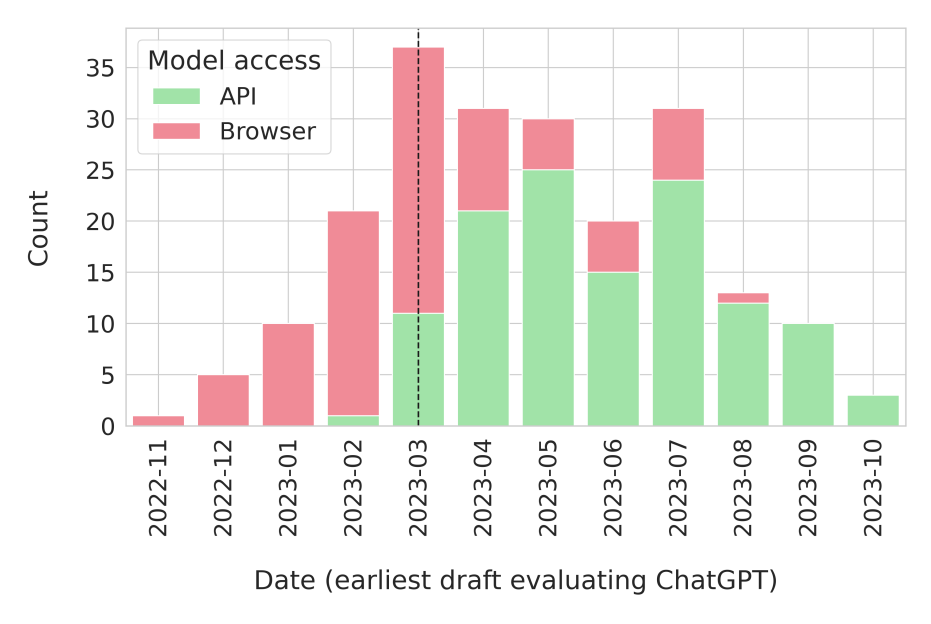
- Identify which papers used web interface vs API access and map potential data leakage to OpenAI’s data usage policy.
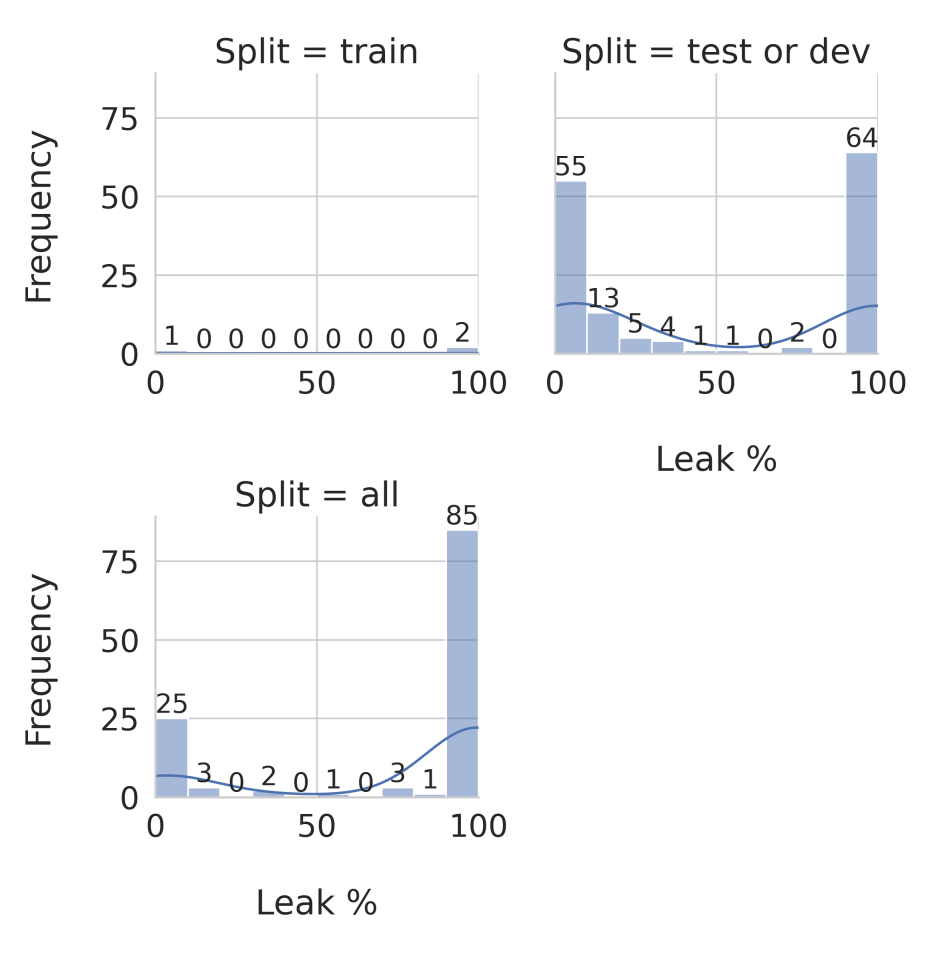
- Estimate leaked data by dataset and split when reported, otherwise assume full dataset usage.
- Assess prompts availability, code repositories, dataset splits, and model version reporting for reproducibility.
- Analyze evaluation fairness by comparing to baselines and ensuring comparable data usage across models.
Experimental results
Research questions
- RQ1Which datasets were demonstrably leaked to GPT-3.5 and GPT-4 in the last year?
- RQ2Do papers evaluating these models include fair comparisons with existing baselines?
- RQ3What are the prevalent practices that impair reproducibility and fairness in closed-source LLM evaluations?
- RQ4What guidelines can mitigate data contamination and evaluation malpractices for closed-source LLMs?
Key findings
- ~42% of the reviewed papers leaked data to GPT-3.5 or GPT-4, totaling ~4.7 million samples across 263 benchmarks.
- 90 papers (~42%) accessed ChatGPT via the web interface, exposing data OpenAI could use for training.
- Datasets leaked were spread across tasks, with high leak counts in natural language inference, question answering, and natural language generation.
- Only ~91% reported prompts used; ~53% provided a code repository; only 40%/23% provided model version details for peer‑reviewed/preprint papers respectively.
- Many studies performed unfair or incomplete comparisons, often evaluating ChatGPT on fewer samples than open models and on different data sizes.
- A collaborative public resource (leak-llm.github.io) was released to document leaks and encourage community contributions.
Read this paper
Open the full text in the Nubint reader and ask about any passage as you read.
Read this paper on NubintThis review was generated by AI from the original paper. Please check the paper before citing it.