
[Paper Review] Chiral Edge States Emerging on Anyon-Net
This paper proposes a symmetry-based lattice model for chiral topological phases using 2+1D anyon chains with exact modular tensor category (MTC) symmetry, enabling the realization of non-Abelian anyons like Fibonacci and Ising anyons. Numerical simulations via matrix product state-based DMRG reveal chiral edge modes with central charge scaling and entanglement spectra matching chiral conformal field theories, confirming topological order in the bulk.
We propose a symmetry-based approach to constructing lattice models for chiral topological phases, focusing on non-Abelian anyons. Using a 2+1D version of anyon chains and modular tensor categories(MTCs), we ensure exact MTC symmetry at the microscopic level. Numerical simulations using tensor networks demonstrate chiral edge modes for topological phases with Ising and Fibonacci anyons. Our method contrasts with conventional solvability approaches, providing a new theoretical avenue to explore strongly coupled 2+1D systems, revealing chiral edge states in non-Abelian anyonic systems.
Motivation & Objective
- To construct a lattice model for chiral topological phases with non-Abelian anyons using exact microscopic symmetry.
- To overcome the limitations of commuting projector Hamiltonians in realizing chiral phases on finite-dimensional lattices.
- To provide a general framework applicable to any modular tensor category (MTC) without relying on solvability.
- To numerically verify the emergence of chiral edge modes in strongly correlated anyonic systems.
- To explore the interplay between microscopic MTC symmetry and topological order in 2+1D systems.
Proposed method
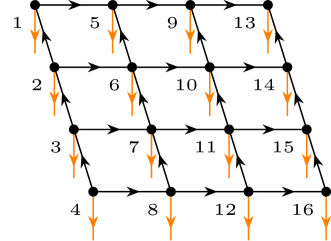
- Construct a 2+1D anyon chain model on a square lattice with open boundary conditions, using the input MTC as the fundamental symmetry.
- Implement the model with a Hamiltonian that enforces exact non-invertible one-form symmetry corresponding to the MTC at the microscopic level.
- Use matrix product state (MPS)-based density matrix renormalization group (DMRG) to simulate the system as a 1D chain with long-range interactions.
- Analyze the ground state using entanglement entropy scaling and entanglement spectrum to detect chiral conformal field theory (CFT) behavior.
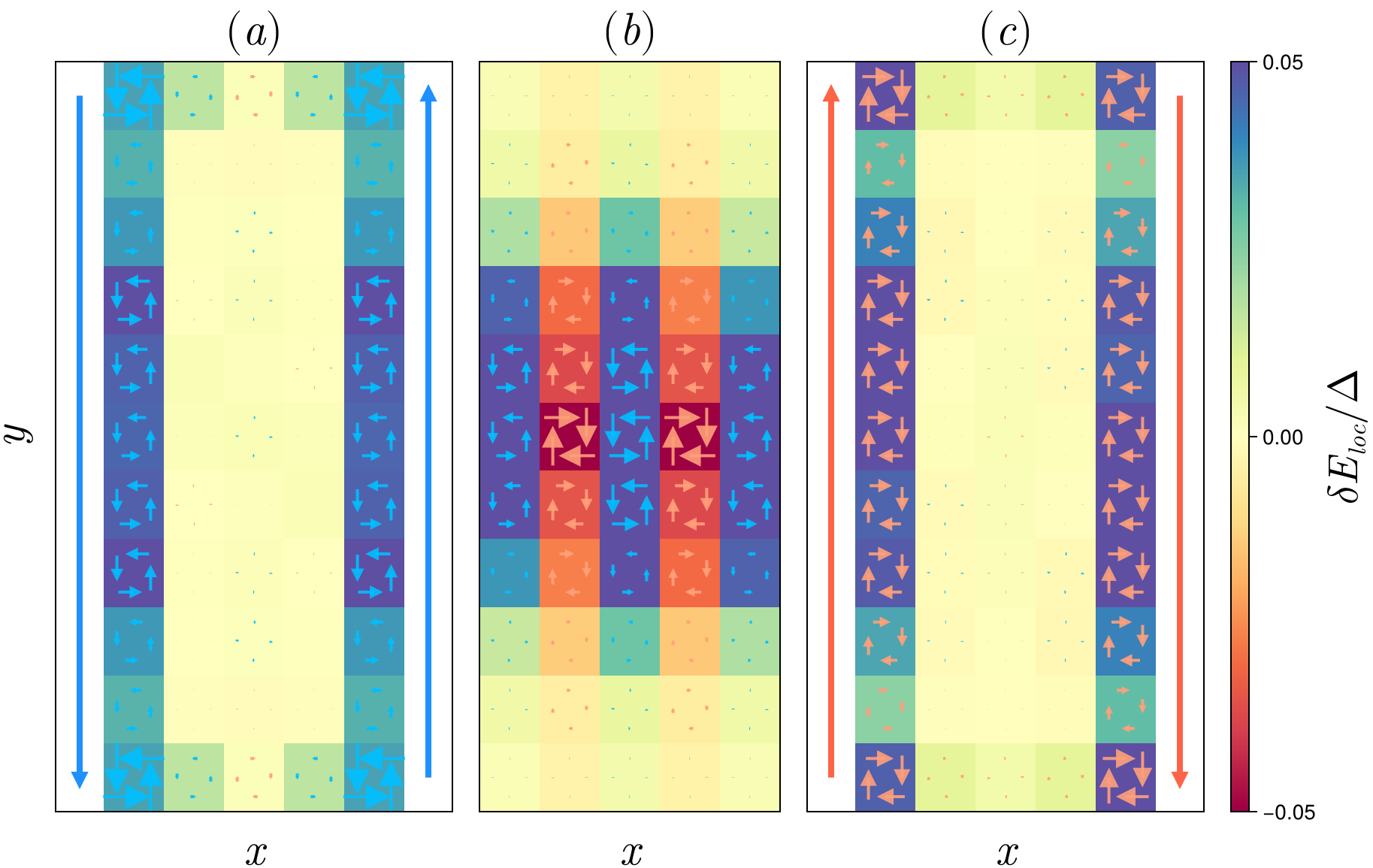
- Compute local excitation energy density and local chirality to visualize edge-localized modes and their handedness.
- Perform exact diagonalization on small systems to cross-validate edge mode chirality and bulk topological order.
Experimental results
Research questions
- RQ1Can a lattice model with exact MTC symmetry realize chiral topological phases with non-Abelian anyons?
- RQ2Do chiral edge modes emerge in such models, and are they detectable via entanglement properties?
- RQ3How does the chiral central charge of the bulk topological order relate to the chirality of the edge modes?
- RQ4Can the model realize both a topological phase and its time-reversed counterpart, despite the input MTC being fixed?
- RQ5What is the role of microscopic MTC symmetry in stabilizing chiral edge states in strongly coupled, isotropic systems?
Key findings
- For the Fibonacci-type model at θ = 0.2π, the bulk topological order is consistent with Fib ⊠ Spin(7)₁, exhibiting a chiral central charge of -0.7 and gapless edge modes with left-chiral character.
- At θ = 0.9π, the bulk order is Fib ⊠ SU(3)₁ with a chiral central charge of 0.8, showing right-chiral edge modes, confirming opposite chirality.
- Entanglement entropy scaling and entanglement spectrum match the predictions of chiral CFTs, providing strong evidence for chiral edge modes.
- Local excitation energy density and chirality maps show edge-localized modes with directionality, confirming chiral behavior in both left- and right-chiral phases.
- For the Ising-type model, edge modes at θ = 0.125π and θ = 1.125π show opposite chirality, suggesting realization of both Ising and its time-reversed phase despite fixed input MTC.
- The model realizes the Fibonacci anyon in both chiral phases due to exact 1-form symmetry, confirming robustness of anyon statistics under topological order.
Read this paper
Open the full text in the Nubint reader and ask about any passage as you read.
Read this paper on NubintThis review was generated by AI from the original paper. Please check the paper before citing it.