
[Paper Review] Chiral topological light for detecting robust enantio-sensitive observables
This paper introduces chiral topological light—a vortex beam with a topological charge that encodes molecular enantiosensitivity in the azimuthal phase of its chiral response. By combining orbital angular momentum and synthetic chiral polarization, the method enables robust, attosecond-resolved detection of enantiomeric excesses down to 1% in randomly oriented chiral molecules, even under intensity fluctuations and imperfect polarization.
Data for "Chiral topological light for detection of robust enantiosensitive observables" This repository contains the data files and Jupyter notebook to reproduce the numerical results from the paper "Chiral topological light for detection of enantiosensitive observables", N. Mayer, D. Ayuso, P. Decleva, M. Khokhlova, E. Pisanty, M. Ivanov and O. Smirnova, Nature Photonics (2024), doi:10.1038/s41566-024-01499-8, arXiv:2303.10932 as well as the results contained in its Supplementary Files. The Python code used to calculate the data files is available from the authors upon reasonable request. Please refer to the Methods section of the paper for a detailed description of the numerical approach behind the numerical simulations. Note that the figures in the paper are assembled in a separate software from the plots reproduced here, and that we include here only the results for the theoretical simulations of the molecular response. The repository contains the following files: atomic_units.py: Python file containing useful definitions of quantities in atomic units. readme.txt: file containing a detailed description of the files contained in files.zip Figures_CTL.ipynb: Jupyter notebook to load the files in files.zip and plot the images of the paper. files.zip: zip file containing the data files. The copyright of this collection rests with the authors (2024). It is made available under the Creative Commons Attribution-ShareAlike 4.0 (CC BY-SA 4.0) license. For any academic use that results in a publication, please cite the main paper in addition to this deposit.
Motivation & Objective
- To develop a topologically robust method for detecting chiral molecular enantiomers that is resilient to experimental noise and decoherence.
- To overcome the weak enantiosensitivity of conventional vortex beams by embedding synthetic chirality into the polarization dynamics of light.
- To map the topological charge of a vortex beam onto the azimuthal phase of the chiral correlation function, enabling spatially patterned, enantiosensitive signals.
- To demonstrate that the nonlinear optical response of chiral molecules to this light encodes enantiomeric excess in a topologically protected manner.
- To enable attosecond time-resolved chiro-optical spectroscopy with high sensitivity and robustness against intensity fluctuations and polarization imperfections.
Proposed method
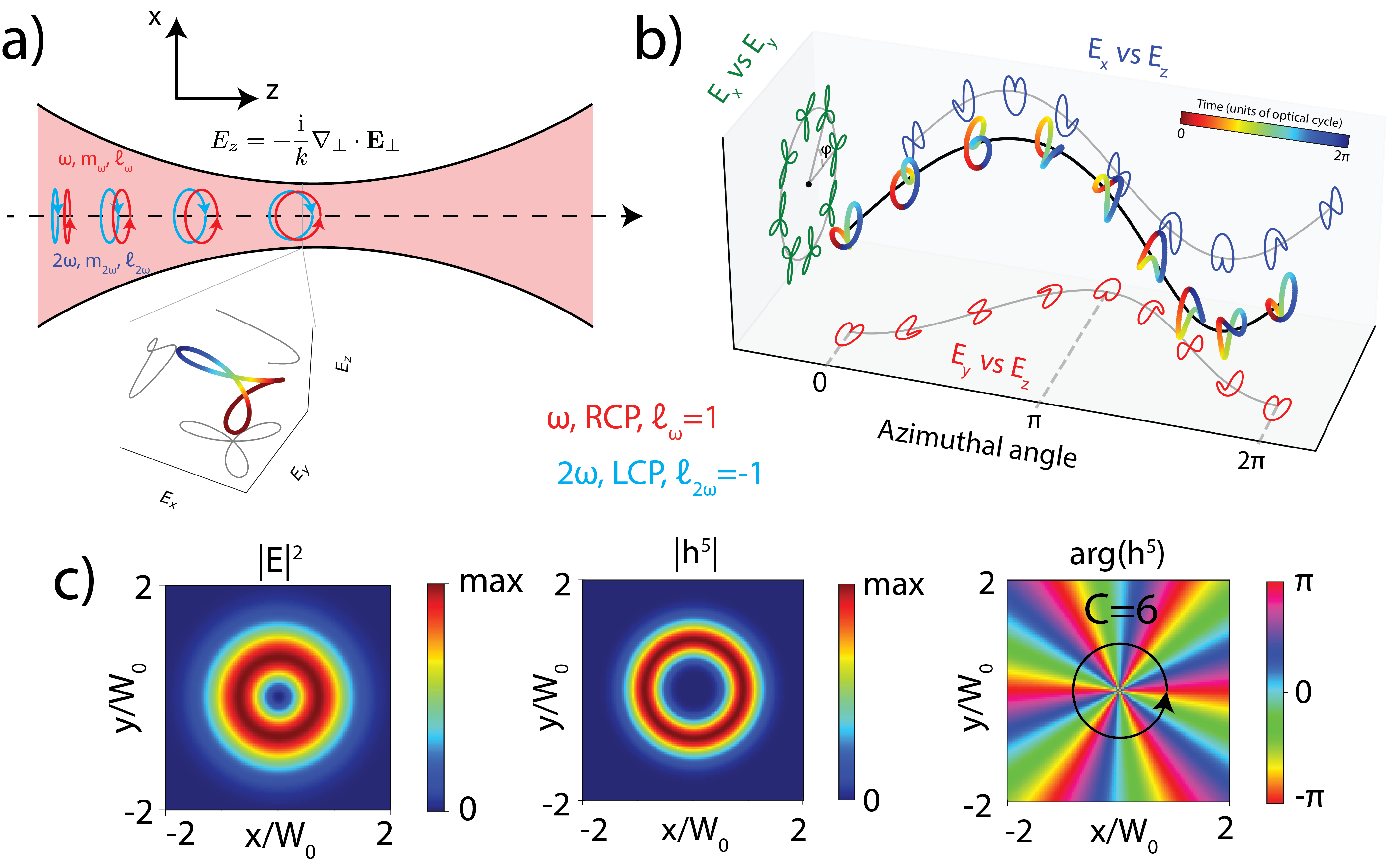
- The authors design a bicircular counter-rotating beam configuration with frequencies ω and 2ω, each carrying orbital angular momentum (OAM) ℓ_ω = -ℓ_2ω = 1, forming a chiral vortex beam.
- The synthetic chiral field is generated via tight focusing, producing a longitudinal electric field component whose polarization vector traces a chiral Lissajous figure over one laser cycle.
- The handedness of the light is encoded in the phase of the chiral correlation function h^(5), with arg[h^(5)] = Cθ + φ_L, where C = 6 is the topological charge and θ is the azimuthal angle.
- The nonlinear optical emission intensity is modeled as I(θ) ∝ cos(φ_M - φ_L + Cθ), where φ_M is the enantiosensitive phase from the chiral molecular medium.
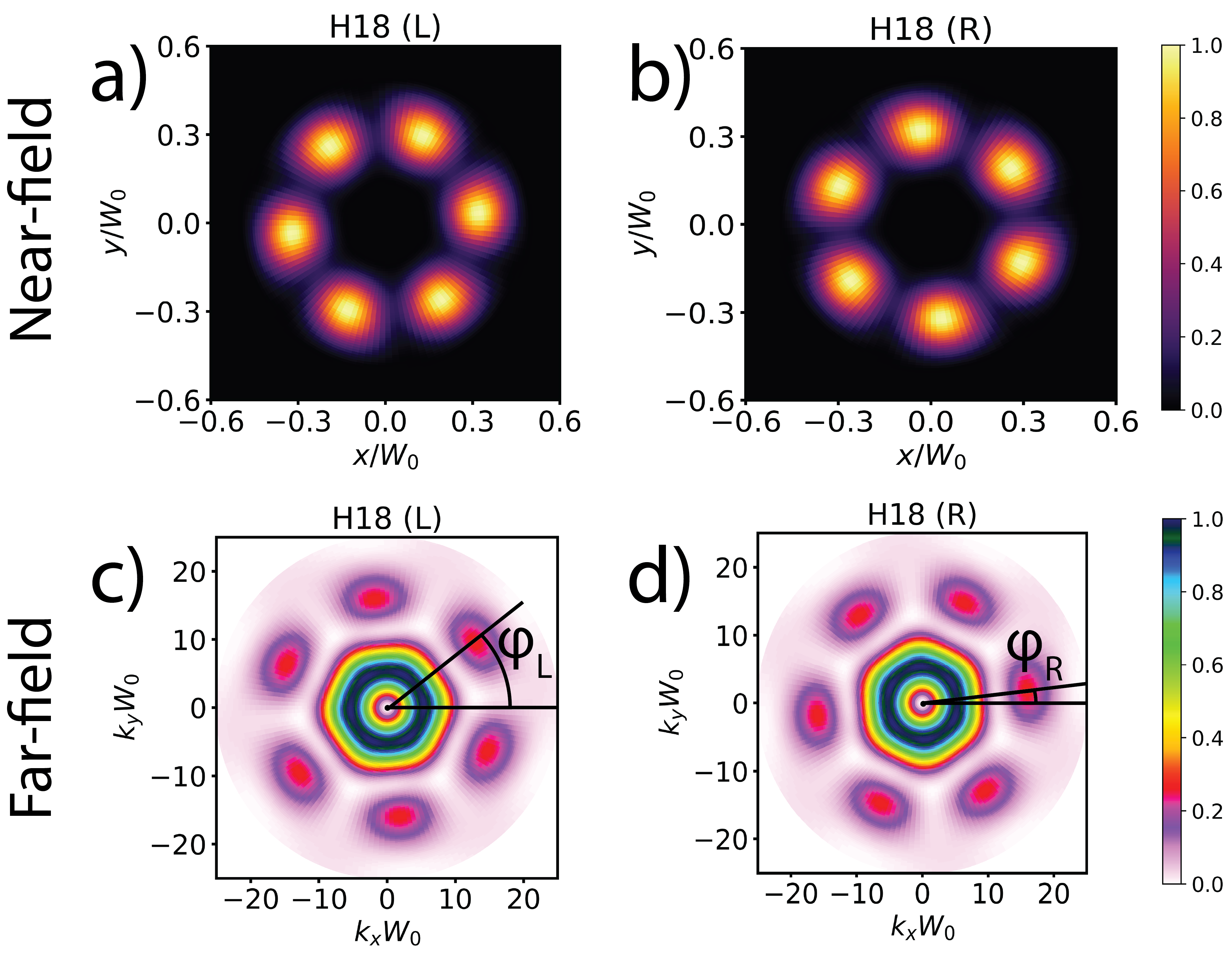
- Numerical simulations using time-dependent density functional theory (TDDFT) and ab initio calculations are performed on fenchone molecules to compute the far-field harmonic emission patterns.
- Noise robustness is tested by introducing Gaussian-distributed intensity fluctuations (σ ≈ 2%) into the electric field, simulating realistic experimental conditions.
Experimental results
Research questions
- RQ1Can topological protection be embedded into the enantiosensitive optical response of chiral molecules using structured light?
- RQ2How does the topological charge of a chiral vortex beam influence the spatial pattern of nonlinear optical emission from chiral molecules?
- RQ3To what extent is the enantiosensitive signal robust against intensity fluctuations and imperfect local polarization states of the driving field?
- RQ4Can attosecond-resolved chiro-optical spectroscopy be achieved with sub-percent-level sensitivity to enantiomeric excess using this approach?
- RQ5What is the role of higher-order nonlinear pathways in the harmonic generation process, and how do they affect the enantiosensitivity of the signal?
Key findings
- The chiral topological light induces a nonlinear optical response patterned in the azimuthal direction with a topological charge C = 6, leading to a robust, molecule-specific intensity modulation.
- The azimuthal intensity profile exhibits a measurable enantiosensitive offset Δθ = π/C = π/6 ≈ 30° between right- and left-handed fenchone molecules, enabling direct discrimination.
- The method achieves detection of enantiomeric excesses as low as 1% in randomly oriented chiral molecule mixtures, even under 2% intensity fluctuations.
- The phase of the ℓ = 6 Fourier component of the outer ring in the far-field emission is linearly dependent on enantiomeric excess, with a slope of approximately 1 rad per 100% ee.
- Achiral harmonic pathways dominate when elliptically polarized fields are used, but the chiral pathway remains resolvable via Fourier analysis of the harmonic profile, especially using the δ = 1 component.
- The topological nature of the signal ensures that the enantiosensitive phase shift is preserved despite intensity noise and polarization imperfections, validating its robustness.
Read this paper
Open the full text in the Nubint reader and ask about any passage as you read.
Read this paper on NubintThis review was generated by AI from the original paper. Please check the paper before citing it.