
[Paper Review] Chirality-Induced Magnetization of Magnetite by an RNA Precursor
This paper proposes that chiral ribose-aminooxazoline (RAO), an RNA precursor, induces avalanche-like magnetization of magnetite (Fe₃O₄) surfaces via the chiral-induced spin selectivity (CISS) effect. The chiral molecules locally align magnetic spins, triggering a cooperative, long-range magnetization cascade that amplifies weak natural remanent magnetization, providing a prebiotically plausible mechanism for persistent spin-selective chemistry on magnetic minerals.
Life is homochiral and homochirality is a fundamental feature of living systems on Earth. While the exact mechanism that led to homochirality is still not fully understood, any realistic scenario on the origins of life needs to address the emergence of homochirality. In order to impose and maintain chirality in a prebiotic network, an environmental factor functioning as a chiral agent is demanded. Magnetized surfaces are prebiotically plausible chiral agents, shown to be effective in enantioseparation of ribose-aminooxazoline (RAO), a ribonucleic acid (RNA) precursor, due to the chiral-induced spin selectivity (CISS) effect. As such, mechanisms for breaking the magnetic symmetry of magnetic minerals are of the utmost importance. Here we report the avalanche magnetization of magnetite $(Fe_{3}O_{4})$ by the crystallization of enantiopure RAO. The observed breaking of the magnetic symmetry is induced by the chiral molecules due to the CISS effect and spreads out across the magnetic surface like an avalanche, providing a way to uniformly magnetize a magnetic surface without fully covering it. Considered together with our previous results on enantioseparation by crystallization on a magnetic surface, chirality-induced avalanche magnetization paves the way for a cooperative feedback between chiral molecules and magnetic surfaces. With this feedback, a weak natural bias in the net magnetization can be amplified and spin-selective processes can be accommodated on magnetic minerals on a persistent basis.
Motivation & Objective
- To investigate how chiral molecules can break magnetic symmetry in prebiotic magnetic minerals like magnetite.
- To explore whether chiral molecules such as ribose-aminooxazoline (RAO) can induce and amplify magnetization in magnetite surfaces.
- To establish a feedback mechanism between chiral molecules and magnetic surfaces that sustains spin-selective processes essential for homochirality.
- To demonstrate that the CISS effect can drive cooperative, long-range magnetization spreading across magnetic surfaces without full coverage.
- To provide a prebiotically plausible pathway for amplifying weak natural magnetic biases into persistent, directional magnetization.
Proposed method
- Synthesized enantiopure ribose-aminooxazoline (RAO), a prebiotic RNA precursor, and used it to crystallize on magnetite (Fe₃O₄) surfaces under prebiotically plausible conditions.
- Employed magneto-optical Kerr effect (MOKE) measurements to detect and map surface magnetization changes induced by RAO crystallization.
- Conducted superconducting quantum interference device (SQUID) magnetometry to quantify net magnetization and magnetic hysteresis of the samples.
- Used magnetic force microscopy (mc-AFM) to image surface topography and correlate molecular crystallization with local magnetic domain structure.
- Applied circular dichroism (CD) spectroscopy to confirm the enantiomeric purity of RAO and its chiral surface interactions.
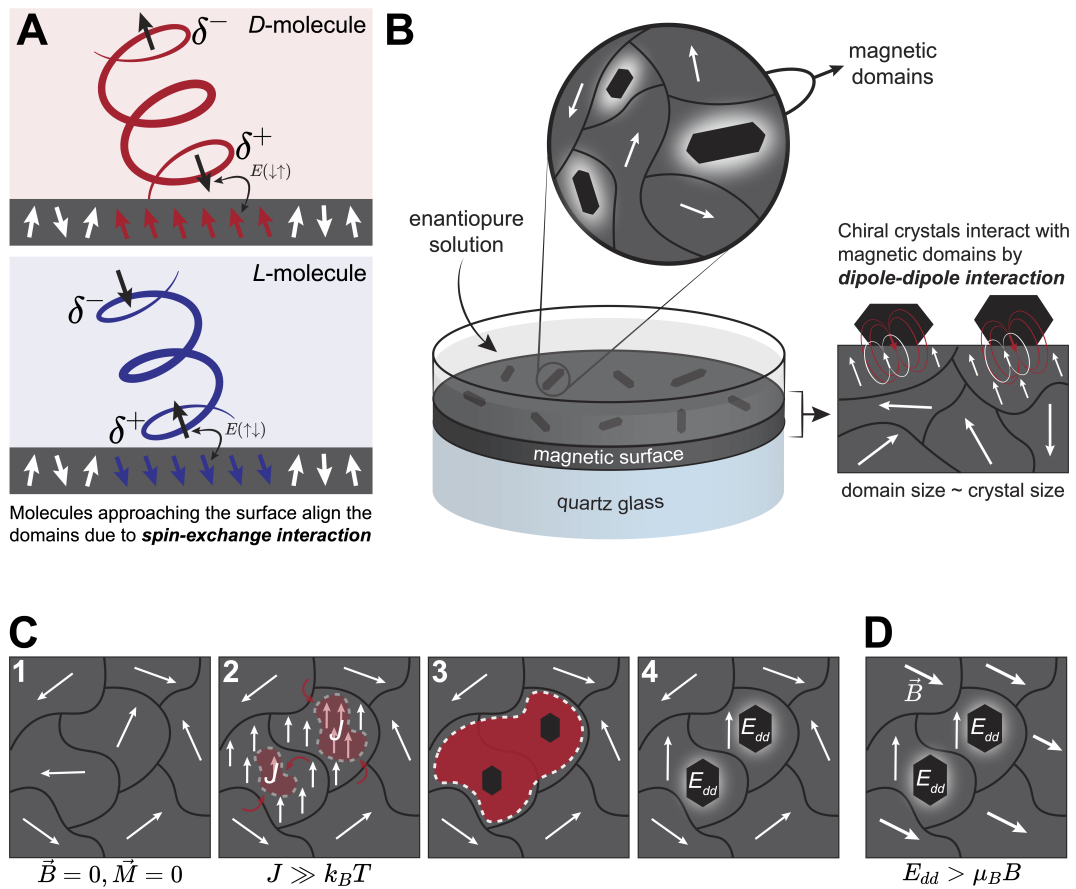
- Modeled the system using a 2D Ising-like Hamiltonian incorporating chiral molecule-spin exchange interaction ($J_c$), showing that chiral molecules generate an effective magnetic field that drives collective spin alignment and avalanche-like magnetization.
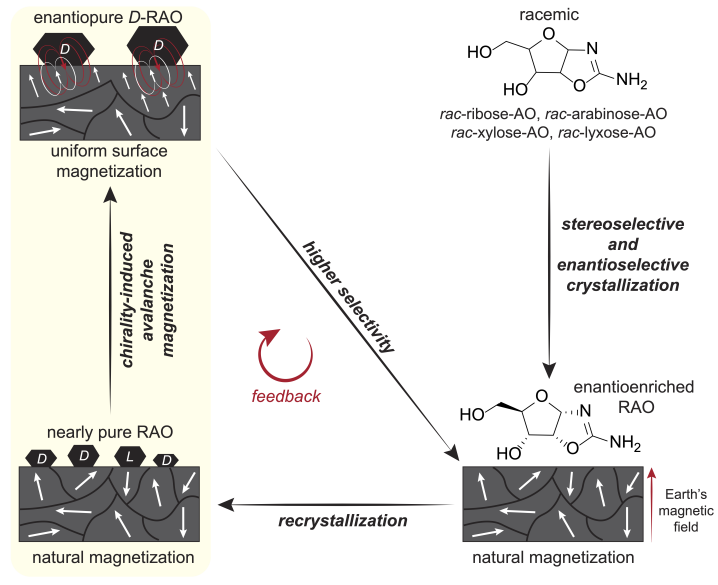
Experimental results
Research questions
- RQ1Can chiral molecules like RAO induce long-range, cooperative magnetization in magnetite surfaces via the CISS effect?
- RQ2Does the presence of chiral RAO crystals lead to a measurable, directional net magnetization in magnetite, even without full surface coverage?
- RQ3Can the weak natural remanent magnetization of authigenic magnetite be amplified through chiral molecule-induced spin alignment?
- RQ4What is the role of the CISS effect in mediating the interaction between chiral molecules and magnetic surfaces to drive collective magnetic ordering?
- RQ5How does temperature influence the efficiency and extent of chiral-induced magnetization spreading in magnetic domains?
Key findings
- Enantiopure RAO crystallization on magnetite surfaces induces a measurable, directional net magnetization, even when only sparsely distributed on the surface.
- The magnetization spreads across the surface in an avalanche-like manner, indicating a cooperative, long-range spin alignment process driven by chiral molecule-surface interactions.
- MOKE and SQUID measurements confirmed that the induced magnetization is persistent and exhibits hysteresis, indicating stable magnetic domain formation.
- The effective magnetic field generated by chiral molecules via spin-exchange interaction ($J_c$) is strong and short-ranged (~0.01–1 eV), sufficient to trigger collective spin reorientation across the surface.
- The system exhibits a second-order phase transition-like behavior in the 2D Ising model approximation, with magnetization spreading more drastically at lower temperatures due to enhanced spin correlation.
- The observed magnetization direction is dictated by the molecular handedness of RAO, confirming a chiral control mechanism over magnetic order.
Read this paper
Open the full text in the Nubint reader and ask about any passage as you read.
Read this paper on NubintThis review was generated by AI from the original paper. Please check the paper before citing it.