
[Paper Review] Classification of Classical Spin Liquids: Detailed Formalism and Suite of Examples
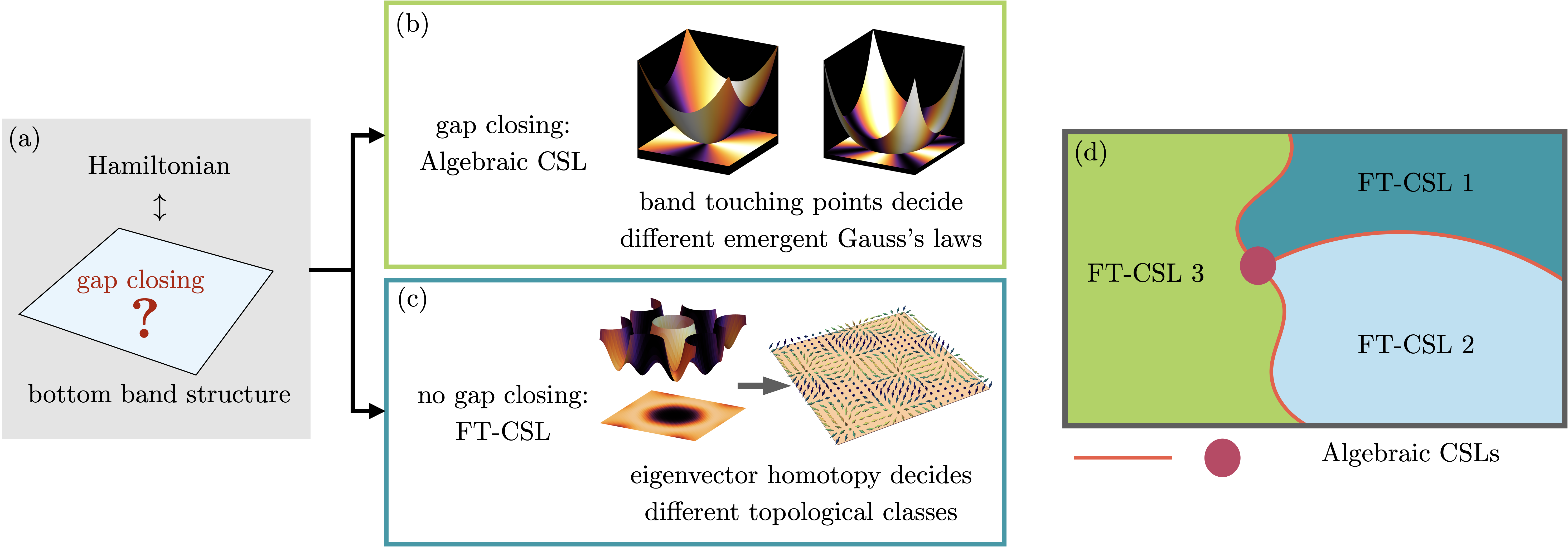
This paper introduces a comprehensive classification scheme for classical spin liquids (CSLs) based on the spectral properties of their soft-spin Hamiltonians. It distinguishes between algebraic CSLs—classified by gapless points and emergent generalized Gauss’s laws—and fragile topological CSLs—classified by eigenvector homotopy of flat bands. The framework unifies known CSL models and predicts new exotic phases, including those with anisotropic Gauss’s laws, pinch-line singularities, and zero-temperature transitions between fragile topological phases.
The hallmark of highly frustrated systems is the presence of many states close in energy to the ground state. Fluctuations between these states can preclude the emergence of any form of order and lead to the appearance of spin liquids. Even on the classical level, spin liquids are not all alike: they may have algebraic or exponential correlation decay, and various forms of long wavelength description, including vector or tensor gauge theories. Here, we introduce a classification scheme, allowing us to fit the diversity of classical spin liquids (CSLs) into a general framework as well as predict and construct new kinds. CSLs with either algebraic or exponential correlation-decay can be classified via the properties of the bottom flat band(s) in their soft-spin Hamiltonians. The classification of the former is based on the algebraic structures of gapless points in the spectra, which relate directly to the emergent generalized Gauss's laws that control the low temperature physics. The second category of CSLs, meanwhile, are classified by the fragile topology of the gapped bottom band(s). Utilizing the classification scheme we construct new models realizing exotic CSLs, including one with anisotropic generalized Gauss's laws and charges with subdimensional mobility, one with a network of pinch-line singularities in its correlation functions, and a series of fragile topological CSLs connected by zero-temperature transitions.
Motivation & Objective
- To develop a systematic classification framework for classical spin liquids (CSLs) that captures their diverse physical behaviors.
- To address the lack of a unified theoretical framework for understanding the variety of CSLs observed in frustrated magnetic systems.
- To classify CSLs based on the spectral structure of their soft-spin Hamiltonians, distinguishing between algebraic and fragile topological CSLs.
- To provide a predictive tool for constructing new CSL models with desired emergent gauge theories and topological properties.
- To connect the classification to flat band theory and real-space ground state degeneracy, enabling analytical and numerical exploration of CSLs.
Proposed method
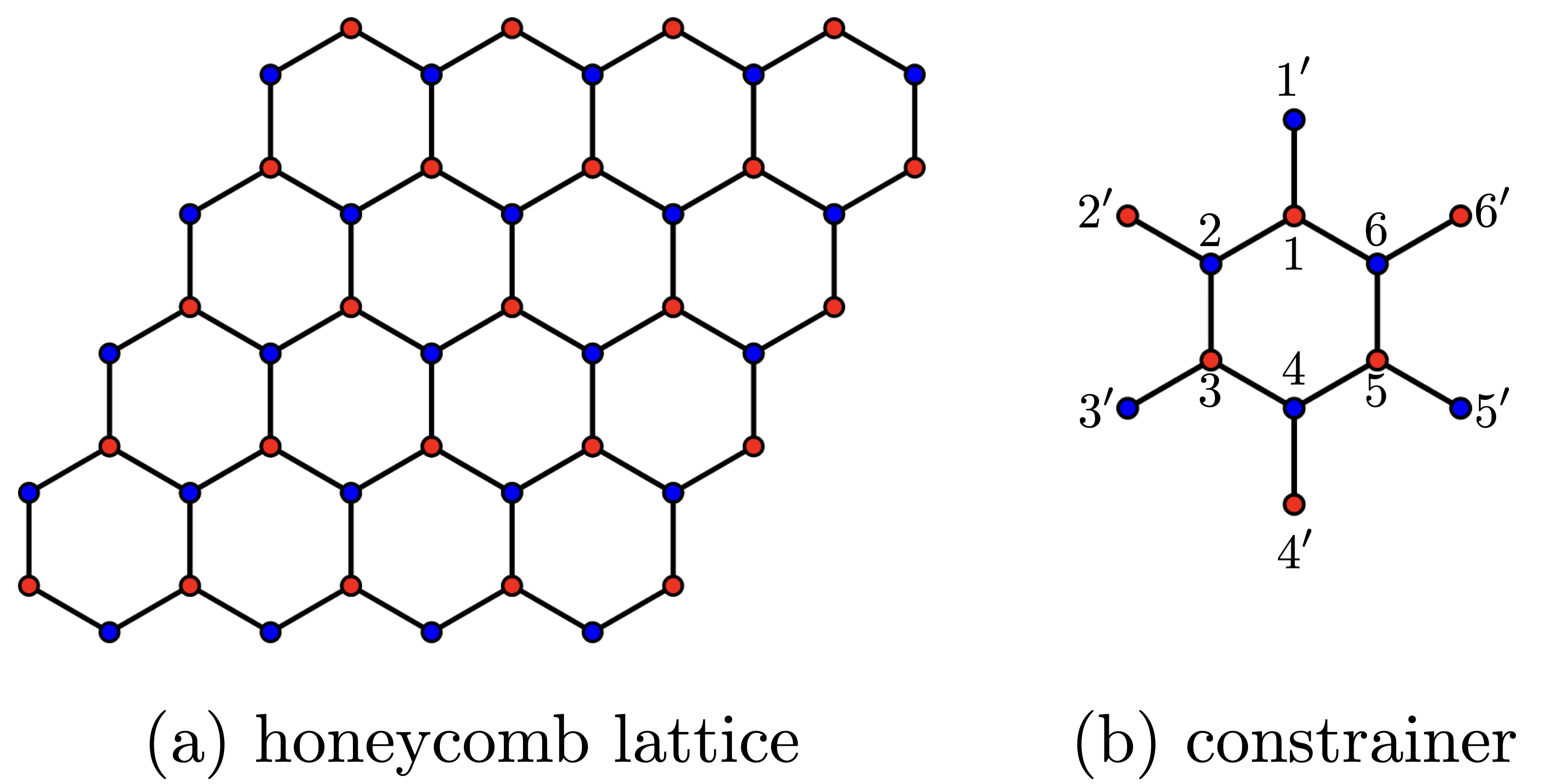
- Formalize the constrainer Hamiltonian approach to model classical spin liquids with extensive ground state degeneracy.
- Analyze the spectrum of the soft-spin Hamiltonian, focusing on the bottom flat band(s) and their coupling to higher dispersive bands.
- Classify algebraic CSLs by identifying gap-closing points in the spectrum and extracting the emergent generalized Gauss’s laws from the eigenvector structure at these points.
- Classify fragile topological CSLs via eigenvector homotopy theory, using the topological invariants of the flat band’s eigenvectors.
- Apply the formalism to known models (e.g., kagome, pyrochlore, honeycomb-snowflake) and construct new models with exotic properties.
- Use the self-consistent Gaussian approximation (SCGA) to study the stability of CSLs and their transitions, while acknowledging limitations in handling hard spin constraints.
Experimental results
Research questions
- RQ1How can classical spin liquids be systematically classified based on their low-energy spectral properties?
- RQ2What determines the emergence of generalized Gauss’s laws in algebraic CSLs, and how are they related to the structure of gap-closing points?
- RQ3What topological invariants classify fragile topological CSLs, and how do they differ from those in algebraic CSLs?
- RQ4Can the classification scheme predict new types of CSLs with non-trivial correlation structures, such as pinch lines or subdimensional charges?
- RQ5How do zero-temperature transitions between different CSL phases manifest in the framework of eigenvector homotopy and spectral topology?
Key findings
- The classification scheme successfully organizes known CSL models—such as the kagome, pyrochlore, and honeycomb-snowflake antiferromagnets—into a unified landscape based on spectral and topological properties.
- Algebraic CSLs are classified by the algebraic structure of gapless points in the soft-spin Hamiltonian spectrum, which directly determines the form of the emergent generalized Gauss’s law.
- Fragile topological CSLs are classified by the homotopy class of the eigenvectors of the bottom flat band, with distinct topological invariants distinguishing different phases.
- The framework predicts a new CSL with anisotropic generalized Gauss’s laws and charges exhibiting subdimensional mobility, extending the scope of known gauge theories in spin liquids.
- A model with a network of pinch-line singularities in its spin correlation functions is constructed, demonstrating a new type of long-wavelength correlation structure in CSLs.
- Zero-temperature transitions between fragile topological CSLs are shown to occur at the boundary between different homotopy classes, providing a mechanism for topological phase transitions in classical systems.
Read this paper
Open the full text in the Nubint reader and ask about any passage as you read.
Read this paper on NubintThis review was generated by AI from the original paper. Please check the paper before citing it.