
[Paper Review] CO2 storage in deep saline aquifers: evaluation of geomechanical risks using integrated modeling workflow
This paper develops a sequentially coupled hydro-geomechanical modeling workflow coupling MUFITS and FLAC3D to evaluate geomechanical risks (fault activation, permeability change, and potential CO2 leakage) during CO2 injection into deep saline aquifers intersected by tectonic faults.
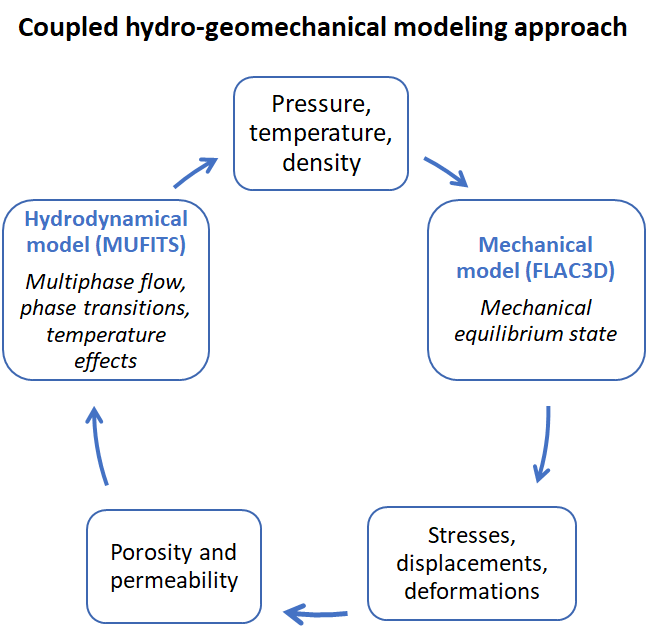
CO2 injection into a saline aquifer crossed by a tectonic fault is studied with coupled fluid mechanics - geomechanics modeling. The simulation approach is based on coupling of the MUFITS reservoir simulator and the FLAC3D mechanical simulator via an in-house API (i.e., an algorithm for data transfer between simulators). MUFITS simulates the non-isothermal multiphase flow of CO2 and brine in rock formation accounting for phase transitions and thermal effects. The modeling workflow is sequential, so that hydrodynamical simulations are carried out at a certain time interval, after which pressure, temperature, and density distributions are passed to FLAC3D, which calculates the equilibrium mechanical state. Computed deformations and stresses are utilized to update the porosity and permeability fields for the subsequent hydrodynamic modeling. In particular, we focus on the tectonic fault and its behavior during CO2 injection. We distinguish the damage zone and core inside the fault and derive the closure relations for their permeability alteration analytically. The coupled approach developed here is applied to simulate CO2 injection into synthetic and realistic reservoir models. For the former one, we study the effect of formation depth and presence of the tectonic stresses at the initial mechanical state, while for the latter, we consider different injection modes (bottomhole pressure). In each numerical experiment, we describe the evolution of the fault permeability due to the slip along its plane and the development of plastic deformations leading to the loss of reservoir integrity and CO2 leakage. Sensitivity analysis of the coupled model to realistic values of input parameters to assess the fault stability is carried out.
Motivation & Objective
- Motivate and address geomechanical risks during CO2 storage in deep saline aquifers.
- Develop a sequentially coupled hydro-geomechanical modeling workflow integrating fluid flow and mechanics.
- Characterize permeability evolution in tectonic fault zones under CO2 injection.
- Assess fault activation, plastic deformation, and CO2 leakage scenarios through synthetic and realistic reservoirs.
Proposed method
- Coupled hydro-geomechanical modeling using MUFITS for non-isothermal, multiphase CO2–brine flow and FLAC3D for mechanical equilibrium.
- Sequential coupling with data transfer between MUFITS and FLAC3D via an in-house API.
- Porosity and permeability updates are computed from total volumetric strain and a power-law permeability relation.
- Analytical closure relations are derived for permeability evolution in fault damage zones and fault cores.
- An analytical model describing fault zone permeability alteration is embedded in the workflow.
- Sensitivity analyses are conducted to explore parameter values affecting fault stability.
Experimental results
Research questions
- RQ1How does CO2 injection in a deep saline aquifer affect the mechanical state of a tectonic fault intersecting the reservoir?
- RQ2How do pore-pressure and temperature changes modify fault permeability via elastic and plastic deformations?
- RQ3What regimes of injection and reservoir configurations lead to fault slip, damage-zone permeability changes, or CO2 leakage pathways?
- RQ4Can an integrated hydro-geomechanical model predict the evolution of porosity and permeability in fault zones during injection?
Key findings
- The coupled MUFITS–FLAC3D workflow enables simulation of pressure, temperature, and density distributions and their impact on porosity and permeability.
- Permeability in the fault zone evolves due to slip along the fault plane and plastic deformations, potentially creating leakage conduits.
- An analytical description of permeability alteration in the damage zone and fault core is integrated into the workflow to quantify conduit formation.
- Sensitivity analyses indicate how input parameters influence fault stability and the risk of CO2 leakage.
- The study assesses both synthetic and realistic reservoir models to illustrate how different injection modes affect geomechanical risks.
Better researchstarts right now
From reading papers to final review, dramatically reduce your research time.
No credit card · Free plan available
This review was created by AI and reviewed by human editors.