
[Paper Review] Comment on "Traversable wormhole dynamics on a quantum processor"
This paper critically evaluates a recent claim of observing traversable wormhole dynamics in a quantum processor experiment, arguing that the observed phenomena—including size winding and teleportation signals—arise not from genuine gravitational dynamics but from generic features of small, fully-commuting Hamiltonians. The authors demonstrate that the model fails to thermalize, and its apparent gravitational signatures are artifacts of training-specific operators and system size, undermining the claim of emergent holographic gravity.
A recent article [Nature 612, 51-55 (2022)] claims to observe traversable wormhole dynamics in an experiment. This claim is based upon performing a teleportation protocol using a Hamiltonian that consists of seven Majorana fermions with five fully-commuting terms. The Hamiltonian is generated via a machine-learning procedure designed to replicate the teleportation behavior of the Sachdev-Ye-Kitaev (SYK) model. The authors claim that the learned Hamiltonian reproduces gravitational dynamics of the SYK model and demonstrates gravitational teleportation through an emergent wormhole. We find: (i) in contrast to these claims, the learned Hamiltonian does not exhibit thermalization; (ii) the teleportation signal only resembles the SYK model for operators that were used in the machine-learning training; (iii) the observed perfect size winding is in fact a generic feature of small-size, fully-commuting models, and does not appear to persist in larger-size fully-commuting models or in non-commuting models at equivalent system sizes
Motivation & Objective
- To assess whether the experimental observation of traversable wormhole dynamics in a quantum processor genuinely reflects gravitational physics as claimed.
- To investigate whether the observed teleportation signals and size winding in the model are generic features of small, fully-commuting Hamiltonians rather than signatures of holographic gravity.
- To evaluate the role of the machine-learning procedure in producing biased, non-universal behavior that mimics gravitational dynamics only for trained operators.
- To determine whether the model exhibits key features of quantum gravity, such as thermalization, chaos, and complexity, which are essential for holographic duality.
Proposed method
- The authors analyze the learned Hamiltonian (Model 1) from the original study, which consists of five fully-commuting four-body Majorana terms, using numerical simulations.
- They compute two- and four-point correlation functions to assess scrambling and thermalization, comparing results with the Sachdev-Ye-Kitaev (SYK) model.
- A phase alignment metric $\bar{r}$ is used to quantify the coherence of teleportation signals, and a slope metric $\chi$ is introduced to evaluate linear size-winding behavior across operators.
- The authors test robustness by replacing coefficients with random values and replacing terms with random commuting four-body Majorana operators, assessing whether key features persist.
- They compare results across Model 1, random variants of Model 1, and random all-to-all Ising models to isolate generic behaviors of small, commuting systems.
- The study evaluates teleportation fidelity and size winding for both trained and untrained operators to test universality of the observed effects.
Experimental results
Research questions
- RQ1Does the learned Hamiltonian in the experiment exhibit thermalization, a key signature of quantum chaotic systems and holographic duality?
- RQ2To what extent do the observed teleportation signals and size winding depend on the specific operators used in the machine-learning training?
- RQ3Are the reported gravitational-like features—such as perfect size winding and linear phase slope—generic to small, fully-commuting Hamiltonians rather than indicators of emergent gravity?
- RQ4How do the dynamics of the learned model compare quantitatively to the true Sachdev-Ye-Kitaev (SYK) model in terms of correlation functions and information scrambling?
- RQ5Can the observed phase alignment and size-winding metrics be reproduced in random, commuting models of similar size, suggesting they are not unique to the learned Hamiltonian?
Key findings
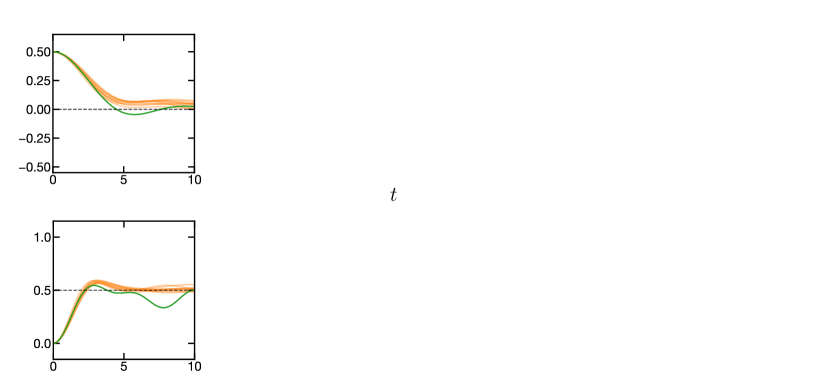
- Model 1 does not thermalize; instead, it exhibits strong oscillations in individual two- and four-point correlation functions, contradicting the claim of thermalization in the original study.
- The observed teleportation signal only resembles the SYK model for the specific operators ($\psi^1$ and $\psi^2$) used in the machine-learning training; untrained operators show no such resemblance.
- Perfect size winding and linear phase slope are generic features of small, fully-commuting Hamiltonians: they persist when coefficients or terms are randomized, indicating no deep connection to gravitational physics.
- The phase alignment metric $\bar{r}$ is significantly higher in Model 1 than in the SYK model, and this high value is reproduced in random commuting models, indicating it is not a signature of gravity but of system size and commutativity.
- The slope metric $\chi$ shows that only trained operators exhibit strong linearity; untrained operators show variable $\chi$, and the distribution of $\chi$ across operators in Model 1 closely matches that of random commuting models, suggesting no fundamental distinction.
- The observed features are inconsistent with the full set of holographic properties: while size winding is present, the absence of thermalization, chaos, and complexity undermines the claim of emergent gravitational dynamics.

Read this paper
Open the full text in the Nubint reader and ask about any passage as you read.
Read this paper on NubintThis review was generated by AI from the original paper. Please check the paper before citing it.