
[Paper Review] Complex Mixer for MedMNIST Classification Decathlon
This paper proposes a Complex Mixer (C-Mixer) with incentive learning and self-supervised pre-training via random masking to address information loss and label uncertainty in MedMNIST (v2), achieving state-of-the-art performance across supervised, weakly supervised, and image enhancement tasks by leveraging complex-valued feature spaces and robust representation learning.
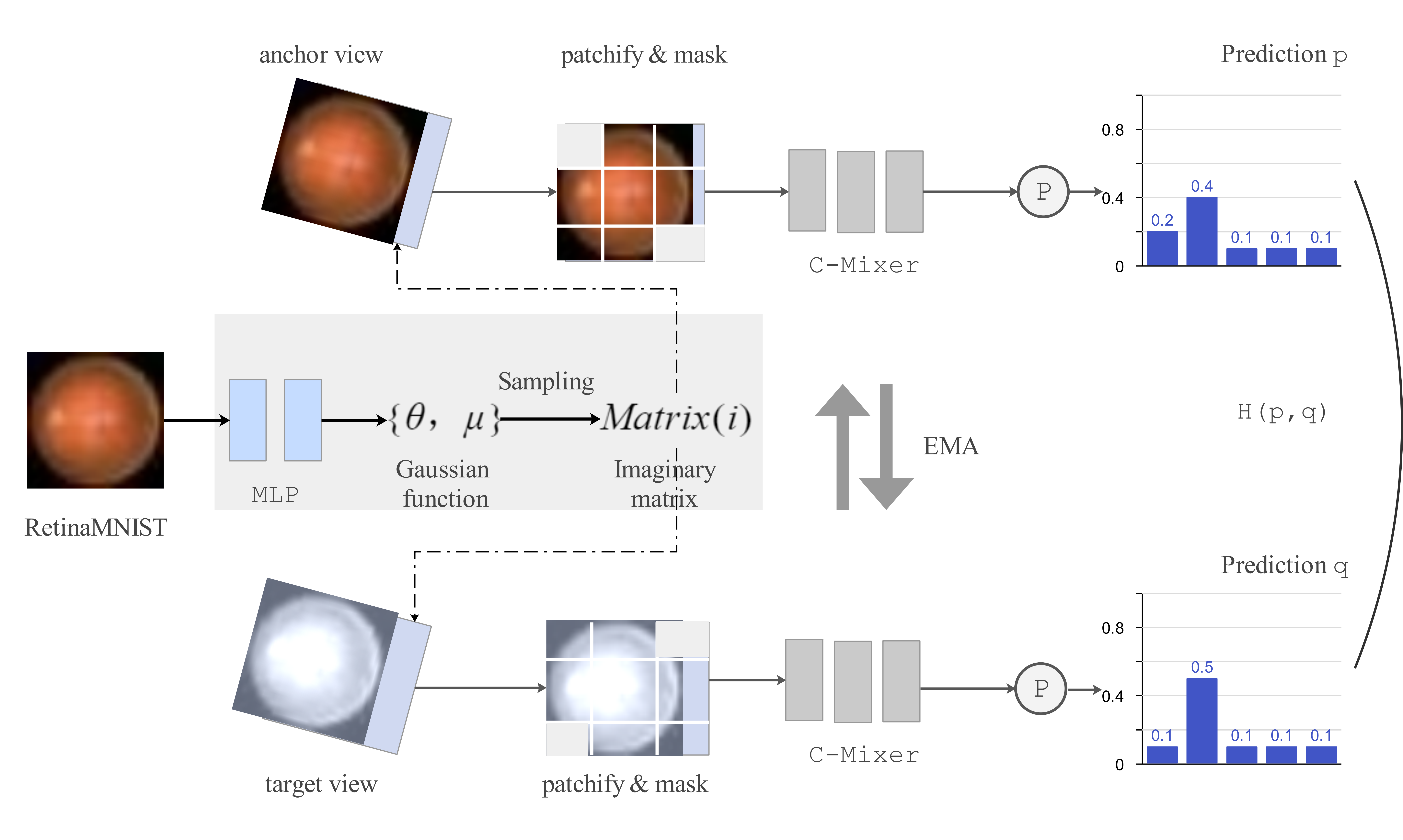
With the development of the medical image field, researchers seek to develop a class of datasets to block the need for medical knowledge, such as ext{MedMNIST} (v2). MedMNIST (v2) includes a large number of small-sized (28 $ imes$ 28 or 28 $ imes$ 28 $ imes$ 28) medical samples and the corresponding expert annotations (class label). The existing baseline model (Google AutoML Vision, ResNet-50+3D) can reach an average accuracy of over 70\% on MedMNIST (v2) datasets, which is comparable to the performance of expert decision-making. Nevertheless, we note that there are two insurmountable obstacles to modeling on MedMNIST (v2): 1) the raw images are cropped to low scales may cause effective recognition information to be dropped and the classifier to have difficulty in tracing accurate decision boundaries; 2) the labelers' subjective insight may cause many uncertainties in the label space. To address these issues, we develop a Complex Mixer (C-Mixer) with a pre-training framework to alleviate the problem of insufficient information and uncertainty in the label space by introducing an incentive imaginary matrix and a self-supervised scheme with random masking. Our method (incentive learning and self-supervised learning with masking) shows surprising potential on both the standard MedMNIST (v2) dataset, the customized weakly supervised datasets, and other image enhancement tasks.
Motivation & Objective
- Address the challenge of information loss due to extreme downscaling of medical images (from 224×224 to 28×28) in MedMNIST (v2), which dilutes lesion details critical for diagnosis.
- Mitigate label uncertainty arising from subjective expert annotations in MedMNIST (v2), which hinders classifier generalization and performance.
- Develop a novel machine learning paradigm—complex-valued representation learning—using imaginary components to enhance feature expressivity and decision boundary robustness.
- Design a self-supervised pre-training framework with random masking to regularize the model and improve generalization under label noise.
- Demonstrate the method’s effectiveness across diverse medical image tasks, including standard classification, weakly supervised learning, and image enhancement.
Proposed method
- Introduce incentive learning by injecting learnable Gaussian noise (with mean and variance as parameters) into input features to enrich recognition-friendly signals and reduce modeling cost.
- Construct a complex space by combining real and imaginary feature representations, enabling the model to learn rotation-invariant and phase-sensitive patterns for improved decision boundary learning.
- Implement a self-supervised pre-training scheme using random masking on image patches, enforcing latent regularization and improving robustness to label uncertainty.
- Use a Vision Transformer (ViT) backbone with complex-valued convolutional layers to process images in the complex domain, enhancing feature representation in high-dimensional space.
- Train the C-Mixer using L1 loss and AdamW optimizer on 512×512 resolution images with a batch size of 8 and a base learning rate of 0.001.
- Fine-tune the pre-trained model on downstream tasks using standard cross-entropy loss and data augmentations such as RandAugment.
Experimental results
Research questions
- RQ1Can incentive learning with learnable noise improve classification performance on low-resolution medical images where fine-grained details are lost?
- RQ2To what extent can self-supervised learning with random masking reduce the negative impact of label uncertainty in MedMNIST (v2) datasets?
- RQ3Does complex-valued feature representation enhance decision boundary learning and robustness in medical image classification tasks?
- RQ4How does the proposed C-Mixer compare to existing models (e.g., MSN, ViT) in terms of accuracy and generalization on both standard and weakly supervised medical image benchmarks?
- RQ5Can the proposed method generalize beyond classification to dense prediction tasks such as image enhancement?
Key findings
- The proposed method achieves a 2% absolute improvement in top-1 accuracy over MSN on CIFAR-10 and CIFAR-100 when fine-tuned end-to-end, demonstrating superior generalization under limited supervision.
- On the MNIST dataset with only 10% of the training data, the method performs nearly identically to MSN, indicating strong performance even with minimal labeled data.
- The model shows significant gains in image enhancement tasks, particularly in texture and color restoration, when using complex convolutional layers in a U-Net-based architecture.
- The self-supervised pre-training with random masking effectively regularizes the model, reducing sensitivity to label noise and improving consistency across similar samples.
- Extensive experiments confirm the method’s strong performance across supervised, weakly supervised, and dense prediction tasks, validating its broad applicability.
- The use of complex-valued representations enables the model to learn more robust decision planes in higher-dimensional space, improving generalization despite low-resolution inputs.
Read this paper
Open the full text in the Nubint reader and ask about any passage as you read.
Read this paper on NubintThis review was generated by AI from the original paper. Please check the paper before citing it.