
[Paper Review] Conformal Field Theories generated by Chern Insulators under Quantum Decoherence
This paper demonstrates that the fidelity between a decohered Chern insulator and a trivial insulator maps to the partition function of a (1+1)d conformal field theory (CFT), with the central charge extractable via finite-size scaling of the Rényi relative entropy. Under weak decoherence, the system flows to interacting CFTs with reduced central charges, enabling topological invariant extraction without prior knowledge of order parameters.
We demonstrate that the fidelity between a pure state trivial insulator and the mixed state density matrix of a Chern insulator under decoherence can be mapped to a variety of two-dimensional conformal field theories (CFT); more specifically, the quantity $\mathcal{Z} = ext{tr}\{ \hatρ^D_c \hatρ_Ω\}$ is mapped to the partition function of the desired CFT, where $\hatρ^D_c$ and $\hatρ_Ω$ are respectively the density matrices of the decohered Chern insulator and a pure state trivial insulator. For a pure state Chern insulator with Chern number $2N$, the fidelity $\mathcal{Z}$ is mapped to the partition function of the $ ext{U}(2N)_1$ CFT; under weak decoherence, the Chern insulator density matrix can experience certain instability, and the "partition function" $\mathcal{Z}$ can flow to other interacting CFTs with smaller central charges. The Rényi relative entropy $\mathcal{F} = - \log ext{tr}\{ \hatρ^D_c \hatρ_Ω\}$ is mapped to the free energy of the CFT, and we demonstrate that the central charge of the CFT can be extracted from the finite size scaling of $\mathcal{F}$, analogous to the well-known finite size scaling of $2d$ CFT.
Motivation & Objective
- To understand the topological properties of mixed-state density matrices arising from weak decoherence in Chern insulators.
- To establish a mapping between quantum fidelity and conformal field theory (CFT) partition functions.
- To develop a method to extract the central charge of the effective CFT without prior knowledge of order parameters.
- To show that weak decoherence can stabilize or drive the system into distinct CFT phases with varying central charges.
Proposed method
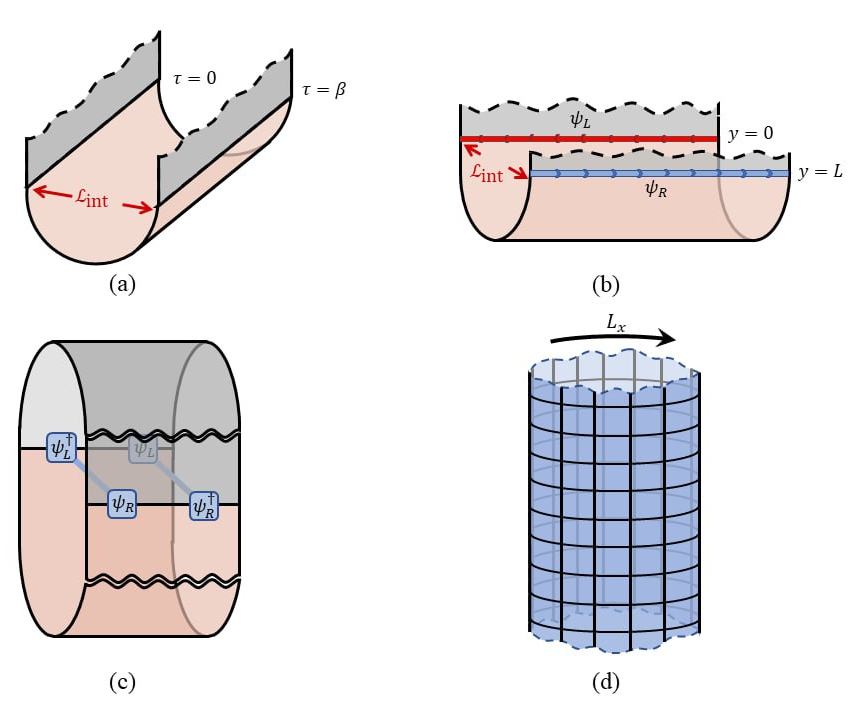
- The fidelity $\mathcal{Z} = \tr\{\hat{\rho}^{D}_{c}\hat{\rho}_{\Omega}\}$ is mapped to the partition function of a (1+1)d nonchiral CFT via space-time rotation.
- The Rényi relative entropy $\mathcal{F} = -\log \mathcal{Z}$ is interpreted as the free energy of the effective CFT.
- Finite-size scaling of $\mathcal{F}$ on a cylindrical geometry is used to extract the central charge, analogous to standard CFT methods.
- The analysis relies on the overlap between a pure-state Chern insulator and a trivial insulator, with the decoherence process encoded as interactions between temporal boundaries in the path integral.
- Type-II strange correlators are used to probe nontrivial topological features in the mixed state, even without knowledge of the specific order parameter.
- The formalism is extended to show that different decoherence channels lead to distinct CFTs, including $\mathrm{U}(2N)_1$ and lower-central-charge interacting CFTs under weak decoherence.
Experimental results
Research questions
- RQ1How does weak quantum decoherence affect the topological structure of a Chern insulator's density matrix?
- RQ2Can the fidelity between a decohered Chern insulator and a trivial insulator be mapped to a conformal field theory partition function?
- RQ3What is the role of the Rényi relative entropy in probing the effective CFT of a decohered topological state?
- RQ4How can the central charge of the effective CFT be extracted from finite-size scaling without prior knowledge of the order parameter?
- RQ5What determines the universality class of the emergent CFT under different decoherence channels?
Key findings
- The fidelity $\mathcal{Z}$ between a decohered Chern insulator and a trivial insulator maps to the partition function of a (1+1)d nonchiral CFT.
- For a pure-state Chern insulator with Chern number $2N$, the fidelity maps to the $\mathrm{U}(2N)_1$ CFT partition function.
- Under weak decoherence, the system can flow to interacting CFTs with smaller central charges, indicating a phase transition in the effective field theory.
- The Rényi relative entropy $\mathcal{F}$ scales with system size in a way analogous to the free energy in standard 2D CFTs, enabling central charge extraction.
- The central charge is extracted via finite-size scaling of $\mathcal{F}$ on a cylindrical geometry, providing a practical method to probe topological invariants in mixed states.
- The method does not require prior knowledge of the order parameter, making it robust for probing topological features in open quantum systems.
Read this paper
Open the full text in the Nubint reader and ask about any passage as you read.
Read this paper on NubintThis review was generated by AI from the original paper. Please check the paper before citing it.