
[Paper Review] Consolidated Control Barrier Functions: Synthesis and Online Verification via Adaptation under Input Constraints
This paper introduces a novel adaptive consolidation of multiple time-varying control barrier functions (CBFs) into a single consolidated CBF (C-CBF), using a predictor-corrector interior-point adaptation law for weights. The method guarantees feasibility of a quadratic program-based control law under input constraints, ensuring safe, smooth, and globally feasible control for nonlinear systems with multiple spatiotemporal constraints, even at higher relative degrees.
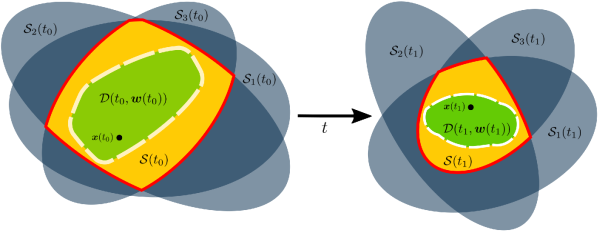
In this paper, we develop a novel adaptation-based approach to constrained control design under multiple state and input constraints. Specifically, we introduce a method for synthesizing any number of time-varying candidate control barrier functions (CBF) into one consolidated CBF (C-CBF) candidate, and propose a predictor-corrector optimization-based adaptation law for the weights of the constituent constraint functions that certifies the C-CBF as valid for a class of nonlinear, control-affine systems. We prove this result by showing that the adapted weights are guaranteed to confer sufficient control authority to meet the new, adaptive C-CBF condition in perpetuity despite input constraints, which thereby permits its use in a quadratic program based control law. We then illustrate the performance of our controller on an academic example, and further highlight that it is successful even for constraint functions with higher or mixed relative-degree by simulating a reach-avoid problem for bicycle robots, which we use to demonstrate how our approach out-performs two baseline approaches.
Motivation & Objective
- Address the challenge of ensuring feasibility and safety in control design under multiple, time-varying spatiotemporal constraints and input limitations.
- Overcome the limitations of existing CBF methods that fail under multiple constraints or require manual tuning or offline verification.
- Develop a unified, adaptive framework that synthesizes any number of CBF candidates into a single consolidated CBF (C-CBF) with guaranteed validity.
- Ensure perpetual feasibility of the C-CBF condition under input constraints by dynamically adapting the weights of constituent CBFs.
- Enable robust, smooth control action without oscillations or sudden switching, even when constraints have mixed or high relative degrees.
Proposed method
- Formalize a generic class of consolidated CBFs (C-CBF) by combining multiple time-varying CBF candidates through a convex combination with adaptive weights.
- Design a predictor-corrector interior-point method-based adaptation law to update the weights of the constituent CBFs in real time.
- Prove that the adapted weights ensure sufficient control authority to satisfy the C-CBF condition at all times, even under input constraints.
- Integrate the C-CBF into a quadratic program (QP)-based control law, ensuring feasibility and safety throughout the control horizon.
- Use a predictor step to estimate future weight dynamics and a corrector step to enforce primal-dual feasibility, mimicking interior-point optimization.
- Apply the method to both a 1D unstable system and a bicycle robot reach-avoid problem with eight constraints, including relative-degree two constraints.
Experimental results
Research questions
- RQ1Can a single consolidated CBF be constructed from multiple time-varying CBF candidates such that the resulting function ensures forward invariance under input constraints?
- RQ2Can an adaptive weight update law be designed to maintain the validity of the C-CBF condition indefinitely, even when control authority is limited?
- RQ3Does the proposed method preserve feasibility of the QP-based control law under input constraints while ensuring smooth, non-oscillatory control actions?
- RQ4How does the method perform on systems with constraints of mixed or high relative degree, particularly when the C-CBF derivative depends only on higher-order dynamics?
- RQ5Can the adaptive C-CBF controller outperform existing baseline methods—such as HO-CBF-QP and E-CBF-QP—under varying levels of conservatism and input constraints?
Key findings
- The proposed adaptive C-CBF controller successfully guides a bicycle robot to its goal in a reach-avoid problem with eight time-varying constraints, including six with relative-degree two.
- Unlike the HO-CBF-QP controller, which became infeasible in all four simulated trials due to input constraints, the adaptive C-CBF controller maintained feasibility and reached the goal.
- The E-CBF-QP controller required expert tuning and was sensitive to gain selection: overly conservative gains led to infeasibility, while aggressive gains caused collisions.
- The C-CBF weights adapted smoothly over time (as shown in Figure 11), avoiding abrupt switching and enabling smooth control inputs without oscillatory behavior.
- All eight constraint functions were satisfied throughout the maneuver, and the C-CBF condition remained feasible, even though six constraints contributed zero to the first derivative of H.
- The controller achieved safe, stable, and globally feasible control without relying on offline verification or manual tuning, demonstrating robustness to dynamic environments and unknown disturbances.
Read this paper
Open the full text in the Nubint reader and ask about any passage as you read.
Read this paper on NubintThis review was generated by AI from the original paper. Please check the paper before citing it.