
[Paper Review] Constraining $f_{NL}$ using the Large-Scale Modulation of Small-Scale Statistics
This paper introduces a computationally efficient method to constrain primordial non-Gaussianity ($f_{NL}$) by leveraging the large-scale modulation of small-scale power spectra in $N$-body simulations. It combines squeezed bispectrum and collapsed trispectrum information via a minimal bias model, achieving strong constraints on $f_{NL}$ from the matter field—though halo statistics provide only marginal improvements over the two-point function alone.
We implement a novel formalism to constrain primordial non-Gaussianity of the local type from the large-scale modulation of the small-scale power spectrum. Our approach combines information about primordial non-Gaussianity contained in the squeezed bispectrum and the collapsed trispectrum of large-scale structure together in a computationally amenable and consistent way, while avoiding the need to model complicated covariances of higher $N$-point functions. This work generalizes our recent work, which used a neural network estimate of local power, to the more conventional local power spectrum statistics, and explores using both matter field and halo catalogues from the Quijote simulations. We find that higher $N$-point functions of the matter field can provide strong constraints on $f_{NL}$, but higher $N$-point functions of the halo field, at the halo density of Quijote, only marginally improve constraints from the two-point function.
Motivation & Objective
- To develop a computationally efficient and consistent framework for constraining $f_{NL}$ using higher-order statistics of large-scale structure.
- To avoid complex modeling of higher $N$-point function covariances by using a minimal bias model that captures the $1/k^2$ scaling from $f_{NL} \neq 0$.
- To test whether the halo bispectrum and trispectrum add significant information beyond the halo power spectrum in realistic simulations.
- To assess the robustness of the method across different tracers (matter vs. halos) and scale ranges, including highly nonlinear modes.
Proposed method
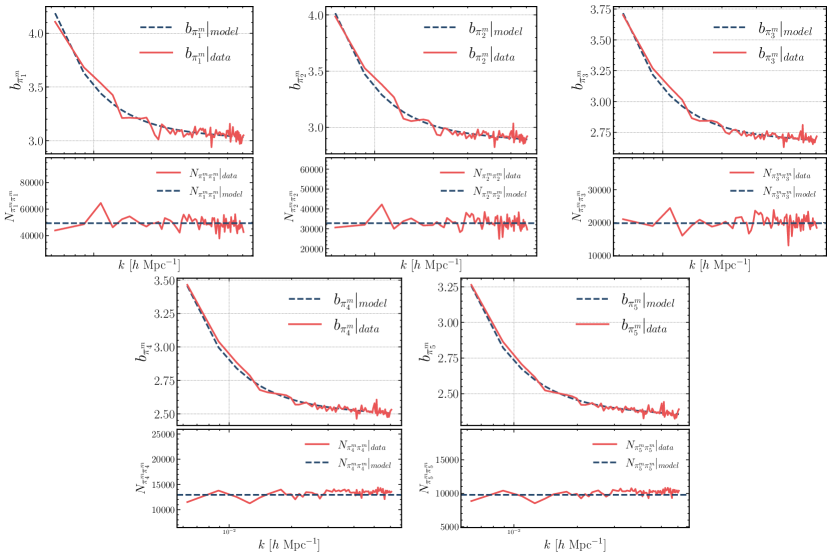
- Uses a minimal bias model that captures the $1/k^2$ scaling of the halo power spectrum in $f_{NL} \neq 0$ universes, without requiring detailed modeling of small-scale physics.
- Applies a likelihood framework that combines information from the halo power spectrum $P_{hh}$, squeezed bispectrum $B_{hhh}$, and collapsed trispectrum $T_{hhhh}$ in a consistent, computationally tractable way.
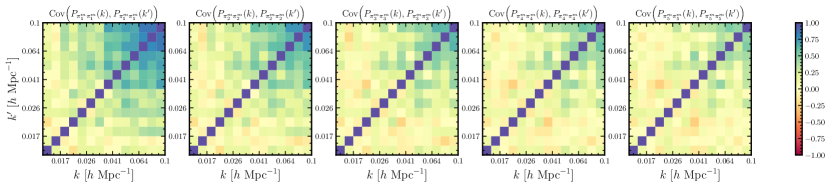
- Employs a likelihood function based on the covariance of the power spectrum and higher-order statistics, marginalized over nuisance parameters via MCMC sampling.
- Validates the method using end-to-end tests on Quijote simulations, confirming unbiased $f_{NL}$ recovery across multiple configurations.
- Extends the approach to include other large-scale tracers, such as reconstructed kSZ velocity fields, for potential sample variance cancellation.
- Uses $N$-body simulations (Quijote) to compute non-Gaussian biases $\beta_h$, $\beta_\pi$ from first principles, assuming perfect knowledge for initial validation.
Experimental results
Research questions
- RQ1Can the combination of squeezed bispectrum and collapsed trispectrum statistics improve $f_{NL}$ constraints beyond the two-point function in $f_{NL}$-sensitive large-scale structure surveys?
- RQ2How much additional $f_{NL}$ information is contained in the halo bispectrum and trispectrum compared to the halo power spectrum alone?
- RQ3Does the method remain robust when applied to halos, where nonlinear bias and limited number density may suppress higher-order signal?
- RQ4To what extent can highly nonlinear scales (approaching $k_{\rm nyquist}$) contribute to $f_{NL}$ constraints without detailed small-scale modeling?
- RQ5How does the performance of the method compare to simulation-based approaches like Quijote-PNG and analytical bispectrum studies in terms of $\sigma(f_{NL})$?
Key findings
- The matter field's higher $N$-point functions provide strong constraints on $f_{NL}$, with $\sigma(f_{NL})$ values slightly better than those reported in prior simulation-based studies.
- For the halo field, the squeezed bispectrum and collapsed trispectrum add only marginal improvement over the two-point function, consistent with findings from the Quijote-PNG collaboration.
- The method achieves robust $f_{NL}$ recovery in end-to-end tests, with unbiased constraints across multiple simulation realizations.
- As $k_{\rm max}$ increases, $\sigma(f_{NL})$ decreases slowly and eventually saturates, indicating that the method effectively captures information from highly nonlinear scales.
- The approach is computationally efficient and avoids the need to model complex covariances of higher $N$-point functions by relying on a minimal bias model.
- Non-Gaussian biases $\beta_h$ and $\beta_\pi$ are found to be degenerate with $f_{NL}$, so incorrect modeling only affects normalization, not the potential for false detection.
Read this paper
Open the full text in the Nubint reader and ask about any passage as you read.
Read this paper on NubintThis review was generated by AI from the original paper. Please check the paper before citing it.