
[Paper Review] Constraining the Graviton Mass with the NANOGrav 15-Year Data Set
This study constrains the graviton mass using the NANOGrav 15-year pulsar timing data by analyzing the stochastic gravitational wave background (SGWB) under massive gravity, which predicts a minimum frequency and modified Hellings-Downs correlations. Despite Bayesian comparisons showing no strong preference for massive gravity over general relativity (Bayes factors < 3), the data’s detection of power at the lowest Fourier frequency yields an upper limit of $ m_g < 8.2 \times 10^{-24}\ \text{eV}/c^2 $.
The recently detected stochastic signal by several pulsar timing array collaborations, offers an opportunity to scrutinize the fundamental properties of gravity, including the potential mass of the graviton. In this study, we analyze the NANOGrav 15-year data set to search for a stochastic gravitational wave background with modified Hellings-Downs correlations predicted by massive gravity. While the Bayesian analysis comparing the massive gravity to massless gravity within the effective searchable mass range of $m_g\in [3 imes 10^{-25}, 8 imes 10^{-24}]\, m{eV}/c^2$ does not yield an explicit upper bound as all the Bayes factors are smaller than $3$, the combined consideration of the minimum frequency inherent in a massive gravity and the observed spectrum leads to an upper limit of $m_g<8.2 imes 10^{-24}\, m{eV}/c^2$.
Motivation & Objective
- Test whether the NANOGrav 15-year data set supports a stochastic gravitational wave background (SGWB) predicted by massive gravity, which introduces a minimum frequency and modified spatial correlations.
- Address the challenge of distinguishing massive gravity from general relativity using pulsar timing array data, particularly in the absence of strong Bayesian evidence for massive gravitons.
- Establish a robust upper bound on the graviton mass by combining the observed low-frequency power with the theoretical minimum frequency inherent in massive gravity.
- Overcome limitations of prior methods that rely on group velocity or binned angular separations by directly modeling frequency-dependent overlap reduction functions.
- Provide a data-driven constraint on the maximum graviton mass consistent with current pulsar timing observations.
Proposed method
- Model the stochastic gravitational wave background (SGWB) in massive gravity using a frequency-dependent overlap reduction function (ORF) that deviates from the standard Hellings-Downs curve due to the graviton's mass.
- Use the de Broglie relation and relativistic dispersion relation to derive the minimum frequency $ f_{\text{min}} = \frac{m_g c^2}{2\pi\hbar} $, which sets a lower bound on observable gravitational wave frequencies.
- Perform Bayesian inference comparing two hypotheses: one assuming a massive graviton with modified ORF (H2), and another assuming a massless graviton with standard Hellings-Downs correlations (H1).
- Apply Markov Chain Monte Carlo (MCMC) sampling via the PTMCMCSampler package to compute posterior distributions and Bayes factors for graviton masses in the range $ m_g \in [3 \times 10^{-25}, 8 \times 10^{-24}]\ \text{eV}/c^2 $.
- Utilize the enterprise and enterprise_extension software packages to compute likelihoods and Bayes factors from the NANOGrav 15-year data set, including timing residuals and pulsar distance models.
- Combine the observed presence of signal power at the lowest Fourier frequency $ 1/T $ with the theoretical $ f_{\text{min}} $ to derive a natural upper bound on the graviton mass.
Experimental results
Research questions
- RQ1Does the NANOGrav 15-year data set show statistically significant evidence for a stochastic gravitational wave background with modified Hellings-Downs correlations expected in massive gravity?
- RQ2Can the observed low-frequency power in the NANOGrav data set be used to constrain the maximum possible graviton mass, given the theoretical minimum frequency in massive gravity?
- RQ3Is there a detectable difference in the spatial correlation structure between a massive graviton and a massless graviton, as inferred from pulsar timing residuals?
- RQ4How do the Bayes factors between massive and massless gravity hypotheses vary across the searchable graviton mass range?
- RQ5Can a direct frequency-dependent analysis of the ORF provide a more robust constraint on the graviton mass than methods relying on group velocity or binned angular separations?
Key findings
- The NANOGrav 15-year data set shows non-zero power at the lowest Fourier frequency $ 1/T $, indicating the presence of a gravitational wave signal at or below this frequency.
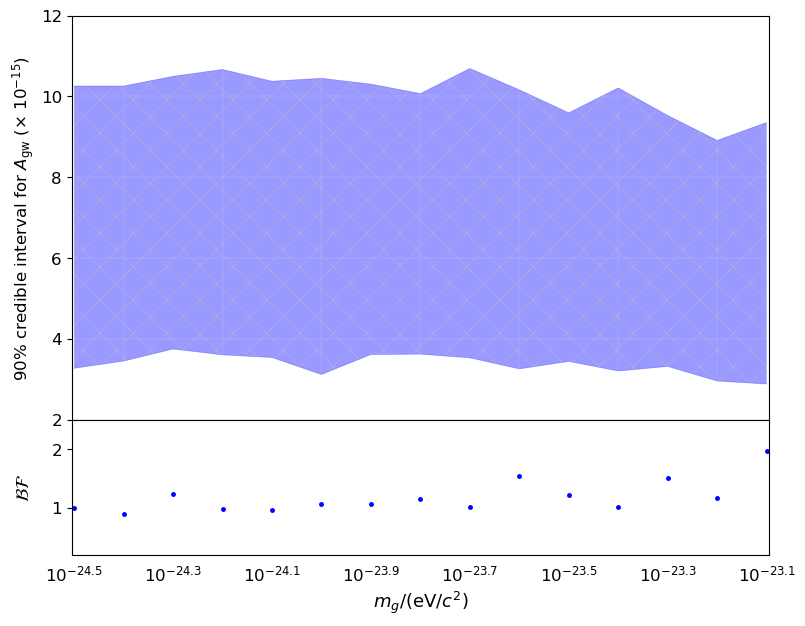
- Despite extensive Bayesian model comparison, all Bayes factors for massive gravity over massless gravity remain below 3 across the explored mass range $ m_g \in [3 \times 10^{-25}, 8 \times 10^{-24}] \text{eV}/c^2 $, indicating no strong evidence for a massive graviton.
- The $ 90\% $ credible intervals for the power spectrum amplitude $ A_{\text{gw}} $ are consistent across the mass range, lying within $ [3, 10] \times 10^{-15} $, and align with results from massless gravity analyses.
- By combining the observed low-frequency signal with the theoretical minimum frequency $ f_{\text{min}} $ in massive gravity, the study derives a robust upper bound: $ m_g < 8.2 \times 10^{-24}\ \text{eV}/c^2 $.
- The upper bound is derived without assuming a specific model for the ORF, relying instead on the natural frequency cutoff imposed by massive gravity and the data’s observed power at low frequencies.
- Alternative methods that rely on group velocity or binned angular separations face ambiguity in selecting the appropriate frequency; this work avoids that by directly modeling the frequency-dependent ORF in the data.
Read this paper
Open the full text in the Nubint reader and ask about any passage as you read.
Read this paper on NubintThis review was generated by AI from the original paper. Please check the paper before citing it.