
[Paper Review] Controlled Variable Selection from Summary Statistics Only? A Solution via GhostKnockoffs and Penalized Regression
This paper proposes a novel method for controlled variable selection using only summary statistics—specifically, marginal correlations between predictors and the response—by extending GhostKnockoffs with penalized regression. It achieves false discovery rate (FDR) control and significantly improves power over prior methods, as demonstrated in simulations and a meta-analysis of Alzheimer’s GWAS data.
Identifying which variables do influence a response while controlling false positives pervades statistics and data science. In this paper, we consider a scenario in which we only have access to summary statistics, such as the values of marginal empirical correlations between each dependent variable of potential interest and the response. This situation may arise due to privacy concerns, e.g., to avoid the release of sensitive genetic information. We extend GhostKnockoffs (He et al. [2022]) and introduce variable selection methods based on penalized regression achieving false discovery rate (FDR) control. We report empirical results in extensive simulation studies, demonstrating enhanced performance over previous work. We also apply our methods to genome-wide association studies of Alzheimer's disease, and evidence a significant improvement in power.
Motivation & Objective
- To develop a method for controlled variable selection that operates solely from summary statistics, avoiding the need for individual-level data due to privacy constraints.
- To extend the GhostKnockoffs framework by incorporating feature importance from penalized regression, improving statistical power over marginal correlation-based methods.
- To ensure rigorous false discovery rate (FDR) control under minimal distributional assumptions, particularly when the full covariate covariance matrix is unavailable.
- To enable effective variable selection in large-scale genetic studies, such as GWAS, using only publicly available summary statistics.
- To demonstrate the method’s utility through extensive simulations and real-world application to Alzheimer’s disease GWAS meta-analyses.
Proposed method
- The method constructs knockoff statistics using penalized regression (e.g., Lasso or pseudo-lasso) on summary statistics, including $\mathbf{X}^T\mathbf{Y}$, $\|\mathbf{Y}\|_2^2$, and sample size $n$, without requiring $\mathbf{X}^T\mathbf{X}$.
- It introduces a pseudo-lasso estimator that approximates the lasso solution using only summary statistics, enabling feature importance computation under limited data access.
- For cases where $\mathbf{X}^T\mathbf{X}$ is missing, the method proposes new imputation techniques to reconstruct the empirical covariance matrix consistently.
- The approach leverages the rotational invariance and linearity of Gaussian distributions to generate valid knockoff statistics from summary statistics alone.
- It integrates the knockoff framework with penalized regression to produce more powerful test statistics than marginal correlation alone.
- The method guarantees FDR control under the assumption that the covariates follow a Gaussian distribution, even when only summary statistics are available.
Experimental results
Research questions
- RQ1Can we achieve FDR-controlled variable selection using only summary statistics such as marginal correlations and response norms?
- RQ2Does incorporating penalized regression-based feature importance improve power compared to marginal correlation-based methods in summary statistics settings?
- RQ3Can we reliably impute the empirical covariance matrix when $\mathbf{X}^T\mathbf{X}$ is not available, while maintaining FDR control?
- RQ4How does the proposed method perform in real-world GWAS applications, particularly in detecting variants with weak marginal effects?
- RQ5Can the method identify biologically relevant loci missed by conventional marginal association tests with stringent FWER correction?
Key findings
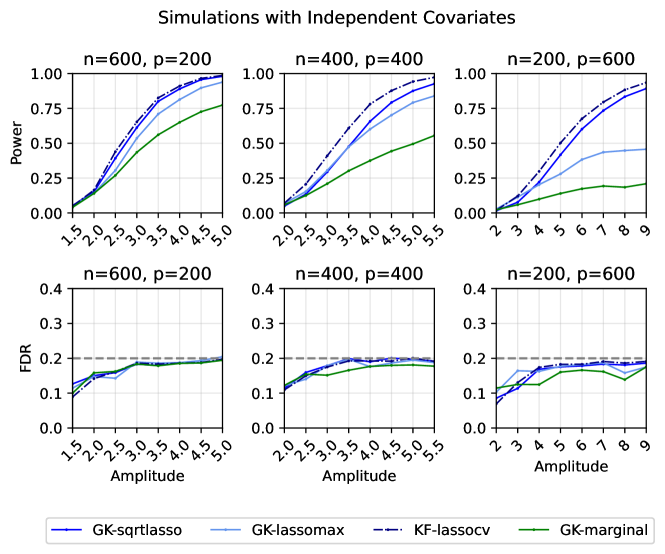
- In simulations, the proposed method (GK-pseudolasso) identified 42 loci at a 10% FDR level, compared to only 10 loci using the marginal correlation method (GK-marginal), demonstrating a substantial power gain.
- At a 20% FDR level, GK-pseudolasso detected 63 loci versus 17 for GK-marginal, further confirming improved discovery power.
- In the Alzheimer’s disease GWAS meta-analysis, 54.0% of the top variants in identified groups had functional evidence (e.g., eQTLs, enhancer regions), significantly higher than the 28.6% background rate.
- The method detected functional variants with small marginal p-values (e.g., >5×10⁻⁸) that were missed by conventional genome-wide thresholding, indicating sensitivity to weak but biologically relevant signals.
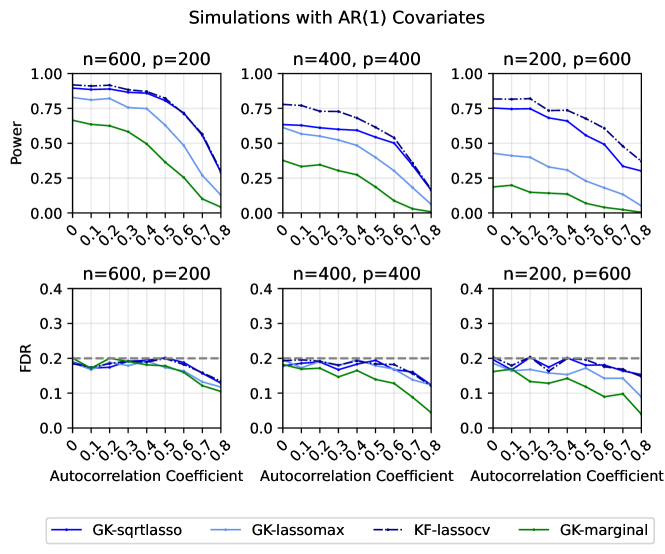
- The proposed imputation methods for $\mathbf{X}^T\mathbf{X}$ consistently outperformed baseline approaches in both synthetic and semi-synthetic simulations while maintaining FDR control.
- The method achieved FDR control under the assumption of Gaussian covariates and leveraged rotational invariance to generate valid knockoff statistics from summary statistics alone.
Better researchstarts right now
From reading papers to final review, dramatically reduce your research time.
No credit card · Free plan available
This review was created by AI and reviewed by human editors.