
[Paper Review] Controlling the Photon Number Coherence of Solid-state Quantum Light Sources for Quantum Cryptography
This paper demonstrates on-demand generation of high-fidelity single photons from semiconductor quantum dots using a tailored two-photon excitation scheme with a stimulation pulse, achieving full control over photon number coherence (PNC) while maintaining high purity and indistinguishability. The method enables tunable PNC levels, making it suitable for diverse quantum cryptography protocols, including those requiring zero or specific non-zero PNC for enhanced security and performance.
Quantum communication networks rely on quantum cryptographic protocols including quantum key distribution (QKD) using single photons. A critical element regarding the security of QKD protocols is the photon number coherence (PNC), i.e. the phase relation between the zero and one-photon Fock state, which critically depends on the excitation scheme. Thus, to obtain flying qubits with the desired properties, optimal pumping schemes for quantum emitters need to be selected. Semiconductor quantum dots generate on-demand single photons with high purity and indistinguishability. Exploiting two-photon excitation of a quantum dot combined with a stimulation pulse, we demonstrate the generation of high-quality single photons with a controllable degree of PNC. Our approach provides a viable route toward secure communication in quantum networks.
Motivation & Objective
- To address the critical challenge of photon number coherence (PNC) in solid-state single-photon sources for quantum cryptography.
- To develop an excitation scheme that enables on-demand control of PNC without degrading single-photon purity or indistinguishability.
- To enable compatibility with a broad range of quantum cryptographic protocols by tailoring PNC levels to specific protocol requirements.
- To demonstrate experimentally that PNC can be precisely controlled using a two-photon excitation protocol with a stimulation pulse in InAs/GaAs quantum dots.
Proposed method
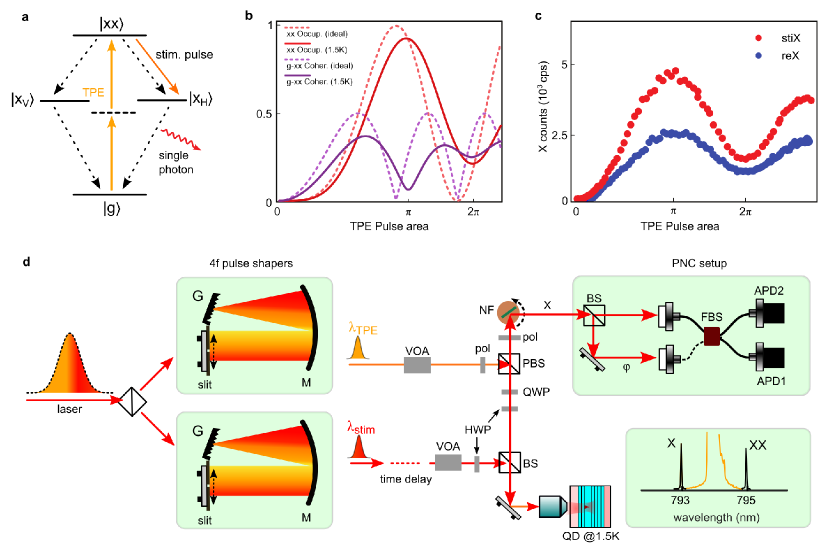
- Employing a two-photon excitation scheme with a stimulated pulse to coherently prepare the quantum dot in a superposition of the ground and single-exciton states.
- Using a sequence of half-wave plates and quarter-wave plates to act as a variable phase shifter, enabling continuous phase modulation of one interferometric arm.
- Implementing a fiber-based Hanbury Brown and Twiss (HBT) setup with a 50:50 fiber beam splitter to measure photon indistinguishability and visibility.
- Applying a theoretical model to decompose the density matrix into pure and mixed components, extracting the PNC via the visibility and photon occupation probability.
- Calibrating the interferometer by interfering the excitation laser with itself to maximize fringe contrast, achieving 98% visibility.
- Using the visibility as a function of the ground state population to extract the coherence parameter λ, which quantifies the degree of PNC.
Experimental results
Research questions
- RQ1Can photon number coherence (PNC) be experimentally controlled in a solid-state single-photon source without compromising single-photon quality?
- RQ2How does the two-photon excitation scheme with a stimulation pulse affect the degree of PNC in semiconductor quantum dots?
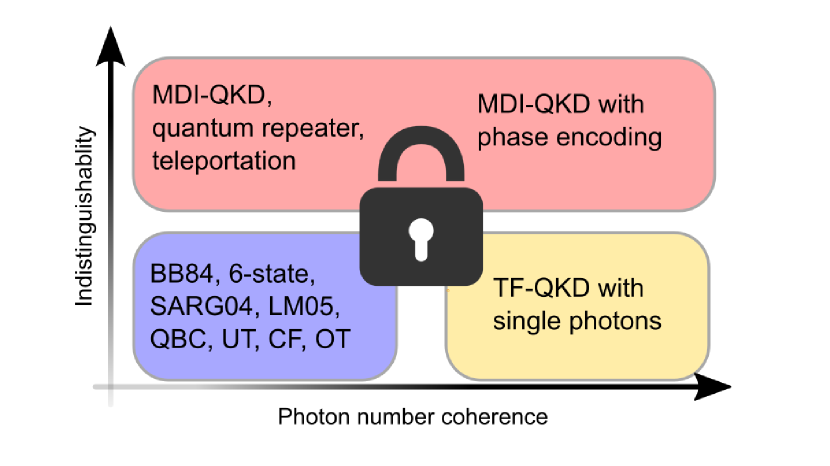
- RQ3To what extent can PNC be tuned to match the requirements of different quantum cryptography protocols, such as BB84, MDI-QKD, or twin-field QKD?
- RQ4What is the relationship between photon indistinguishability, visibility, and the extracted PNC in a controlled excitation scheme?
- RQ5Can the PNC be measured and quantified accurately using a modified HBT setup and density matrix decomposition?
Key findings
- The experiment achieved a visibility of 98% in the HBT interferometer, indicating high photon indistinguishability and stable interferometric alignment.
- The degree of photon number coherence (PNC) was experimentally controlled and measured, with values tunable across the full range from zero to maximum coherence.
- The method enabled a photon output rate up to twice that of conventional resonant excitation, significantly improving source brightness.
- The PNC was extracted using a model-based analysis of visibility and population, yielding PNC^exp = λ√(ρ₁,₁(1−ρ₁,₁)), where λ quantifies the coherence strength.
- The approach maintains high single-photon purity and indistinguishability while enabling precise PNC control, making it suitable for advanced quantum cryptography protocols.
- The results demonstrate a viable path toward secure, high-performance quantum networks using semiconductor quantum dots as on-demand single-photon sources.
Better researchstarts right now
From reading papers to final review, dramatically reduce your research time.
No credit card · Free plan available
This review was created by AI and reviewed by human editors.