
[Paper Review] Cosmological constraints from HSC Y1 lensing convergence PDF
This study presents the first cosmological constraints from the weak lensing convergence probability distribution function (PDF) using HSC Y1 data, combining it with the power spectrum to improve $S_8$ measurements. The PDF, derived from standard deviation-normalized convergence maps, captures non-Gaussian structure and tightens the power spectrum-only constraint by ~10%, yielding $S_8 = 0.798^{+0.029}_{-0.042}$ (68% CL).
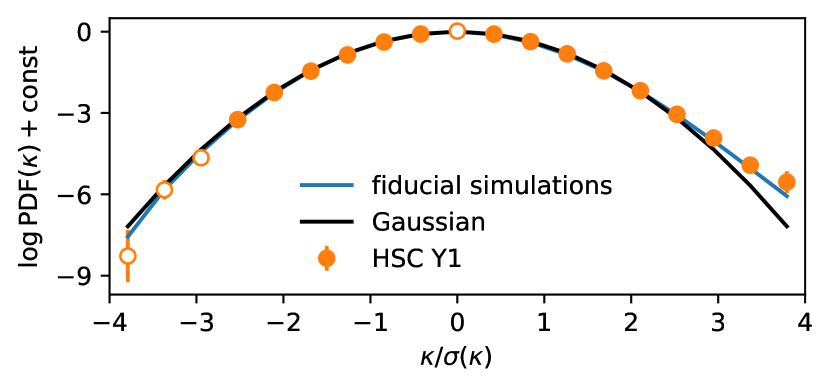
We utilize the probability distribution function (PDF) of normalized convergence maps reconstructed from the Subaru Hyper Suprime-Cam (HSC) Y1 shear catalogue, in combination with the power spectrum, to measure the matter clustering amplitude $S_8=σ_8\sqrt{Ω_m/0.3}$. The large-scale structure's statistical properties are incompletely described by the traditional two-point statistics, motivating our investigation of the PDF -- a complementary higher-order statistic. By defining the PDF over the standard deviation-normalized convergence map we are able to isolate the non-Gaussian information. We use tailored simulations to compress the data vector and construct a likelihood approximation. We mitigate the impact of survey and astrophysical systematics with cuts on smoothing scales, redshift bins, and data vectors. We find $S_8=0.860^{+0.066}_{-0.109}$ from the PDF alone and $S_8=0.798^{+0.029}_{-0.042}$ from the combination of PDF and power spectrum (68% CL). The PDF improves the power spectrum-only constraint by about 10%.
Motivation & Objective
- To extract cosmological information from the non-Gaussian statistics of weak lensing convergence maps, specifically the PDF, to complement traditional two-point statistics.
- To address the $S_8$-tension by probing higher-order statistical information not captured by the power spectrum.
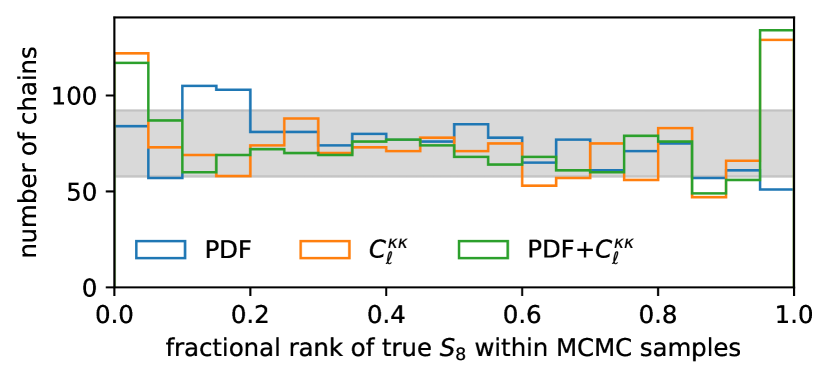
- To validate that systematics from survey geometry and astrophysical effects are under control through scale, redshift, and data vector cuts.
- To develop a likelihood approximation using tailored cosmological simulations to model the PDF and its dependence on cosmological parameters.
- To demonstrate the PDF's complementarity to the power spectrum in tightening constraints on $S_8$ without relying on variance information.
Proposed method
- Reconstructed weak lensing convergence maps from the HSC Y1 shear catalogue using the Kaiser-Squires inversion method.
- Constructed the PDF of convergence maps normalized by their local standard deviation to isolate non-Gaussian, higher-order statistical information.
- Used a large suite of tailored cosmological simulations matching HSC Y1 survey geometry and systematics to model the PDF and build a likelihood approximation.
- Applied data compression and likelihood approximation techniques to handle the high-dimensional data vector while preserving cosmological information.
- Implemented a three-step blinding procedure to minimize confirmation bias in the analysis.
- Combined the PDF likelihood with the power spectrum likelihood to jointly constrain $S_8 = \sigma_8 \sqrt{\Omega_m / 0.3}$, using a joint posterior analysis.
Experimental results
Research questions
- RQ1Can the probability distribution function (PDF) of weak lensing convergence maps provide cosmologically relevant, complementary information beyond the power spectrum?
- RQ2How does the PDF-based constraint on $S_8$ compare to the power spectrum-only constraint in terms of precision and central value?
- RQ3To what extent can the PDF help mitigate or resolve the $S_8$-tension when combined with two-point statistics?
- RQ4Are survey and astrophysical systematics adequately controlled when using the PDF as a summary statistic?
- RQ5Does the PDF contain information independent of the variance, thus avoiding direct overlap with two-point statistics?
Key findings
- The PDF alone yields a $S_8 = 0.860^{+0.066}_{-0.109}$ constraint (68% CL), with a $9\sigma$ detection of nonlinear clustering, indicating strong cosmological sensitivity.
- The combination of PDF and power spectrum tightens the $S_8$ constraint by approximately 10% compared to the power spectrum alone, yielding $S_8 = 0.798^{+0.029}_{-0.042}$ (68% CL).
- The PDF-only constraint is statistically consistent with the power spectrum-only result but shows a slightly higher mean value, indicating independent information content.
- The analysis confirms that the PDF is largely independent of variance, as the convergence maps were normalized by their standard deviation to remove two-point statistics.
- The posterior from the combined PDF and power spectrum is consistent with previous HSC Y1 two-point analyses in mean value, though slightly wider due to differences in data vector, priors, and systematic treatments.
- No tension is found between the $S_8$ inferred from HSC Y1 lensing and from primordial CMB measurements, supporting the robustness of the current constraints.
Read this paper
Open the full text in the Nubint reader and ask about any passage as you read.
Read this paper on NubintThis review was generated by AI from the original paper. Please check the paper before citing it.