
[Paper Review] Cosmological constraints from weak lensing scattering transform using HSC Y1 data
This study presents the first cosmological constraints from weak lensing using the scattering transform on HSC Y1 data, a statistical estimator that combines interpretability, robustness, and high constraining power. It achieves a 2× tighter constraint on Ωₘ compared to the power spectrum and reveals that photometric redshift calibration—particularly in the z ≈ 1 bin—is the dominant limitation for S₈ inference, not the choice of spatial statistic.
As weak lensing surveys go deeper, there is an increasing need for reliable characterization of non-Gaussian structures at small angular scales. Here we present the first cosmological constraints with weak lensing scattering transform, a statistical estimator that combines efficiency, robustness, and interpretability. With the Hyper Suprime-Cam survey (HSC) year 1 data, we obtain $Ω_ ext{m}=0.29_{-0.03}^{+0.04}$, $S_8\equiv σ_8(Ω_ ext{m}/0.3)^{0.5}=0.83\pm0.02$, and intrinsic alignment strength $A_ ext{IA}=1.0\pm0.4$ through simulation-based forward modeling. Our constraints are consistent with those derived from Planck. The error bar of $Ω_ ext{m}$ is 2 times tighter than that obtained from the power spectrum when the same scale range is used. This constraining power is on par with that of convolutional neural networks, suggesting that further investment in spatial information extraction may not yield substantial benefits. We also point out an internal tension of $S_8$ estimates linked to a redshift bin around z ~ 1 in the HSC data. We found that discarding that bin leads to a consistent decrease of $S_8$ from 0.83 to 0.79, for all statistical estimators. We argue that photometric redshift estimation is now the main limitation in the estimation of $S_8$ using HSC. This limitation is likely to affect other ground-based weak lensing surveys reaching redshifts greater than one. Alternative redshift estimation techniques, like clustering redshifts, may help alleviate this limitation.
Motivation & Objective
- To apply the scattering transform—a non-Gaussian, interpretable, and robust statistical estimator—to real weak lensing data for cosmological parameter inference.
- To improve constraints on Ωₘ and S₈ by capturing non-Gaussian structures in convergence maps that power spectra miss.
- To assess whether the scattering transform outperforms traditional two-point statistics and to evaluate its sensitivity to systematics, especially photometric redshift errors.
- To identify the primary limiting factor in S₈ estimation from ground-based weak lensing surveys, particularly in the context of the S₈ tension.
Proposed method
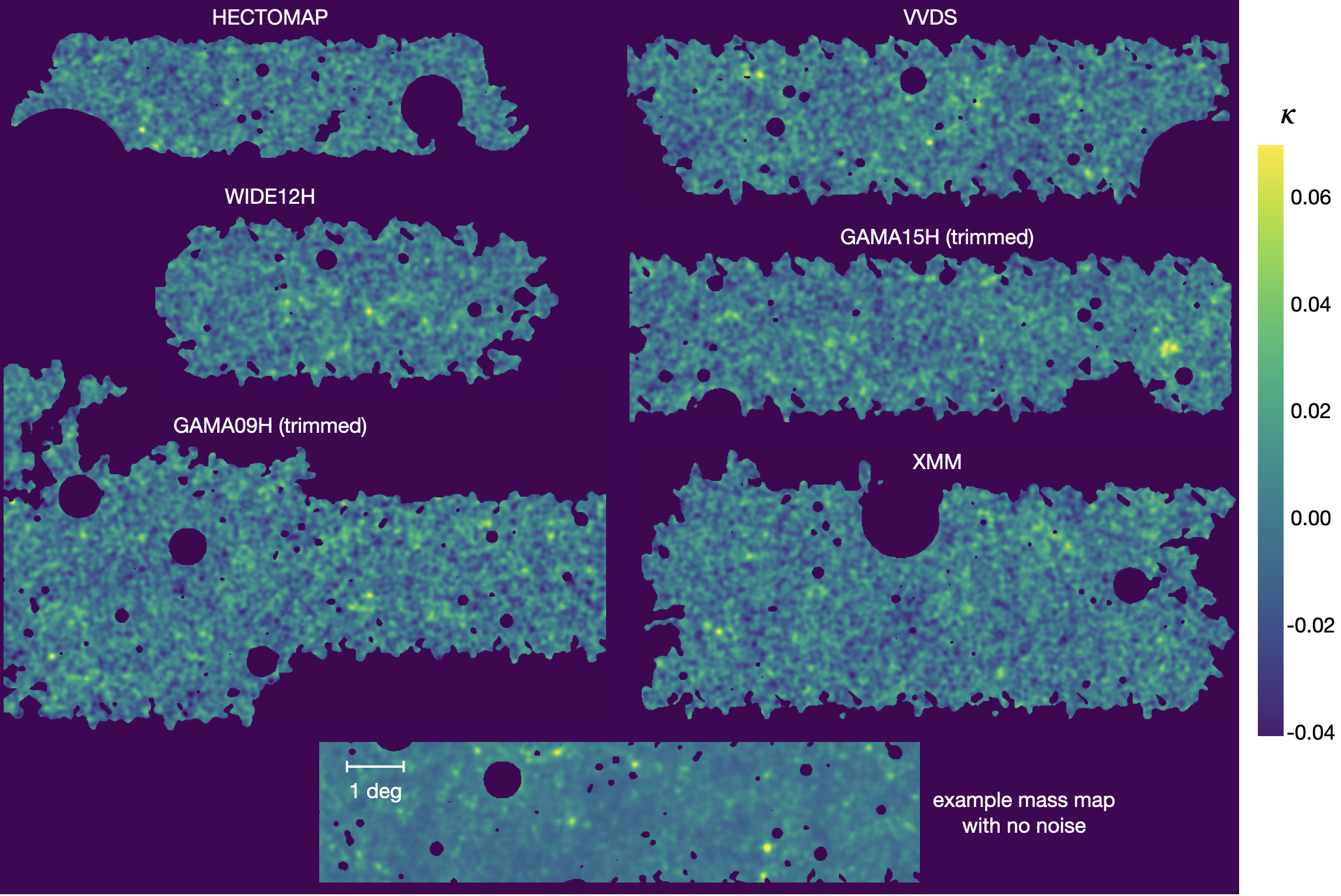
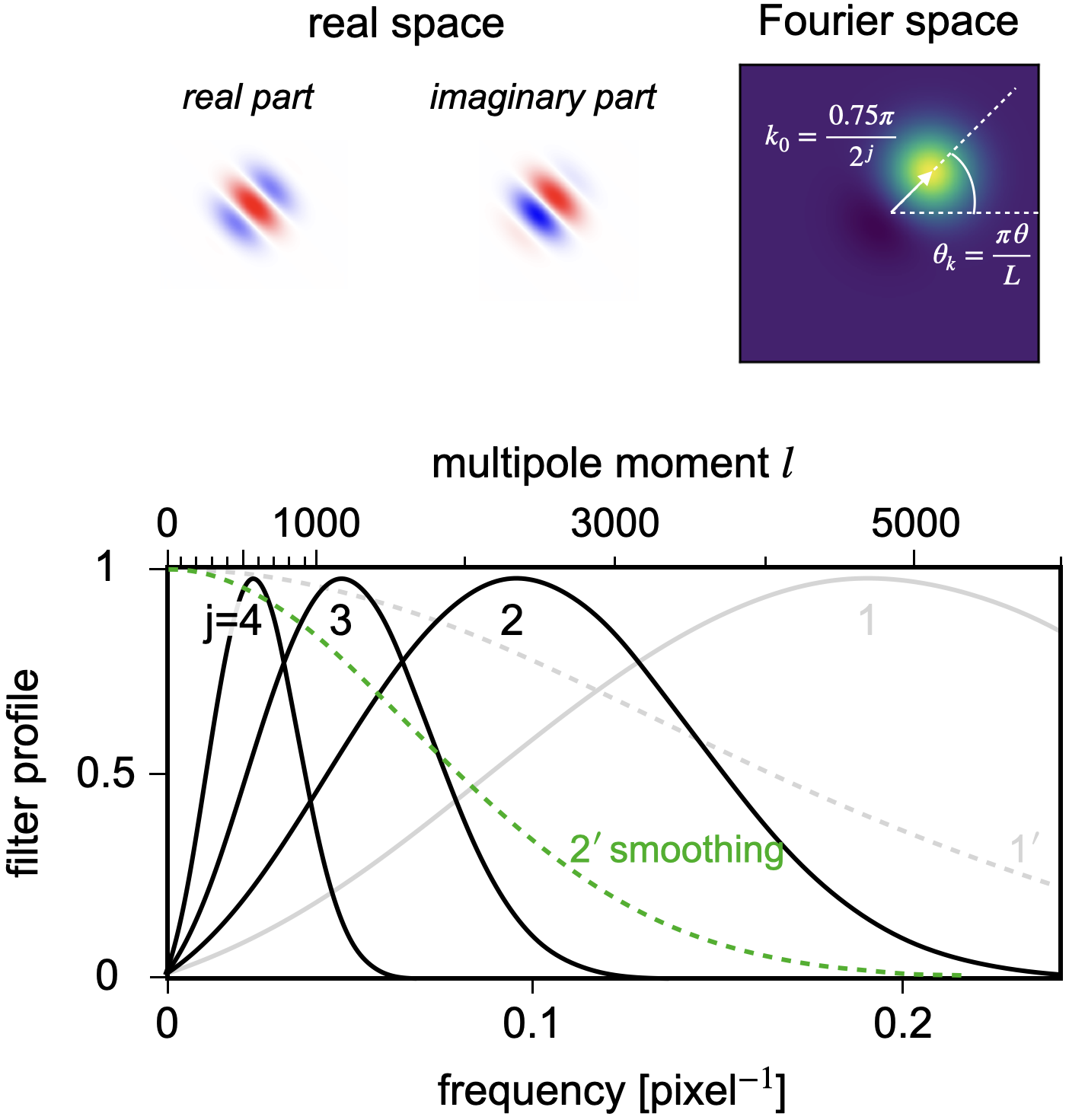
- The scattering transform is applied to weak lensing convergence maps derived from the HSC Y1 shear catalog, using a multi-scale, wavelet-based hierarchical filtering approach to extract non-Gaussian features.
- A forward modeling framework is employed, using a large ensemble of N-body simulations and mock galaxy catalogs tailored to the HSC Y1 survey's observing conditions.
- Cosmological constraints are derived via Bayesian inference, comparing observed statistics to simulated data distributions to estimate Ωₘ, S₈, and intrinsic alignment amplitude A_IA.
- Tomographic analysis is performed across multiple redshift bins, with sensitivity tested by excluding the z ≈ 1 bin to assess redshift calibration effects.
- The method is compared to traditional power spectrum analysis and shown to achieve comparable constraining power to deep learning models, but with full interpretability and no training required.
- Photometric redshift uncertainties are probed by systematically removing the third redshift bin (z ≈ 0.9–1.2) and observing shifts in S₈.
Experimental results
Research questions
- RQ1Can the scattering transform provide tighter constraints on Ωₘ than the power spectrum when applied to real weak lensing data?
- RQ2How does the scattering transform’s performance compare to deep learning methods in terms of constraining power and interpretability?
- RQ3Is the S₈ tension in HSC data driven by systematics in photometric redshift estimation, particularly in the z ≈ 1 redshift bin?
- RQ4To what extent do non-Gaussian features across tomographic redshift bins contribute to improved cosmological constraints?
- RQ5Can the scattering transform help identify and quantify systematic biases in weak lensing surveys, especially those related to redshift calibration?
Key findings
- The scattering transform reduces the error bar on Ωₘ by a factor of 2 compared to the power spectrum when using the same angular scale range, achieving constraining power comparable to convolutional neural networks.
- The constraint on Ωₘ is Ωₘ = 0.29⁻⁰.⁰³⁺⁰.⁰⁴, and S₈ = 0.83 ± 0.02, both consistent with Planck results.
- Excluding the redshift bin at z ≈ 1 (0.9–1.2) reduces S₈ from 0.83 to 0.79 across all statistical estimators, indicating a systematic bias in photometric redshifts.
- The study identifies photometric redshift estimation as the primary limitation for S₈ inference in HSC Y1 and other ground-based weak lensing surveys reaching z > 1.
- Non-Gaussian statistics, including the scattering transform, are robust to photometric redshift bias when constraining Ωₘ, but S₈ inference remains sensitive to redshift calibration.
- Future improvements in S₈ constraints are unlikely to come from better spatial statistics or machine learning tools unless photometric redshift accuracy is enhanced, e.g., via clustering redshifts or near-infrared photometry from space telescopes like Euclid or Roman.
Read this paper
Open the full text in the Nubint reader and ask about any passage as you read.
Read this paper on NubintThis review was generated by AI from the original paper. Please check the paper before citing it.