
[Paper Review] Cosmology meets cohomology
This paper introduces a cohomological framework for computing cosmological correlators in Friedmann-Robertson-Walker (FRW) spacetimes using relative twisted cohomology and canonical differential equations. By leveraging mathematical tools from Feynman integral theory—particularly intersection theory and twisted cohomology—it provides an efficient algorithm to predict basis sizes and simplify differential equations for FRW wavefunction coefficients, significantly streamlining computations that are otherwise intractable via direct integration.
The cosmological polytope and bootstrap programs have revealed interesting connections between positive geometries, modern on-shell methods and bootstrap principles studied in the amplitudes community with the wavefunction of the Universe in toy models of FRW cosmologies. To compute these FRW correlators, one often faces integrals that are too difficult to evaluate by direct integration. Borrowing from the Feynman integral community, the method of (canonical) differential equations provides an efficient alternative for evaluating these integrals. Moreover, we further develop our geometric understanding of these integrals by describing the associated \emph{relative} twisted cohomology. Leveraging recent progress in our understanding of relative twisted cohomology in the Feynman integral community, we give an algorithm to predict the basis size and simplify the computation of the differential equations satisfied by FRW correlators.
Motivation & Objective
- To develop a systematic method for computing differential equations of FRW wavefunction coefficients, which are otherwise intractable via direct integration.
- To apply advanced mathematical tools from the Feynman integral community—specifically relative twisted cohomology and intersection theory—to cosmological correlators.
- To streamline the basis reduction process by predicting basis size without solving large IBP systems, using geometric data from the integrand structure.
- To establish a formal geometric framework for FRW correlators as integrals over hyperplane arrangements with twisted coordinates.
- To enable efficient computation of cosmological correlators by connecting them to the well-developed machinery of canonical differential equations.
Proposed method
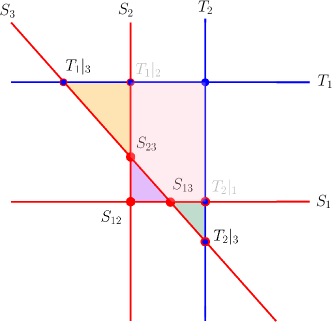
- The paper employs relative twisted cohomology to describe the integrals arising in FRW wavefunction coefficients, treating them as integrals over hyperplane arrangements with twisted coordinate hyperplanes.
- It applies the method of canonical differential equations to efficiently compute the resulting integrals, avoiding the need for solving large systems of integration-by-parts (IBP) identities.
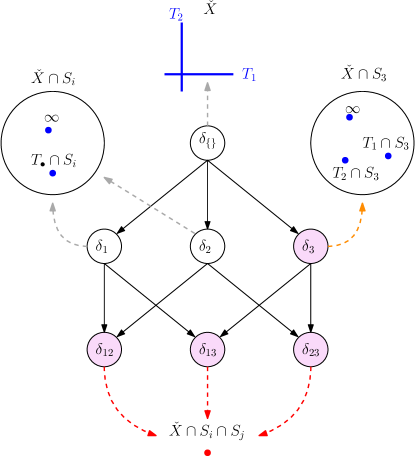
- The authors use intersection theory on twisted cohomology classes to compute intersection numbers, which determine the structure of the differential equations and the basis size.
- By setting the regulator ε to zero from the outset, the method simplifies intermediate calculations and reduces computational complexity.
- The framework uses residue calculus and local coordinates at intersection points to evaluate intersection numbers, with explicit examples in two- and three-site models.
- The physical differential equations are derived from the cohomological data, with the alphabet of logarithmic forms encoded in kinematic invariants.
Experimental results
Research questions
- RQ1How can relative twisted cohomology be used to systematically compute and simplify differential equations for FRW cosmological correlators?
- RQ2What is the role of intersection theory in predicting the size of the master integral basis for FRW wavefunction coefficients?
- RQ3How does the geometric structure of FRW integrals—defined by hyperplane arrangements with twisted coordinates—enable more efficient computation than standard perturbative methods?
- RQ4Can the formalism of canonical differential equations be adapted to cosmological correlators, given their non-rational singularity structure?
- RQ5To what extent can the cohomological framework for Feynman integrals be generalized to cosmological wavefunction coefficients in non-maximally symmetric spacetimes?
Key findings
- The intersection number ⟨φ̂₁|φ₁⟩ in the three-site tree-level example evaluates to 1, confirming the consistency of the cohomological framework.
- For the two-site example, the intersection number ⟨φ̂₁|ϑ₂⟩ evaluates to −1, demonstrating the method’s ability to handle non-trivial singularities and twisted forms.
- The method predicts a basis size of 19 for the five-point, three-site differential equation, with the physical alphabet explicitly listed in terms of kinematic invariants.
- The use of relative twisted cohomology allows setting the regulator ε to zero from the start, simplifying intermediate calculations and reducing computational overhead.
- The framework successfully maps cosmological correlators to a cohomological structure analogous to that of Feynman integrals, enabling the use of advanced mathematical tools.
- The canonical differential equation approach reduces the problem of basis reduction to geometric data, avoiding the need to solve large IBP systems.
Read this paper
Open the full text in the Nubint reader and ask about any passage as you read.
Read this paper on NubintThis review was generated by AI from the original paper. Please check the paper before citing it.