
[Paper Review] Cosmology with 6 parameters in the Stage-IV era: efficient marginalisation over nuisance parameters
This paper introduces an efficient Laplace approximation method to analytically marginalize over a large number of nuisance parameters in cosmological parameter inference, particularly for Stage-IV photometric surveys. It achieves near-brute-force accuracy with 3–10× speedups, enabling scalable joint analysis of multiple surveys despite high-dimensional nuisance spaces.
The analysis of photometric large-scale structure data is often complicated by the need to account for many observational and astrophysical systematics. The elaborate models needed to describe them often introduce many ``nuisance parameters'', which can be a major inhibitor of an efficient parameter inference. In this paper we introduce an approximate method to analytically marginalise over a large number of nuisance parameters based on the Laplace approximation. We discuss the mathematics of the method, its relation to concepts such as volume effects and profile likelihood, and show that it can be further simplified for calibratable systematics by linearising the dependence of the theory on the associated parameters. We quantify the accuracy of this approach by comparing it with traditional sampling methods in the context of existing data from the Dark Energy Survey, as well as futuristic Stage-IV photometric data. The linearised version of the method is able to obtain parameter constraints that are virtually equivalent to those found by exploring the full parameter space for a large number of calibratable nuisance parameters, while reducing the computation time by a factor 3-10. Furthermore, the non-linearised approach is able to analytically marginalise over a large number of parameters, returning constraints that are virtually indistinguishable from the brute-force method in most cases, accurately reproducing both the marginalised uncertainty on cosmological parameters, and the impact of volume effects associated with this marginalisation. We provide simple recipes to diagnose when the approximations made by the method fail and one should thus resort to traditional methods. The gains in sampling efficiency associated with this method enable the joint analysis of multiple surveys, typically hindered by the large number of nuisance parameters needed to describe them.
Motivation & Objective
- Address the growing challenge of high-dimensional nuisance parameter spaces in cosmological analyses of photometric large-scale structure data.
- Overcome computational bottlenecks in MCMC sampling caused by numerous nuisance parameters from systematics like redshift distribution errors and intrinsic alignments.
- Develop a fast, analytically tractable method to marginalize over nuisance parameters without sacrificing accuracy in cosmological constraints.
- Enable robust, scalable joint analysis of multiple future surveys (e.g., LSST, Euclid, Roman) by drastically reducing sampling time.
- Quantify the accuracy and failure conditions of the approximation relative to traditional sampling methods in realistic data scenarios.
Proposed method
- Apply the Laplace approximation to analytically marginalize over nuisance parameters in the likelihood function, reducing the dimensionality of the parameter space.
- Leverage analytical derivatives of the theory prediction with respect to nuisance parameters (e.g., bias, intrinsic alignment) to compute the Laplace approximation efficiently.
- Introduce a linearized variant of the method for calibratable systematics, where the theory depends linearly on nuisance parameters, simplifying the approximation.
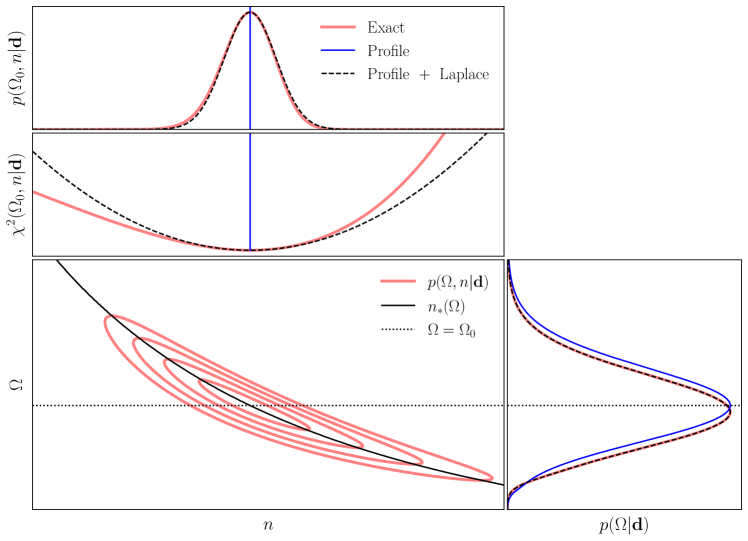
- Use the Laplace approximation to capture volume effects in marginalization, which are critical for accurate uncertainty estimation and avoiding bias.
- Diagnose failure cases using simple criteria based on non-Gaussianity and non-quadratic behavior of the likelihood, signaling when to revert to full sampling.
- Integrate the method into MCMC pipelines, achieving 2–15× faster convergence due to reduced parameter space dimensionality and efficient gradient access.
Experimental results
Research questions
- RQ1Can an analytical marginalization method based on the Laplace approximation achieve near-brute-force accuracy in cosmological parameter inference while significantly reducing computational cost?
- RQ2How does the performance of the Laplace approximation compare to traditional MCMC sampling in terms of accuracy and speed for both real DES data and simulated Stage-IV data?
- RQ3In what regimes does the Laplace approximation break down, and what diagnostic tools can reliably identify such cases?
- RQ4To what extent can the linearized version of the method preserve accuracy when the theory depends linearly on nuisance parameters, and how does it scale with increasing nuisance parameter count?
- RQ5Can this method enable the joint analysis of multiple photometric surveys by mitigating the computational burden of high-dimensional nuisance spaces?
Key findings
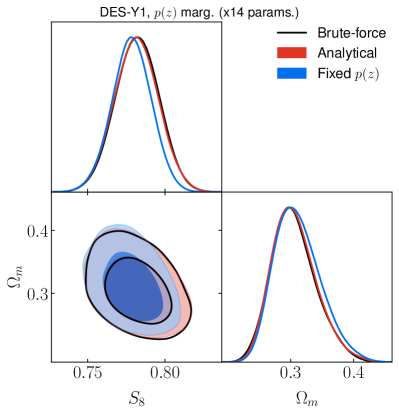
- The linearized Laplace approximation achieves parameter constraints virtually indistinguishable from full MCMC sampling, with a 3–10× reduction in computation time for calibratable systematics.
- The non-linearized Laplace method accurately reproduces both the marginal uncertainty on cosmological parameters and the volume effects from marginalization, matching brute-force results in most cases.
- The method reduces MCMC convergence time by a factor of 2–15, due to lower-dimensional parameter space and efficient gradient computation.
- The profile likelihood method was found to yield unbiased constraints, while the marginal distribution was biased in the tested setup, highlighting the importance of volume effects.
- The authors provide diagnostic rules to detect when the approximation fails, such as in cases of non-Gaussian data or non-quadratic likelihoods, where traditional sampling remains necessary.
- The approach enables scalable joint analysis of multiple photometric surveys by overcoming the computational bottleneck of high-dimensional nuisance parameter spaces.
Read this paper
Open the full text in the Nubint reader and ask about any passage as you read.
Read this paper on NubintThis review was generated by AI from the original paper. Please check the paper before citing it.