
[Paper Review] Curriculum reinforcement learning for quantum architecture search under hardware errors
CRLQAS introduces curriculum-based reinforcement learning for quantum architecture search in noisy quantum environments, with a 3D tensor circuit encoding, illegal actions, random halting, and Adam-SPSA optimizers, achieving chemical accuracy on several molecules under realistic noise.
The key challenge in the noisy intermediate-scale quantum era is finding useful circuits compatible with current device limitations. Variational quantum algorithms (VQAs) offer a potential solution by fixing the circuit architecture and optimizing individual gate parameters in an external loop. However, parameter optimization can become intractable, and the overall performance of the algorithm depends heavily on the initially chosen circuit architecture. Several quantum architecture search (QAS) algorithms have been developed to design useful circuit architectures automatically. In the case of parameter optimization alone, noise effects have been observed to dramatically influence the performance of the optimizer and final outcomes, which is a key line of study. However, the effects of noise on the architecture search, which could be just as critical, are poorly understood. This work addresses this gap by introducing a curriculum-based reinforcement learning QAS (CRLQAS) algorithm designed to tackle challenges in realistic VQA deployment. The algorithm incorporates (i) a 3D architecture encoding and restrictions on environment dynamics to explore the search space of possible circuits efficiently, (ii) an episode halting scheme to steer the agent to find shorter circuits, and (iii) a novel variant of simultaneous perturbation stochastic approximation as an optimizer for faster convergence. To facilitate studies, we developed an optimized simulator for our algorithm, significantly improving computational efficiency in simulating noisy quantum circuits by employing the Pauli-transfer matrix formalism in the Pauli-Liouville basis. Numerical experiments focusing on quantum chemistry tasks demonstrate that CRLQAS outperforms existing QAS algorithms across several metrics in both noiseless and noisy environments.
Motivation & Objective
- Motivate automatic design of PQCs tailored for VQE under NISQ hardware constraints.
- Develop a curriculum-based RL QAS (CRLQAS) framework to explore the circuit space efficiently.
- Incorporate mechanisms to handle noise and promote shorter, gate-efficient circuits.
- Provide an optimized noisy-simulation pipeline using Pauli-transfer matrices and GPU acceleration.
Proposed method
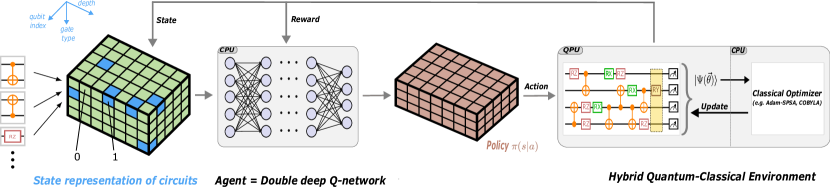
- 3D tensor-based binary encoding of quantum circuits to represent state and moments (depth).
- Illegal actions mechanism to prune invalid or canceling gate sequences.
- Random halting (RH) to bias learning toward shorter circuits.
- Two Adam-SPSA variants with adaptive momentum and variable shot budgets for faster convergence under noise.
- GPU-accelerated, offline PTM-based noise fusion enabling fast noisy simulations up to larger qubit counts.
Experimental results
Research questions
- RQ1How can curriculum learning improve QAS performance in noisy VQAs compared to existing methods?
- RQ2What encoding, action pruning, and optimization strategies best enable efficient search for compact, accurate PQCs under hardware noise?
- RQ3Can CRLQAS achieve chemical accuracy for benchmark molecules under realistic IBM device noise?
- RQ4How does the PTM-based fast noise simulation impact training efficiency and scalability?
Key findings
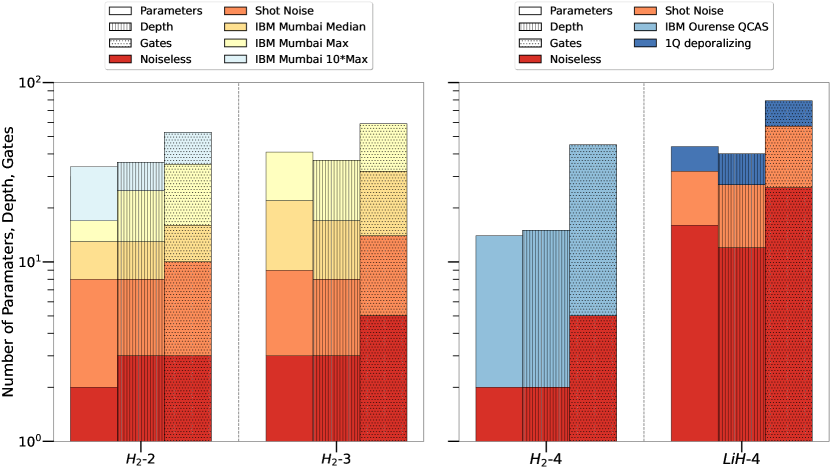
- CRLQAS outperforms existing QAS methods on noiseless and noisy VQE tasks for H2 (2–4 qubits), LiH (4–6 qubits), and H2O (8 qubits).
- CRLQAS achieves chemical accuracy with fewer gates and shallower depth in several settings, e.g., H2-4 with RH reaches energy errors near 8e-8 in the table-claim context.
- Under realistic noise, CRLQAS produces ground-state energies within chemical accuracy for selected molecules and noise profiles, and shows circuit size reductions relative to baselines.
- The Adam-SPSA variant with continuous decay and multi-stage flexibility accelerates convergence, reducing function evaluations by about half.
- PTM-based offline noise fusion with GPU/JAX yields up to six-fold speedups in training and enables scalable noisy simulations.
Read this paper
Open the full text in the Nubint reader and ask about any passage as you read.
Read this paper on NubintThis review was generated by AI from the original paper. Please check the paper before citing it.