
[Paper Review] Deciphering Lyman-$α$ Emission Deep into the Epoch of Reionisation
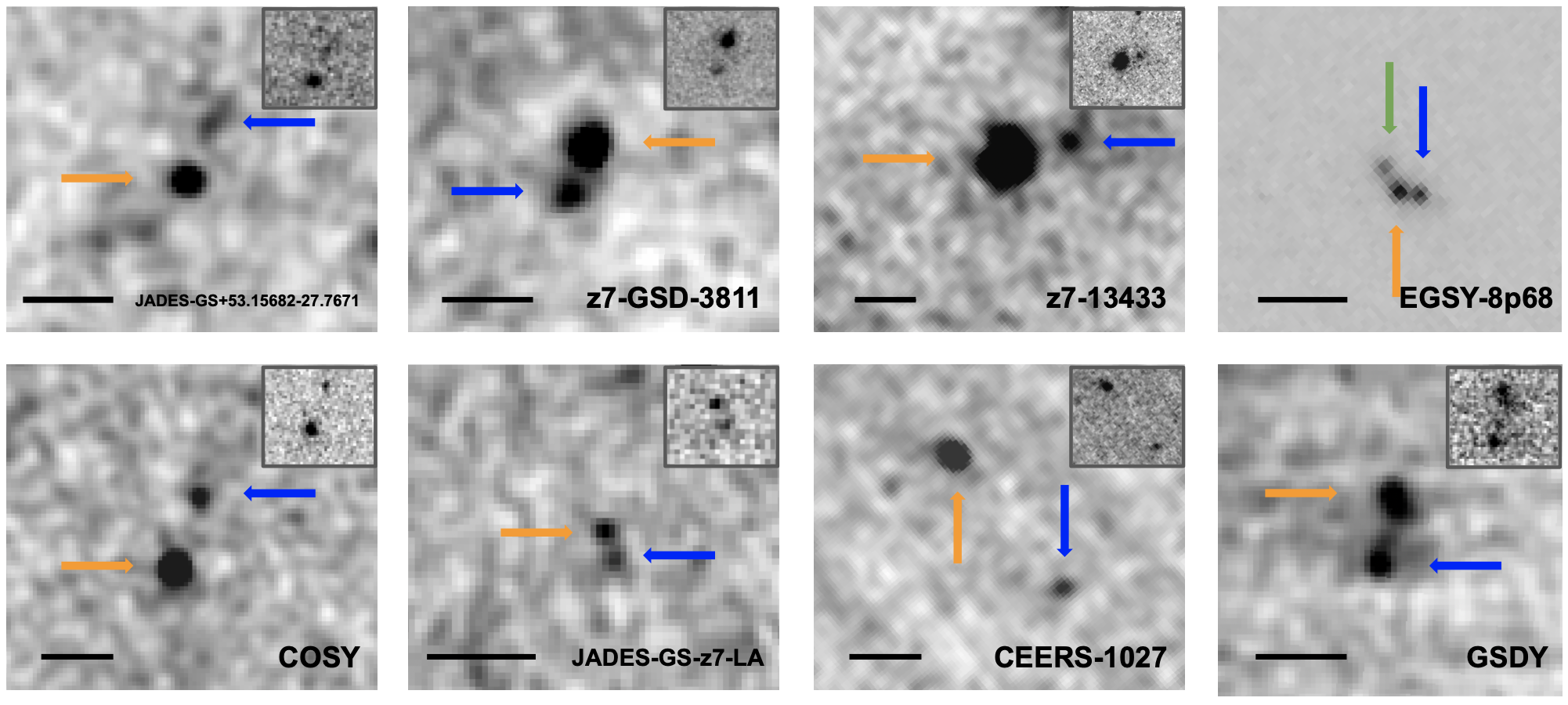
This paper proposes that frequent mergers in high-redshift galaxies at z > 7 drive bursty star formation, creating channels of cleared neutral gas that enable Lyman-α photons to escape despite dense interstellar and intergalactic media. Using high-resolution JWST NIRCam imaging and novel radiative transfer simulations with cosmic ray feedback, the authors show that all observed Lyman-α emitters at z > 7 have close companions, and that merger-driven feedback facilitates Lyman-α escape, resolving the long-standing puzzle of Lyman-α detection in the epoch of reionisation.
During the epoch of reionisation the first galaxies were enshrouded in pristine neutral gas, with one of the brightest emission lines in star-forming galaxies, Lyman-$α$ (Ly$α$), expected to remain undetected until the Universe became ionised. Providing an explanation for the surprising detection of Ly$α$ in these early galaxies is a major challenge for extra-galactic studies. Recent JWST observations have reignited the debate on whether residence in an overdensity of galaxies is a it sufficient and necessary condition for Ly$α$ to escape. Here, we take unique advantage of both high-resolution and high-sensitivity images from the JWST instrument NIRCam to reveal that all galaxies in a sample of z>7 Ly$α$ emitters have close companions. We exploit novel on-the-fly radiative transfer magnetohydrodynamical simulations with cosmic ray feedback to show that galaxies with frequent mergers have very bursty star formation which drives episodes of high intrinsic Ly$α$ emission and facilitates the escape of Ly$α$ photons along channels cleared of neutral gas. We conclude that the rapid build up of stellar mass through mergers presents a compelling solution to the long-standing puzzle of the detection of Ly$α$ emission deep into the epoch of reionisation.
Motivation & Objective
- To resolve the paradox of Lyman-α emission detection in high-redshift galaxies during the epoch of reionisation, where neutral gas should suppress such emission.
- To investigate whether galaxy overdensities or merger activity are the key drivers enabling Lyman-α escape in z > 7 Lyman-α emitters (LAEs).
- To determine the physical mechanisms allowing Lyman-α photons to escape from gas-rich, neutral environments in early galaxies.
- To link observational JWST data with advanced cosmological simulations to test the role of merger-driven feedback in facilitating Lyman-α escape.
Proposed method
- Analyzed high-resolution, high-sensitivity JWST NIRCam imaging of nine spectroscopically confirmed z > 7 Lyman-α emitters from multiple deep fields (GOODS-N, GOODS-S, EGS, COSMOS).
- Identified close companions for all nine z > 7 Lyman-α emitters, using high-resolution imaging to assess spatial clustering and interaction potential.
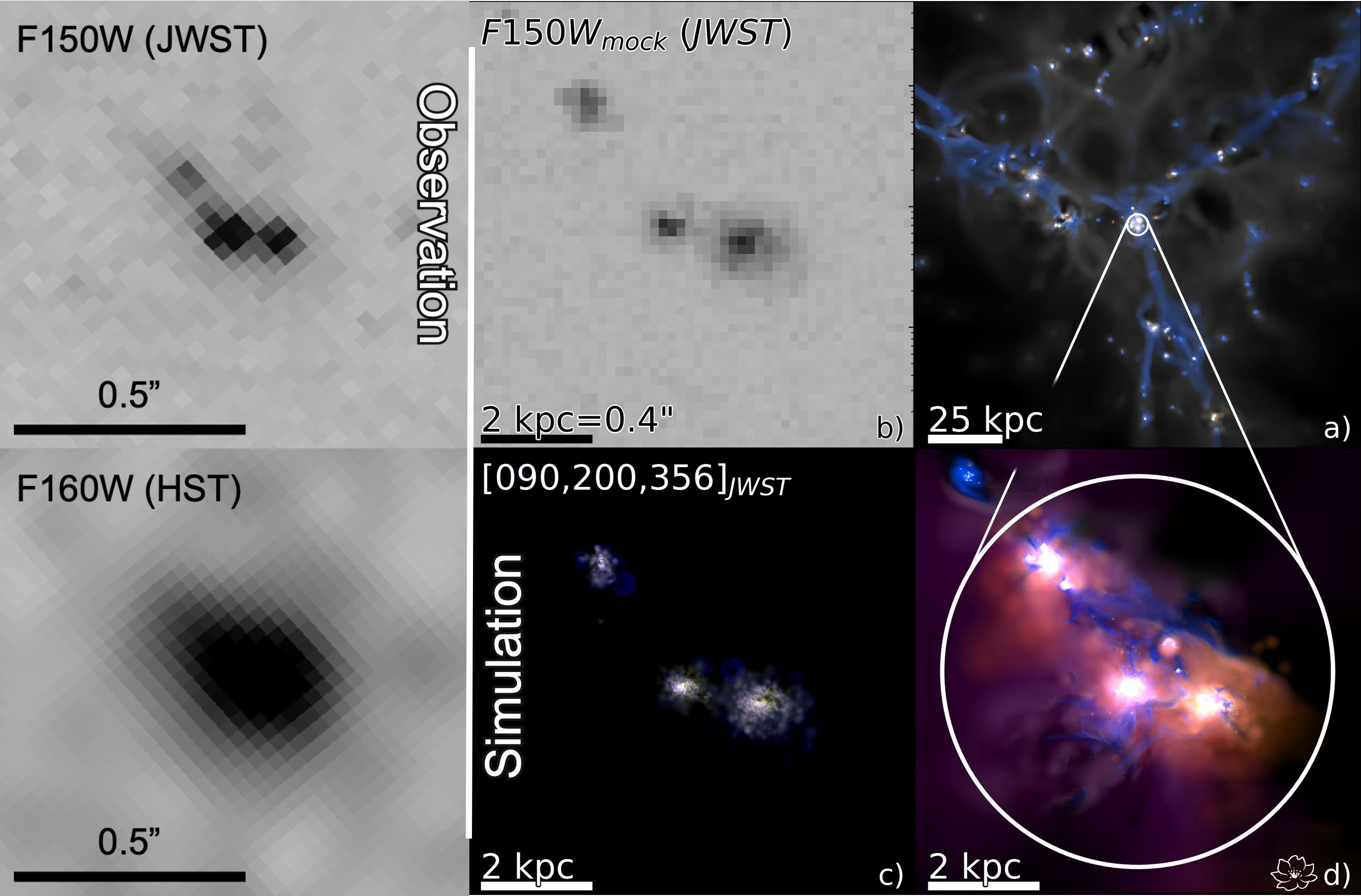
- Performed on-the-fly radiative transfer simulations using magnetohydrodynamical models with cosmic ray feedback to simulate Lyman-α photon propagation through merger-driven, gas-cleared channels.
- Used the RASCAS code to simulate Lyman-α profiles through different lines of sight, accounting for resonant scattering and IGM attenuation.
- Compared simulated Lyman-α profiles (velocity offset, FWHM, asymmetry) with observed profiles from EGSY8p68, validating model consistency.
- Conducted SED fitting and photometric analysis on the observed galaxies to constrain stellar mass, star formation rates, and dust content.
Experimental results
Research questions
- RQ1Why are Lyman-α photons detectable in high-redshift galaxies at z > 7, despite the expected strong attenuation by neutral gas in the ISM and IGM?
- RQ2Is the presence of close galaxy companions a necessary or sufficient condition for Lyman-α escape in the epoch of reionisation?
- RQ3How do merger-driven star formation episodes and cosmic ray feedback facilitate the escape of Lyman-α photons through neutral gas?
- RQ4To what extent do simulated Lyman-α profiles match observed profiles in high-redshift LAEs like EGSY8p68?
- RQ5Can merger-induced gas clearing create low-opacity channels that allow resonant Lyman-α photons to escape the ISM?
Key findings
- All nine z > 7 Lyman-α emitters in the sample have close companions, indicating a strong association with galaxy overdensities or interactions.
- Merger-driven, bursty star formation leads to episodic high intrinsic Lyman-α luminosity, increasing the probability of escape during transient clearing of neutral gas.
- Simulations show that cosmic ray feedback from mergers clears low-density channels in the ISM, enabling Lyman-α photons to escape along preferential lines of sight.
- The simulated Lyman-α profile for a z = 7.3 system matches the observed profile of EGSY8p68 in velocity offset (~200 km/s) and FWHM (~200 km/s), with a clear asymmetric shape.
- The observed Lyman-α emission is consistent with escape through transient, low-opacity channels cleared by merger-induced feedback, rather than through large-scale ionised bubbles.
- The combination of high-resolution imaging and advanced radiative transfer simulations provides strong evidence that mergers are a key mechanism enabling Lyman-α escape in the early universe.
Read this paper
Open the full text in the Nubint reader and ask about any passage as you read.
Read this paper on NubintThis review was generated by AI from the original paper. Please check the paper before citing it.