
[论文解读] Deep Graph Memory Networks for Forgetting-Robust Knowledge Tracing
该论文提出深度图记忆网络(DGMN),一种新颖的知识追踪模型,通过将遗忘门控机制与基于注意力的记忆结构相结合,动态建模多个潜在概念中的遗忘行为。通过构建捕捉概念间演化关系的动态潜在概念图,DGMN 在四个基准数据集上优于最先进模型,展现出在建模遗忘行为与概念相互依赖关系方面的卓越性能。
Tracing a student's knowledge is vital for tailoring the learning experience. Recent knowledge tracing methods tend to respond to these challenges by modelling knowledge state dynamics across learning concepts. However, they still suffer from several inherent challenges including: modelling forgetting behaviours and identifying relationships among latent concepts. To address these challenges, in this paper, we propose a novel knowledge tracing model, namely \emph{Deep Graph Memory Network} (DGMN). In this model, we incorporate a forget gating mechanism into an attention memory structure in order to capture forgetting behaviours dynamically during the knowledge tracing process. Particularly, this forget gating mechanism is built upon attention forgetting features over latent concepts considering their mutual dependencies. Further, this model has the capability of learning relationships between latent concepts from a dynamic latent concept graph in light of a student's evolving knowledge states. A comprehensive experimental evaluation has been conducted using four well-established benchmark datasets. The results show that DGMN consistently outperforms the state-of-the-art KT models over all the datasets. The effectiveness of modelling forgetting behaviours and learning latent concept graphs has also been analyzed in our experiments.
研究动机与目标
- 为解决现有知识追踪模型在建模多个潜在概念上遗忘行为方面的局限性。
- 从学生交互序列中学习潜在概念间的动态关系,而无需依赖预定义图结构。
- 通过考虑概念间相互依赖关系的遗忘门控机制,将遗忘动态整合到知识状态表征中。
- 通过结合记忆网络、图结构与遗忘感知注意力机制,提升知识追踪的预测准确率。
- 通过避免对学生知识状态的先验假设,实现有效的冷启动学习。
提出的方法
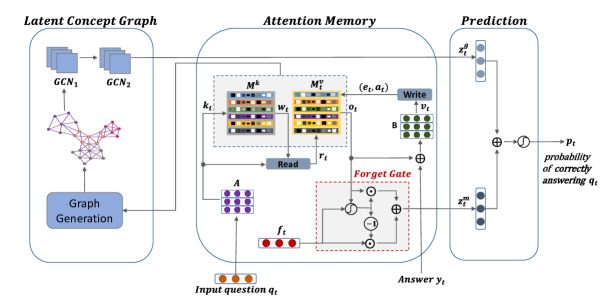
- DGMN 采用基于注意力的记忆网络,利用问答序列随时间维护和更新知识状态。
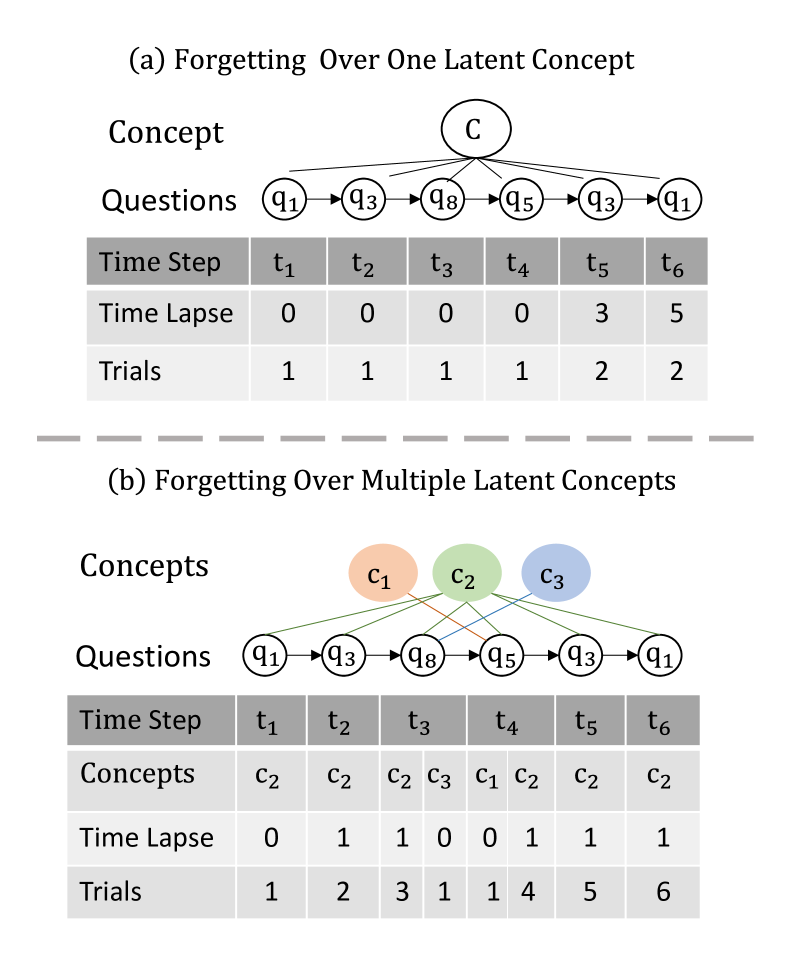
- 引入遗忘门控机制,通过关注多个潜在概念上的时间间隔与基于试验的遗忘特征,建模遗忘行为。
- 该模型利用记忆网络的信息动态构建潜在概念图,捕捉概念间的演化关系。
- 图结构基于学生的知识状态转移迭代更新,使模型能够上下文感知地学习概念依赖关系。
- 注意力机制用于加权图中邻近概念的重要性,增强表征学习。
- 最终的预测头结合记忆状态与图嵌入表征,预测正确答案的概率。
实验结果
研究问题
- RQ1如何有效建模多个潜在概念上的遗忘行为,而非仅针对单个问题?
- RQ2潜在概念间的动态关系在多大程度上能提升知识追踪性能?
- RQ3一种考虑概念间相互依赖关系的遗忘门控机制能否提升预测准确率?
- RQ4记忆网络与动态图学习的结合在多大程度上提升了知识追踪的泛化能力?
- RQ5所提出的模型在多样化的知识追踪数据集上是否具备良好的泛化能力?
主要发现
- DGMN 在四个广泛使用的基准数据集上持续优于所有最先进知识追踪模型。
- 模型在 AUC 与 AUPRC 指标上取得显著提升,表明其在未见问题序列上的预测性能更优。
- 消融实验确认,遗忘门控机制与动态概念图学习均对性能提升有显著贡献。
- 模型有效捕捉了遗忘动态,尤其在长期序列中遗忘效应明显时表现更优。
- 动态图构建机制成功学习到与学生学习模式相关的有意义概念关系。
- 由于其基于记忆且无需先验知识的设计,模型在冷启动场景下表现出强大的泛化能力。
更好的研究,从现在开始
从阅读论文到最终审阅,大幅缩短您的研究时间。
无需绑定信用卡
本解读由 AI 生成,并经人工编辑审核。