
[Paper Review] Deep Learning for Visual Speech Analysis: A Survey
This survey provides a comprehensive review of deep learning methods in visual speech analysis, focusing on visual speech recognition (VSR) and visual speech generation (VSG). It synthesizes recent advances, benchmarks, challenges, and future directions, highlighting the dual role of deep learning in advancing both recognition and generation tasks with state-of-the-art performance and identifying key gaps in real-world deployment, privacy, and robustness.
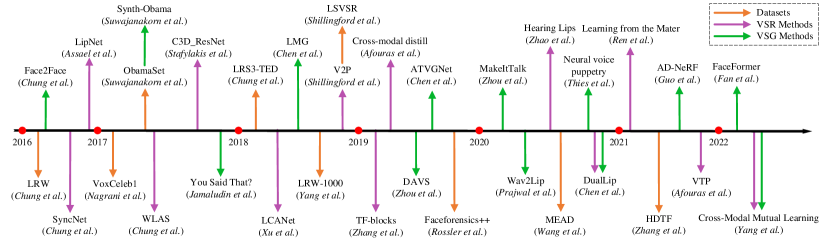
Visual speech, referring to the visual domain of speech, has attracted increasing attention due to its wide applications, such as public security, medical treatment, military defense, and film entertainment. As a powerful AI strategy, deep learning techniques have extensively promoted the development of visual speech learning. Over the past five years, numerous deep learning based methods have been proposed to address various problems in this area, especially automatic visual speech recognition and generation. To push forward future research on visual speech, this paper aims to present a comprehensive review of recent progress in deep learning methods on visual speech analysis. We cover different aspects of visual speech, including fundamental problems, challenges, benchmark datasets, a taxonomy of existing methods, and state-of-the-art performance. Besides, we also identify gaps in current research and discuss inspiring future research directions.
Motivation & Objective
- To provide a systematic and comprehensive review of deep learning-based visual speech analysis (VSA) methods, particularly VSR and VSG.
- To identify key challenges and limitations hindering real-world deployment of VSA systems.
- To analyze benchmark datasets, evaluation protocols, and state-of-the-art (SOTA) performance across VSR and VSG tasks.
- To highlight unresolved practical issues such as real-time inference, label efficiency, and robustness to adversarial attacks.
- To propose future research directions, including multilingual VSA, privacy-preserving techniques, and applications in Metaverse and Deepfake detection.
Proposed method
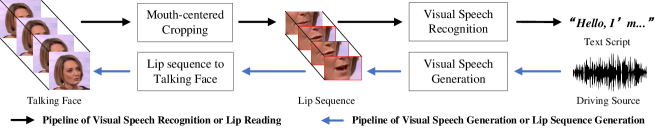
- Categorizes and analyzes deep learning-based VSA methods into visual speech recognition (VSR) and visual speech generation (VSG), emphasizing their formal duality.
- Reviews representative architectures such as CNNs, RNNs, Transformers, and GANs used in VSR and VSG, including dual learning and adversarial training mechanisms.
- Evaluates performance using standardized benchmarks like LRS2, LRS3, and Common Voice, with metrics including Word Error Rate (WER) and Fréchet Audio Distance (FAD).
- Examines self-supervised and label-efficient learning paradigms such as cross-modal contrastive learning and knowledge distillation to reduce reliance on large-scale annotations.
- Discusses architectural innovations like 3D CNNs, 2D+1D convolutions, and attention mechanisms for improved spatiotemporal modeling of facial sequences.
- Proposes integration of advanced sensors (e.g., contact-based motion sensors) to overcome limitations of non-contact lip-reading under occlusion or poor lighting.
Experimental results
Research questions
- RQ1What are the core challenges in visual speech recognition and generation that limit real-world deployment?
- RQ2How do deep learning models compare in performance across major benchmark datasets like LRS2 and LRS3?
- RQ3What are the key limitations of current VSA systems in terms of robustness, privacy, and real-time inference?
- RQ4How can self-supervised and label-efficient learning reduce dependency on large-scale annotated datasets?
- RQ5What future research directions are most promising for advancing VSA in emerging domains like Metaverse and multilingual applications?
Key findings
- State-of-the-art VSR models achieve Word Error Rates (WER) below 10% on the LRS3 dataset using end-to-end deep learning with attention mechanisms and large-scale pretraining.
- VSG methods based on diffusion models and adversarial training have significantly improved visual quality and temporal coherence, with FAD scores approaching those of real speech videos.
- Current VSA systems struggle with real-time inference, with most methods requiring more than 100ms per frame, limiting practical deployment in interactive systems.
- Existing VSA models are vulnerable to adversarial attacks and spoofing, with no systematic defense mechanisms currently adopted in mainstream frameworks.
- Privacy-preserving techniques such as Federated Learning and Homomorphic Encryption remain underexplored in VSA, despite the sensitivity of facial data.
- Multilingual VSA is underdeveloped, with most datasets and models focused on English, creating a significant gap for global deployment in multilingual settings.
Read this paper
Open the full text in the Nubint reader and ask about any passage as you read.
Read this paper on NubintThis review was generated by AI from the original paper. Please check the paper before citing it.