
[Paper Review] MixSpeech: Cross-Modality Self-Learning with Audio-Visual Stream Mixup for Visual Speech Translation and Recognition
Proposes MixSpeech, a cross-modality self-learning framework that uses mixed audio-visual speech to regularize visual speech translation and lip reading, achieving state-of-the-art results on AVMuST-TED and LRS/LRS2/CMLR datasets.
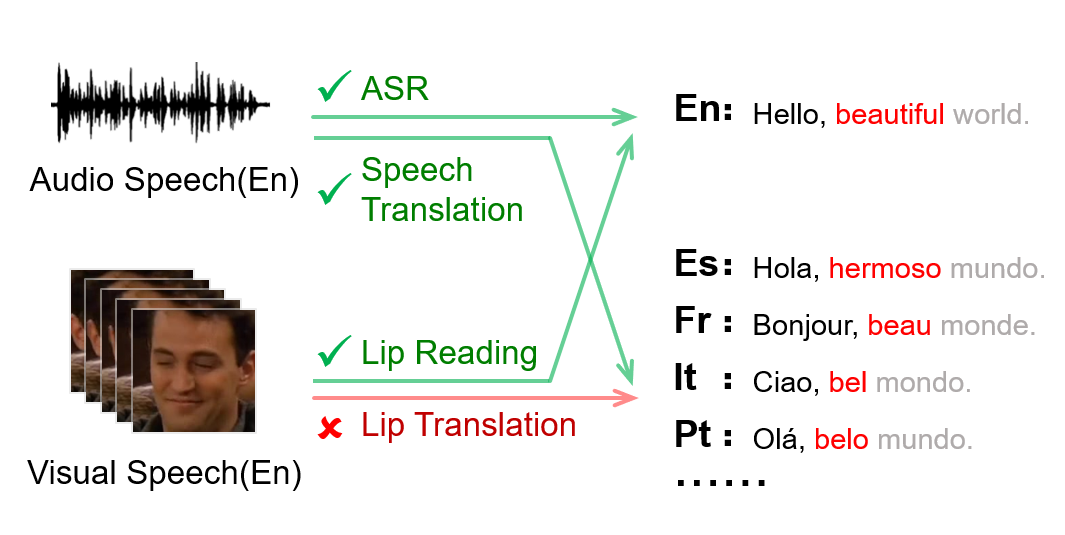
Multi-media communications facilitate global interaction among people. However, despite researchers exploring cross-lingual translation techniques such as machine translation and audio speech translation to overcome language barriers, there is still a shortage of cross-lingual studies on visual speech. This lack of research is mainly due to the absence of datasets containing visual speech and translated text pairs. In this paper, we present extbf{AVMuST-TED}, the first dataset for extbf{A}udio- extbf{V}isual extbf{Mu}ltilingual extbf{S}peech extbf{T}ranslation, derived from extbf{TED} talks. Nonetheless, visual speech is not as distinguishable as audio speech, making it difficult to develop a mapping from source speech phonemes to the target language text. To address this issue, we propose MixSpeech, a cross-modality self-learning framework that utilizes audio speech to regularize the training of visual speech tasks. To further minimize the cross-modality gap and its impact on knowledge transfer, we suggest adopting mixed speech, which is created by interpolating audio and visual streams, along with a curriculum learning strategy to adjust the mixing ratio as needed. MixSpeech enhances speech translation in noisy environments, improving BLEU scores for four languages on AVMuST-TED by +1.4 to +4.2. Moreover, it achieves state-of-the-art performance in lip reading on CMLR (11.1\%), LRS2 (25.5\%), and LRS3 (28.0\%).
Motivation & Objective
- Motivate cross-lingual visual speech research due to scarcity of visual speech with translations.
- Introduce AVMuST-TED, the first audio-visual multilingual speech translation dataset for four languages.
- Develop a cross-modality self-learning framework that regularizes visual speech translation using high-discrimination audio speech.
- Bridge modality gaps with mixed speech to improve knowledge transfer and robustness in noisy environments.
- Demonstrate state-of-the-art lip translation and lip reading across multiple datasets.
- Provide insights into cross-lingual visual speech translation and potential applications.
Proposed method
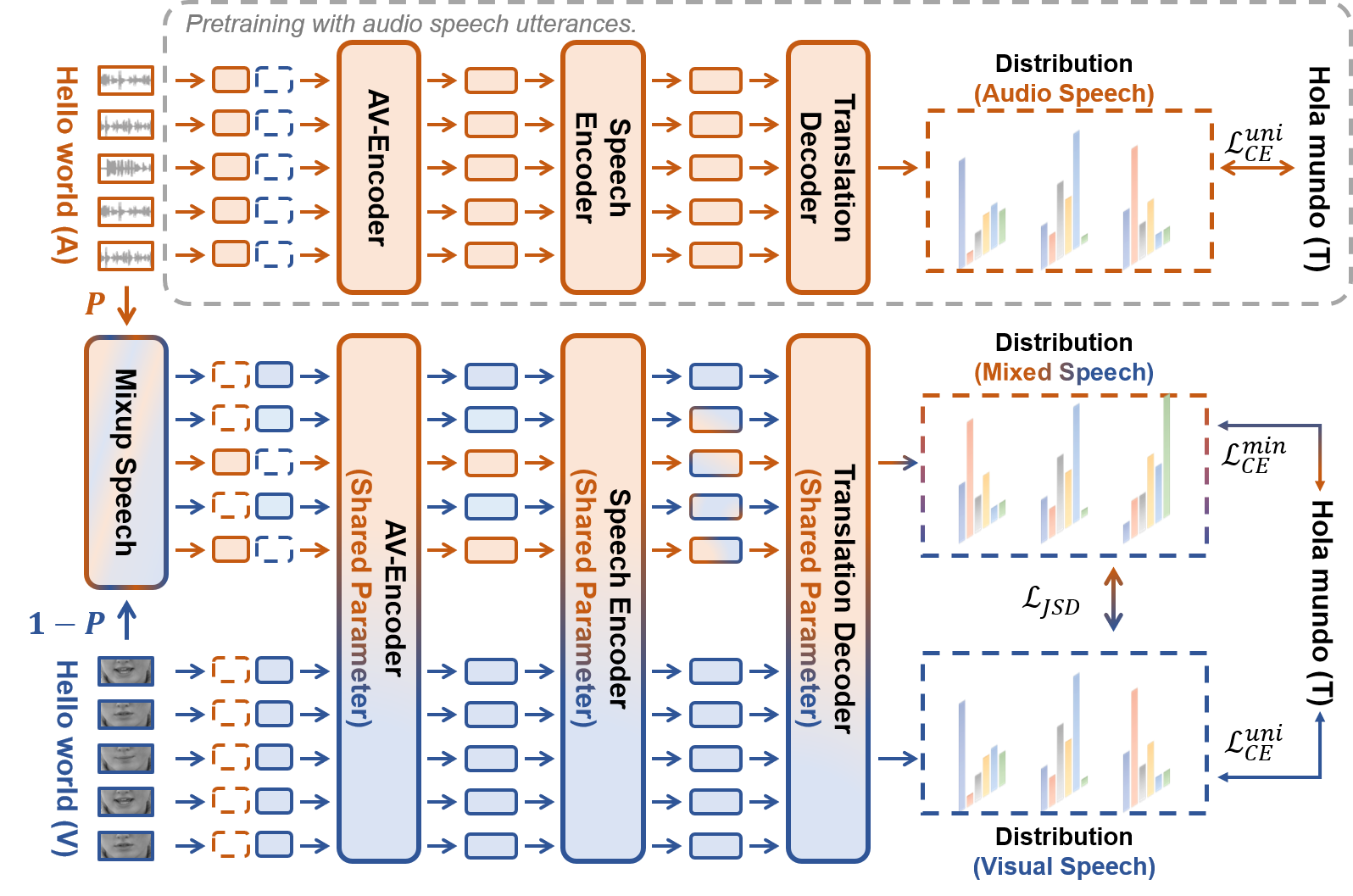
- Pretrain a translation decoder on high-discrimination audio speech to learn inter-lingual mappings from source phonemes to target language text.
- Align visual speech with audio speech via cross-modality self-learning to transfer the audio-derived mappings to visual speech.
- Synthesize mixed speech by interpolating audio and visual speech at frame level to bridge modality gaps (MixSpeech).
- Use curriculum-learning to adapt the mixing ratio during training based on prediction uncertainty.
- Regularize visual and mixed-speech translations with Jensen-Shannon Divergence to align their output distributions while maintaining audio-vision knowledge via a mixed-objective loss.
Experimental results
Research questions
- RQ1Can audio speech pretraining improve visual speech translation and reduce cross-modality transfer gaps?
- RQ2Does interpolating audio and visual streams (mixed speech) further reduce modality gap and boost visual speech translation performance?
- RQ3Can a curriculum-based mixing strategy adaptively optimize cross-modality knowledge transfer during training?
- RQ4How does MixSpeech perform on AVMuST-TED lip translation and on standard lip-reading benchmarks (LRS2, LRS3, CMLR) under varying resource conditions?
Key findings
- MixSpeech improves visual speech translation BLEU scores by +1.4 to +4.2 across four languages on AVMuST-TED compared to baselines.
- End-to-end MixSpeech achieves state-of-the-art lip translation on AVMuST-TED and lip reading on LRS2 (25.5%), LRS3 (28.0%), and CMLR (11.1%).
- MixSpeech bridges cross-modality gaps by using mixed speech, with notable gains when mixing ratio is appropriately configured (e.g., En-Es).
- A curriculum-learning-based mixing ratio adapts during training, further boosting translation performance.
- Across noisy audio conditions, MixSpeech maintains robustness and outperforms audio-only baselines in visual speech translation.
Better researchstarts right now
From reading papers to final review, dramatically reduce your research time.
No credit card · Free plan available
This review was created by AI and reviewed by human editors.