
[Paper Review] DeepSeek-Coder-V2: Breaking the Barrier of Closed-Source Models in Code Intelligence
DeepSeek-Coder-V2 is an open-source Mixture-of-Experts code model (16B and 236B) that approaches or surpasses closed-source models on code and math tasks, expands language support to 338 languages, and increases context length to 128K tokens.
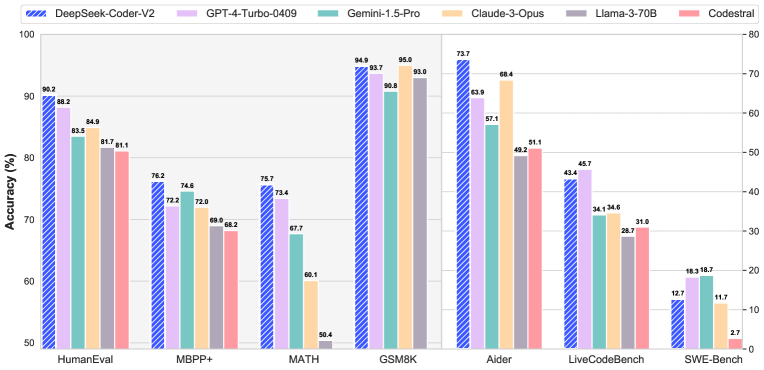
We present DeepSeek-Coder-V2, an open-source Mixture-of-Experts (MoE) code language model that achieves performance comparable to GPT4-Turbo in code-specific tasks. Specifically, DeepSeek-Coder-V2 is further pre-trained from an intermediate checkpoint of DeepSeek-V2 with additional 6 trillion tokens. Through this continued pre-training, DeepSeek-Coder-V2 substantially enhances the coding and mathematical reasoning capabilities of DeepSeek-V2, while maintaining comparable performance in general language tasks. Compared to DeepSeek-Coder-33B, DeepSeek-Coder-V2 demonstrates significant advancements in various aspects of code-related tasks, as well as reasoning and general capabilities. Additionally, DeepSeek-Coder-V2 expands its support for programming languages from 86 to 338, while extending the context length from 16K to 128K. In standard benchmark evaluations, DeepSeek-Coder-V2 achieves superior performance compared to closed-source models such as GPT4-Turbo, Claude 3 Opus, and Gemini 1.5 Pro in coding and math benchmarks.
Motivation & Objective
- Bridge the gap between open-source code models and closed-source leaders (e.g., GPT-4-Turbo) in coding and math tasks.
- Scale language and context coverage to support diverse programming languages and long-range code understanding.
- Improve coding and mathematical reasoning through multi-source pre-training, long-context training, and RL-based alignment.
- Release open-source models under permissive licenses to enable research and unrestricted commercial use.
Proposed method
- Continued pre-training from a DeepSeek-V2 intermediate checkpoint using an additional 6 trillion tokens, totaling 10.2 trillion training tokens across code, math, and natural language domains.
- Code corpus expanded from 86 to 338 programming languages and increased code tokens to 1,170B, with 60% code, 10% math, and 30% natural language in the mix.
- Extended context length from 16K to 128K tokens using the Yarn framework, with staged long-context training.
- Two-stage alignment: supervised fine-tuning on an instruction dataset combining code, math, and general data, followed by reinforcement learning with Group Relative Policy Optimization (GRPO) using a reward model tuned on compiler/test-case feedback.
- For 16B, employ Fill-In-Middle (FIM) training (Prefix-Suffix-Middle structure) to enhance code completion; for 236B, rely on Next-Token-Prediction objective.
- Compare with open- and closed-source baselines across coding, math, and NL tasks to validate performance gains.
Experimental results
Research questions
- RQ1Can an open-source Mixture-of-Experts code model reach parity with or surpass closed-source leaders on coding and mathematical benchmarks?
- RQ2How does expanding programming language coverage and context length affect coding accuracy and reasoning capabilities?
- RQ3What is the impact of data composition, long-context training, and RL-alignment strategies on open-source code model performance?
- RQ4To what extent can open-source models maintain general language capabilities while specializing in code and math tasks?
Key findings
- DeepSeek-Coder-V2 (236B) attains performance on par with or superior to GPT-4-Turbo, Claude 3 Opus, and Gemini 1.5 Pro on code and math benchmarks.
- Code benchmarks show 90.2% on HumanEval and 76.2% on MBPP for the 236B model (EvalPlus pipeline), with 43.4% on LiveCodeBench.
- On math tasks, DeepSeek-Coder-V2 reaches 75.7% on MATH, nearly matching GPT-4o, and outperforms several closed-source models on AIME 2024 and related datasets.
- The model supports 338 programming languages and a maximum context length of 128K tokens, up from 86 languages and 16K context in prior work.
- Open-source DeepSeek-Coder-V2-Instruct achieves a 75.3% average on HumanEval/MBPP combining languages, second only to GPT-4o in the benchmark set presented.
- Long-context and FIM-enabled variants (16B) demonstrate strong code completion and repair capabilities, with notable results in FIM tasks and repair benchmarks.

Better researchstarts right now
From reading papers to final review, dramatically reduce your research time.
No credit card · Free plan available
This review was created by AI and reviewed by human editors.