
[Paper Review] Defining eccentricity for gravitational wave astronomy
This paper proposes a gauge-invariant, waveform-based definition of eccentricity ($e_{\text{gw}}$) and mean anomaly ($l_{\text{gw}}$) derived directly from gravitational wave signals, enabling consistent comparison across diverse models and simulations. The method, implemented in the open-source Python package *gw_eccentricity*, achieves accurate eccentricity measurements across post-Newtonian, effective one-body, extreme mass ratio, and numerical relativity waveforms, with robustness confirmed for eccentricities from $10^{-5}$ to 0.999.
Eccentric compact binary mergers are significant scientific targets for current and future gravitational wave observatories. To detect and analyze eccentric signals, there is an increasing effort to develop waveform models, numerical relativity simulations, and parameter estimation frameworks for eccentric binaries. Unfortunately, current models and simulations use different internal parameterisations of eccentricity in the absence of a unique natural definition of eccentricity in general relativity, which can result in incompatible eccentricity measurements. In this paper, we adopt a standardized definition of eccentricity and mean anomaly based solely on waveform quantities, and make our implementation publicly available through an easy-to-use Python package, gw_eccentricity. This definition is free of gauge ambiguities, has the correct Newtonian limit, and can be applied as a postprocessing step when comparing eccentricity measurements from different models. This standardization puts all models and simulations on the same footing and enables direct comparisons between eccentricity estimates from gravitational wave observations and astrophysical predictions. We demonstrate the applicability of this definition and the robustness of our implementation for waveforms of different origins, including post-Newtonian theory, effective one body, extreme mass ratio inspirals, and numerical relativity simulations. We focus on binaries without spin-precession in this work, but possible generalizations to spin-precessing binaries are discussed.
Motivation & Objective
- To resolve inconsistencies in eccentricity measurements across gravitational wave models and simulations due to differing internal parameterizations.
- To define eccentricity and mean anomaly using only observable waveform quantities, eliminating gauge dependencies.
- To enable direct comparison between gravitational wave observations and astrophysical predictions by standardizing eccentricity measurements.
- To provide a robust, postprocessing-ready method applicable to waveforms from diverse theoretical and numerical sources.
- To lay the foundation for future extension to spin-precessing eccentric binaries.
Proposed method
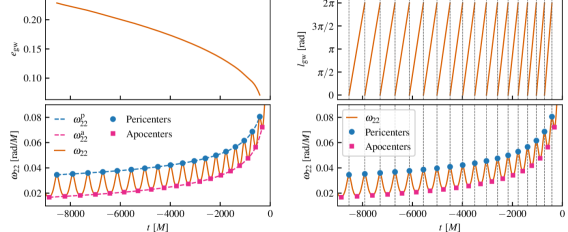
- Define eccentricity $e_{\text{gw}}$ and mean anomaly $l_{\text{gw}}$ based solely on the time-domain gravitational wave strain, specifically using pericenter and apocenter passage times.
- Identify pericenter and apocenter passages via amplitude modulations, residual amplitude analysis, or fitting techniques in the time series.
- Use the time intervals between successive pericenter and apocenter passages to compute $e_{\text{gw}}$ and $l_{\text{gw}}$ via a waveform-based, gauge-invariant formalism.
- Ensure the definition reduces to the Newtonian limit in the weak-field regime and remains valid for bound orbits across the full eccentricity range.
- Implement the method in a publicly available Python package, *gw_eccentricity*, for use in parameter estimation and postprocessing.
- Validate the method across waveforms from post-Newtonian theory, effective one body, extreme mass ratio inspirals, and numerical relativity simulations.
Experimental results
Research questions
- RQ1How can a consistent, gauge-invariant definition of eccentricity be derived directly from gravitational wave signals without relying on orbital elements?
- RQ2What waveform-based techniques reliably identify pericenter and apocenter passages across different eccentricity regimes?
- RQ3How does the proposed $e_{\text{gw}}$ definition compare to internal eccentricity measures used in existing waveform models and simulations?
- RQ4Can the method robustly measure eccentricity in high-eccentricity systems ($e \gtrsim 0.9$) and low-eccentricity systems ($e \sim 10^{-5}$)?
- RQ5How can the reference and start frequencies in GW data analysis be generalized for eccentric binaries to align with the new standard?
Key findings
- The proposed $e_{\text{gw}}$ definition is free of gauge ambiguities and correctly reduces to the Newtonian limit in the weak-field regime.
- The method successfully measures eccentricity across waveforms from post-Newtonian, effective one body, extreme mass ratio, and numerical relativity models with consistent results.
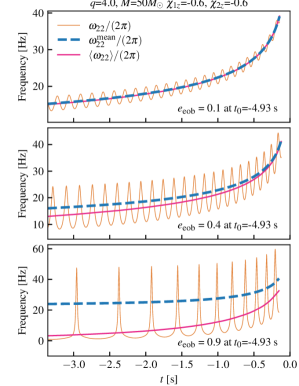
- For a system with $e_{\text{eob}} = 0.999$ at $t_0 = -5 \times 10^6 M$, the measured $e_{\text{gw}}$ at $\widehat{t}_0 \approx -2 \times 10^6 M$ is $e_{\text{gw}} \approx 0.99$, demonstrating smooth evolution even at high eccentricity.
- The Amplitude, ResidualAmplitude, and AmplitudeFits methods provide reliable eccentricity estimates, with the Amplitude method effective for $e_{\text{gw}} \gtrsim 10^{-3}$ and the others for lower eccentricities.
- Smoothness tests revealed noisy features in some waveform models, demonstrating the method’s utility in diagnosing model artifacts.
- The implementation is robust for waveforms with at least 4–5 orbits, though challenges remain for high-eccentricity numerical relativity simulations due to limited orbital coverage.
Read this paper
Open the full text in the Nubint reader and ask about any passage as you read.
Read this paper on NubintThis review was generated by AI from the original paper. Please check the paper before citing it.