
[Paper Review] DiffInfinite: Large Mask-Image Synthesis via Parallel Random Patch Diffusion in Histopathology
DiffInfinite presents a hierarchical diffusion framework to generate arbitrarily large histology images by first creating segmentation masks and then performing parallel random patch diffusion to synthesize high-fidelity images, scalable with fast training on small patches.
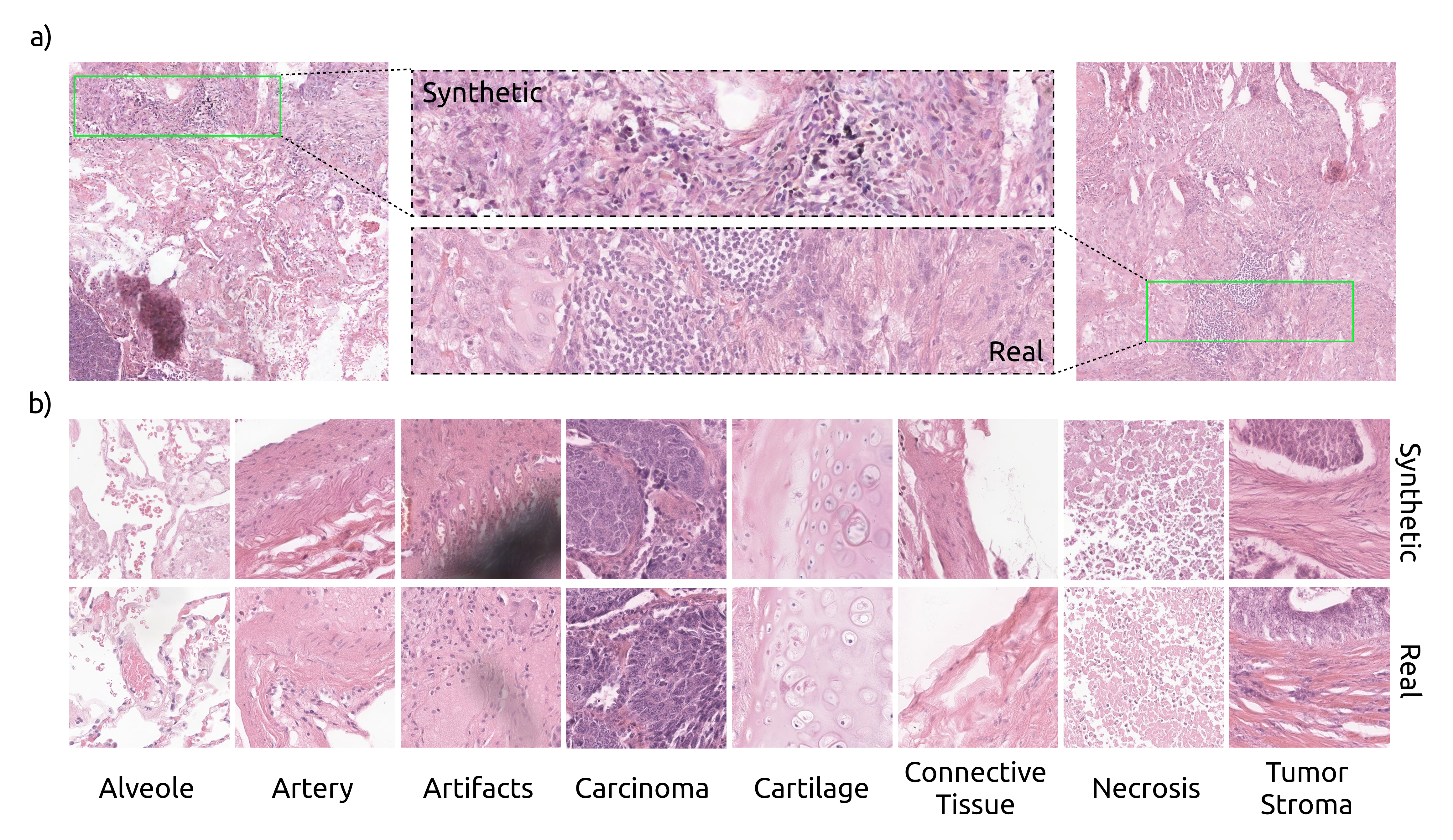
We present DiffInfinite, a hierarchical diffusion model that generates arbitrarily large histological images while preserving long-range correlation structural information. Our approach first generates synthetic segmentation masks, subsequently used as conditions for the high-fidelity generative diffusion process. The proposed sampling method can be scaled up to any desired image size while only requiring small patches for fast training. Moreover, it can be parallelized more efficiently than previous large-content generation methods while avoiding tiling artifacts. The training leverages classifier-free guidance to augment a small, sparsely annotated dataset with unlabelled data. Our method alleviates unique challenges in histopathological imaging practice: large-scale information, costly manual annotation, and protective data handling. The biological plausibility of DiffInfinite data is evaluated in a survey by ten experienced pathologists as well as a downstream classification and segmentation task. Samples from the model score strongly on anti-copying metrics which is relevant for the protection of patient data.
Motivation & Objective
- Address data scarcity and costly annotation in histopathology by generating large, realistic histology images with long-range spatial structure.
- Develop a scalable, patch-based diffusion framework that can produce arbitrarily large images without tiling artifacts.
- Leverage classifier-free guidance to augment small labeled datasets with unlabeled data in a semi-supervised manner.
- Evaluate biological plausibility through expert pathologist surveys and downstream task performance.
- Assess data protection and memorization to ensure synthetic data do not copy patient information.
Proposed method
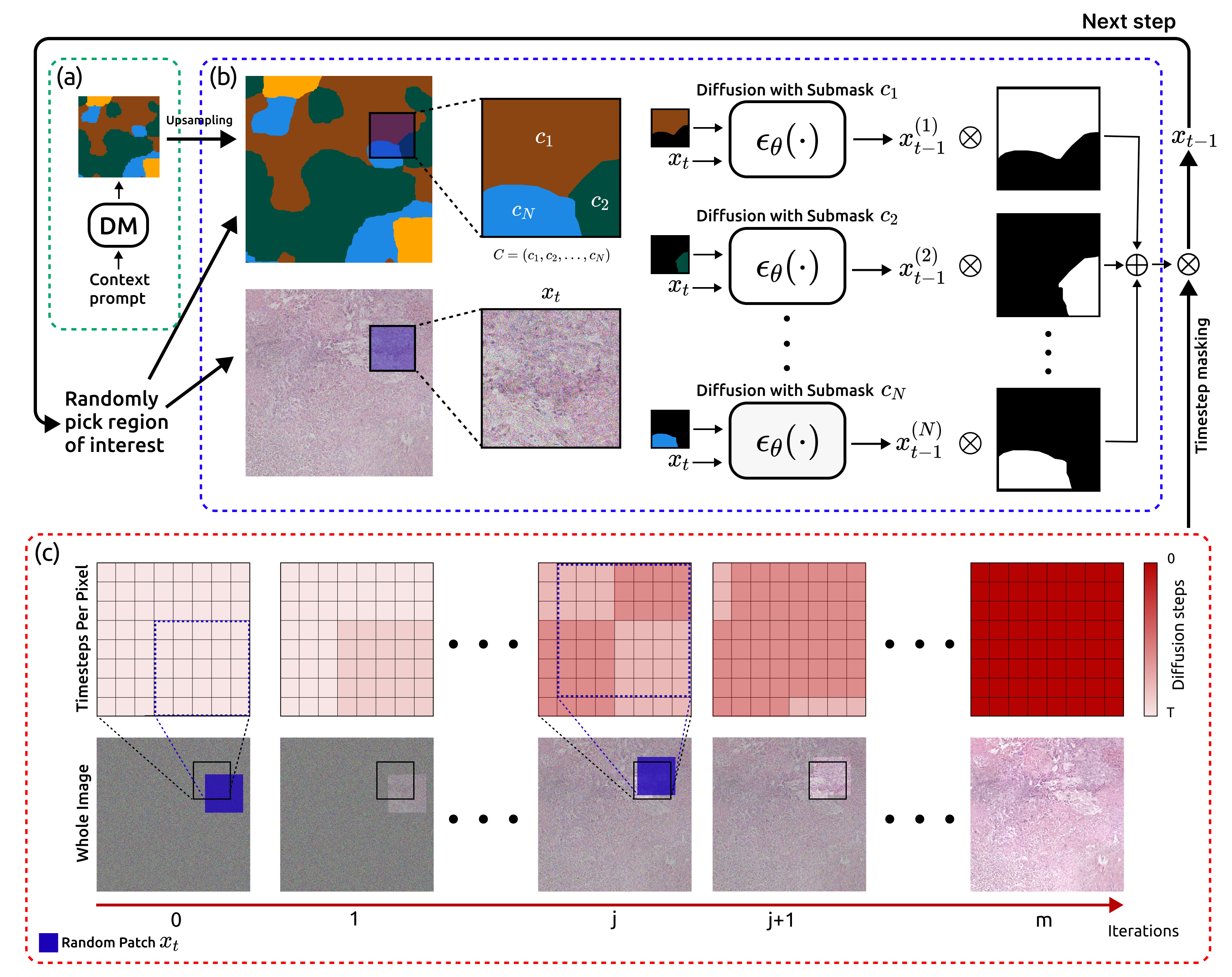
- Introduce a hierarchical diffusion model that first generates segmentation masks and then performs a high-fidelity diffusion-based image synthesis conditioned on those masks.
- Propose a parallel random patch sampling strategy that evolves overlapping latent-space patches to generate large images without conditional independence assumptions.
- Use classifier-free guidance to mix conditional and unconditional diffusion modeling, enabling semi-supervised augmentation from unlabelled data.
- Implement a large-scale outpainting-like sampling in latent space by randomly cropping latent patches and aggregating their diffusion steps to form the final image.
- Track per-pixel diffusion time steps and update only pixels with the highest time step to preserve long-range correlations across patches.
- Optionally extend the random patch diffusion to segmentation mask generation, enabling arbitrary-sized mask synthesis with preserved correlation length.
Experimental results
Research questions
- RQ1Can DiffInfinite generate arbitrarily large histopathology images while preserving long-range spatial correlations?
- RQ2Does a two-stage generation (segmentation masks first, then image synthesis) improve fidelity and structural plausibility at high resolutions?
- RQ3Can semi-supervised guidance using unlabelled data meaningfully improve synthetic data diversity and downstream task performance?
- RQ4Do diffusion-based synthetic histology images raise privacy concerns, or exhibit memorization and data-copying patterns?
- RQ5How does DiffInfinite compare to existing large-content diffusion methods (e.g., DiffCollage) in terms of quality, speed, and tiling artifact reduction?
Key findings
- DiffInfinite achieves high-quality large-scale histology generation, with improved precision (IP) and recall (IR) metrics (e.g., IP 0.94, IR 0.70 on 512×512 images) and competitive perceptual metrics for large images when compared to prior methods.
- Pathologists judged synthetic images as plausibly histological, with overall difficulty distinguishing real vs synthetic patches and no clear correlation between experience and accuracy.
- Downstream tasks show synthetic data can match or boost performance: classification and segmentation results indicate that augmenting small annotated datasets with synthetic data can approach or exceed real-data baselines in several out-of-distribution settings (e.g., classification accuracy up to 0.857 on IH1 and improvements in segmentation F1 from 0.614 to 0.710 on IH2).
- The method demonstrates reduced tiling artifacts and improved parallelization for large-content generation compared to prior approaches (e.g., DiffInfinite outperforms DiffCollage in IP/IR and scales with image size).
- Memorization analyses report high authenticity scores (A ranging from 0.86 to 0.98) and low data-copying measures (C_T near 0), suggesting synthetic data are not trivially copied from training data.
Read this paper
Open the full text in the Nubint reader and ask about any passage as you read.
Read this paper on NubintThis review was generated by AI from the original paper. Please check the paper before citing it.