
[Paper Review] Dipolar Spin Liquid Ending with Quantum Critical Point in a Gd-based Triangular Magnet
This study identifies a dipolar spin liquid (DSL) phase in the Gd-based triangular-lattice magnet KBaGd(BO₃)₂, driven by strong dipolar and Heisenberg interactions. The DSL persists over a broad field-temperature regime and terminates at an unconventional quantum critical point (QCP) at B₇ ≈ 0.75 T, belonging to the 3D XY universality class and exhibiting Berezinskii-Kosterlitz-Thouless (BKT) physics with emergent U(1) symmetry, enabling exceptional magnetic cooling performance near the QCP.
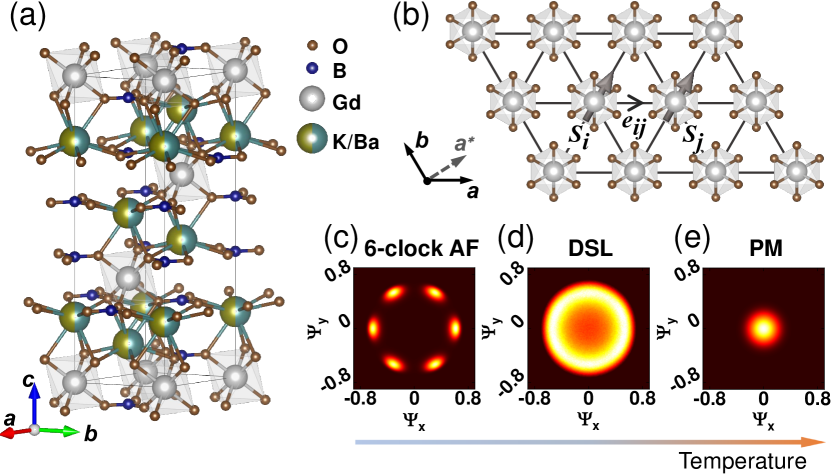
By performing experiment and model studies on a triangular-lattice dipolar magnet KBaGd(BO$_3$)$_2$ (KBGB), we find the highly frustrated magnet with a planar anisotropy hosts a strongly fluctuating dipolar spin liquid (DSL), which originates from the intriguing interplay between dipolar and Heisenberg interactions. The DSL constitutes an extended regime in the field-temperature phase diagram, which gets lowered in temperature as field increases and eventually ends with an unconventional quantum critical point (QCP) at $B_c\simeq 0.75$~T. Based on dipolar Heisenberg model calculations, we identify the DSL as a Berezinskii-Kosterlitz-Thouless (BKT) phase with emergent U(1) symmetry. Due to the tremendous entropy accumulation that can be related to the strong BKT and quantum fluctuations, unprecedented magnetic cooling effects are observed in the DSL regime and particularly near the QCP, making KBGB a superior dipolar coolant to commercial Gd-based refrigerants. We establish the phase diagram for triangular-lattice dipolar quantum magnets where emergent symmetry plays an essential role, and provide a basis and opens an avenue for their applications in sub-Kelvin refrigeration.
Motivation & Objective
- To identify and characterize a quantum spin liquid phase in a rare-earth-based triangular-lattice magnet with strong dipolar interactions.
- To understand the interplay between dipolar and Heisenberg interactions in stabilizing a strongly fluctuating spin liquid state.
- To determine the nature of the quantum phase transition terminating the dipolar spin liquid regime.
- To evaluate the material's potential as a magnetic refrigerant for sub-Kelvin applications.
- To establish a phase diagram for triangular-lattice dipolar quantum magnets with emergent symmetry.
Proposed method
- Experimental investigation of single-crystal KBaGd(BO₃)₂ using low-temperature thermodynamic and magnetocaloric measurements.
- Development of a classical dipolar Heisenberg model with parameters J = 47 mK and D = 80 mK to describe the spin interactions.
- Application of classical Monte Carlo simulations with the Metropolis algorithm on lattices up to 60×60 to simulate thermodynamic properties.
- Analysis of the complex order parameter Ψxy = Ψx + iΨy to identify BKT-like fluctuations and 6-fold degenerate orderings.
- Use of specific heat, ac susceptibility, and adiabatic demagnetization to probe the spin liquid and quantum critical point.
- Calibration of RuO₂ thermometers under high magnetic fields and low temperatures (down to 30 mK) for precise magnetocaloric measurements.
Experimental results
Research questions
- RQ1What is the nature of the quantum spin liquid phase stabilized in the Gd-based triangular-lattice magnet KBaGd(BO₃)₂?
- RQ2How do dipolar and Heisenberg interactions jointly stabilize a strongly fluctuating spin liquid with emergent U(1) symmetry?
- RQ3What is the universality class of the quantum critical point at which the dipolar spin liquid terminates?
- RQ4How does the magnetic entropy density in the spin liquid regime compare to conventional refrigerants, and what is its cooling efficiency?
- RQ5Can the observed quantum critical point and spin liquid phase enable superior magnetic cooling performance below 1 K?
Key findings
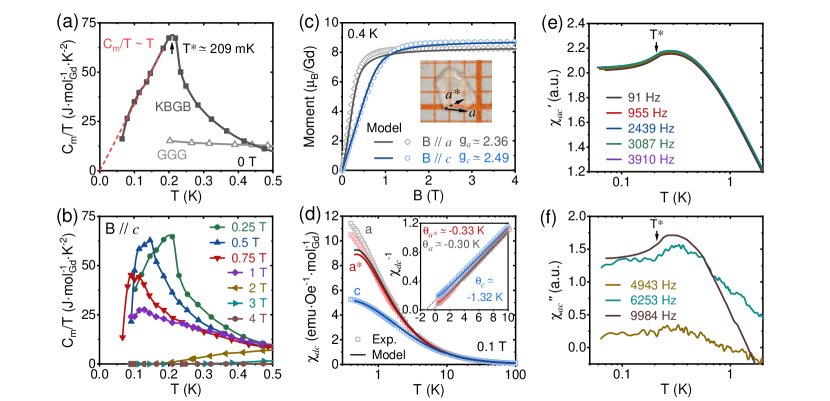
- The dipolar spin liquid (DSL) phase in KBaGd(BO₃)₂ is stabilized by the interplay of dipolar and Heisenberg interactions, with no long-range magnetic order observed down to 108 mK.
- The DSL exhibits algebraic temperature dependence of specific heat and strong spin fluctuations, confirmed by imaginary ac susceptibility (χ′′_ac), indicating a Berezinskii-Kosterlitz-Thouless (BKT) phase with emergent U(1) symmetry.
- The DSL regime ends at a quantum critical point (QCP) at Bc ≈ 0.75 T, identified as belonging to the 3D XY universality class based on Monte Carlo simulations.
- Single-crystal KBGB cools from 2 K and 4 T down to Tm ≈ 108 mK, outperforming GGG (Tm ≈ 412 mK) under comparable conditions, demonstrating unprecedented magnetic cooling efficiency.
- The system exhibits a pronounced dip in isentropic cooling curves and diverging peaks in derivative measurements, confirming the presence of the QCP near 0.75 T.
- Monte Carlo simulations reproduce the experimental specific heat peak at ~270 mK and show that increasing magnetic field shifts the peak to lower temperatures, consistent with experimental data.
Read this paper
Open the full text in the Nubint reader and ask about any passage as you read.
Read this paper on NubintThis review was generated by AI from the original paper. Please check the paper before citing it.